



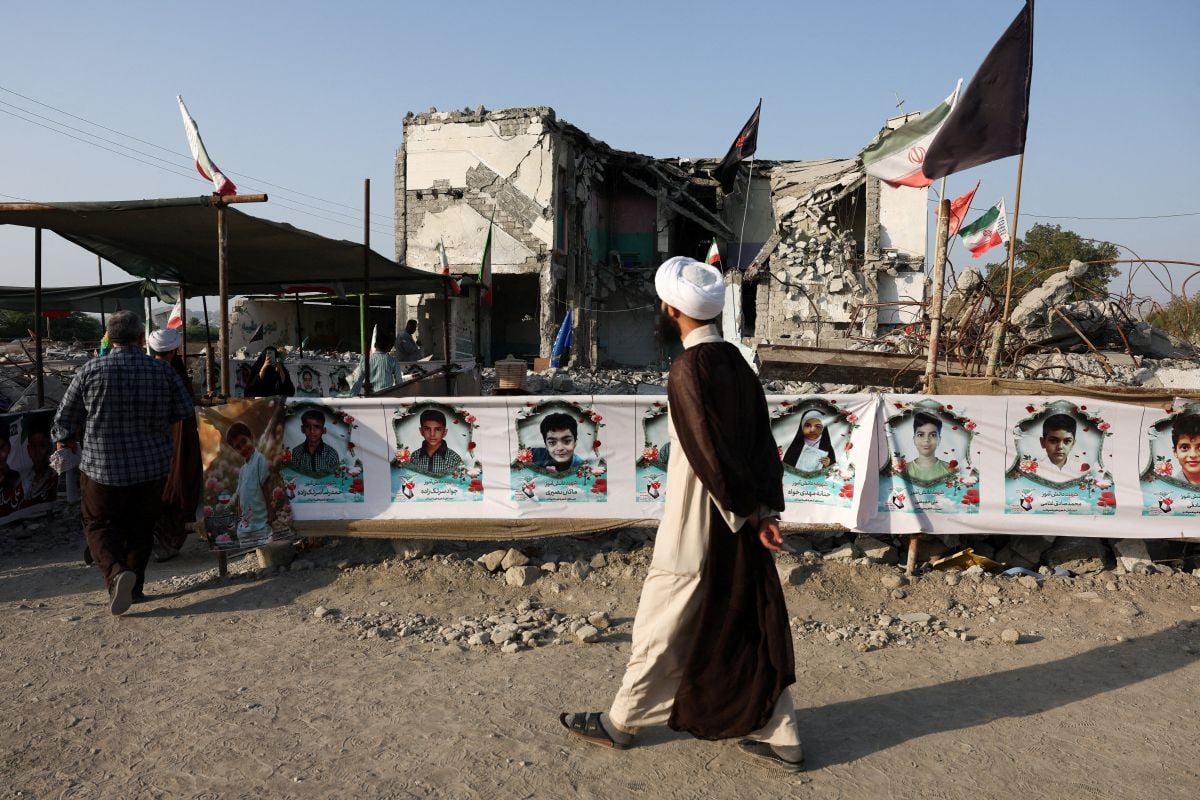
A man passes in front of Minab school, the site a U.S.-Israeli strike on Feb. 28, in Minab, Iran, on Aug. 27, 2026. (Credit: Majid Asgaripour/WANA/Reuters)






Iranians find themselves trapped between "extreme" state repression and the impact of the U.S. war in the Middle East, triggered on Feb. 28 by Israeli-U.S. airstrikes, U.N. investigators warned Thursday. The mission also reports having reasonable grounds to believe that the United States carried out two military strikes on a school and a sports facility in Iran in February, constituting war crimes.
Civilians "are caught between serious human rights violations and crimes against humanity committed by their own government, and the deadly conflict between the country and the United States and Israel," the Independent International Fact-Finding Mission on Iran said.
Significant escalation of Iranian repression
In its latest report, which will be presented Monday to the Human Rights Council, the mission finds that Tehran's response to last winter's protests "marks a significant escalation compared to the past." Investigators observe an increase "both in the scale of violence and killings, and in efforts to cut ties between communities and with the outside world, the use of repressive laws, and the growing use of the death penalty as a tool for intimidation and control."
The protest movement, which had initially begun at the end of December to denounce the rising cost of living, quickly turned into large anti-government demonstrations, peaking on Jan. 8 and 9. NGOs report that the crackdown caused thousands of deaths, while the government reported more than 3,000 deaths, attributing the violence to "terrorist acts" orchestrated by the United States and Israel.
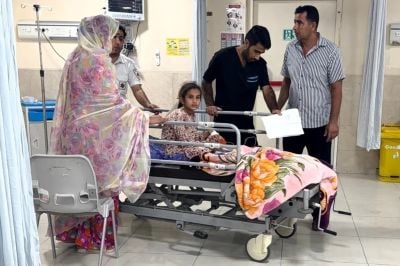
The mission accuses security forces of having "carried out killings on a staggering scale in all 31 provinces," with the highest tolls reported in Tehran, Karaj (west of Tehran), Mashhad (northeast), Isfahan (center), and Rasht (north). Furthermore, it notes that "tens of thousands of people have been deprived of their liberty in the context of large-scale arbitrary arrests and detentions," sometimes accompanied by "torture" and solitary confinement.
The authorities also suspended access to the international internet during the protests, and again starting Feb. 28, at the beginning of the U.S. and Israeli strikes against the country, for several months. Since the beginning of the war, the Iranian government "has intensified its use of the death penalty against protesters," the investigators say, stating that between March and August 2026, at least 29 men were executed "after expedited trials" linked to the demonstrations. "More than 70 people, including five women and three boys, remain at imminent risk of execution," they add.
The report concludes that many of these violations constitute "crimes against humanity, including murder, imprisonment, acts of torture, and other inhuman acts." The war, which has caused thousands of deaths, has also dealt a severe blow to the Iranian economy.
US war crimes
Meanwhile, U.N. experts said they have reasonable grounds to believe that U.S. forces were responsible for an attack on the Shajareh Tayyibeh primary school in Minab, which killed more than 150 people, including about 120 schoolchildren, according to Iranian officials. The attack constituted an indiscriminate strike resulting in civilian deaths and damage to civilian infrastructure, which under international law amounts to a war crime, the mission concluded.
According to the report, the United States relied on intelligence suggesting the presence of a senior Iranian military commander at the site, but did not sufficiently verify this information before launching the strike. The investigators determined that the failure to update targeting intelligence and to confirm that the building was a military objective went beyond mere negligence. "The United States, on the contrary, directed the strikes at the school building while being aware of a substantial risk of hitting civilian property, and acted irresponsibly with respect to the possibility that this could occur."
In June, President Donald Trump said that "no one" had deliberately attacked a girls' school in Iran in February, citing an investigation into the incident. Reuters initially reported that a preliminary internal U.S. military investigation indicated that U.S. forces were likely responsible for the deadly strike in Minab, in southern Iran. The Pentagon subsequently elevated the level of the investigation, but has not published any preliminary findings.
U.N. experts judged that the school was a clearly identifiable civilian object and found no evidence that it had been used for military purposes. The experts reached a similar conclusion regarding a strike on a sports center in Lamerd. The report says the attack damaged residential buildings and a school nearby, and killed or injured 22 civilians. It concludes that the strike was indiscriminate and therefore amounted to a war crime. U.S. Central Command (CENTCOM) said in a statement in March that U.S. forces did not conduct any strikes on the city of Lamerd on that day.

 7 p.m. recap: Houthis strike Riyadh airport again; Yemeni forces claim Bab al-Mandeb gains; Abbas postpones Palestinian polls