


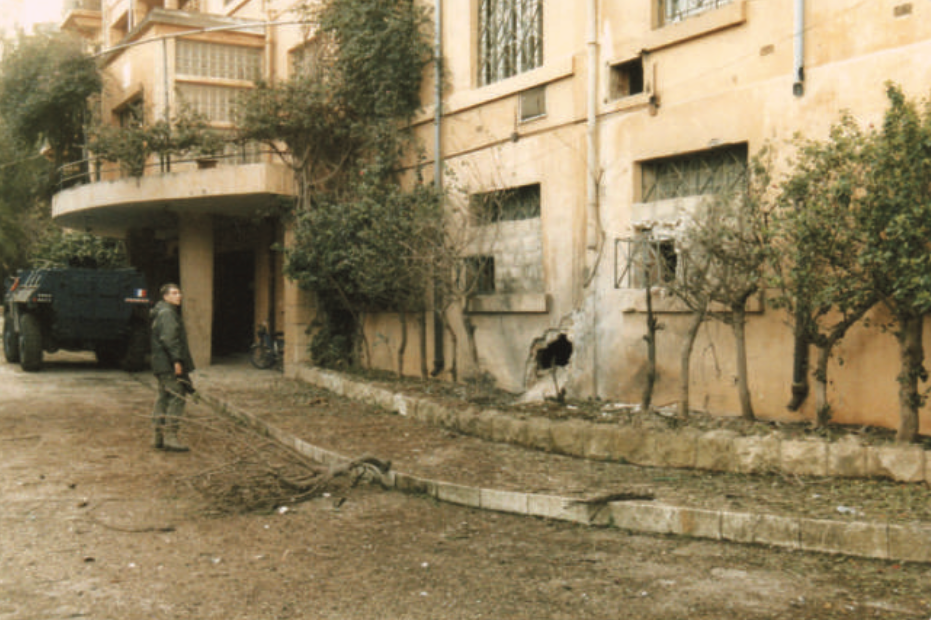
The rear façade of the main building during the war. Photo provided by ESA.






Thirty years ago, ESA settled on a historic site whose different lives tell, in themselves, part of Lebanon's history over more than a century. To tell the story of the school, its director general, Maxence Duault, begins with the story of the place.
The land where the school now stands originally consisted of two plots: that of the Villa Rose and the main plot, which in the 19th century housed a German Protestant hospital of the Order of Malta, Saint John of Jerusalem. Next to it, the de Portalis family settled — silk manufacturers from the Lyon region who had fled epidemics of the time to start silkworm farms in the Lebanese mountains.
World War I changed everything. With the victory of the Allies and the signing of the Treaty of Versailles, the French recovered the land as war reparations. The land thus became French property.
Under the French Mandate, the site was renovated and reorganized. France kept the hospital function, and the place took the name of Maurice Rottier Military Hospital, an establishment in the Levant dedicated to welcoming French soldiers and their allies. Another round of construction began and, in the 1920s, France purchased the Villa Rose. It was at this point that the site began to take the shape we know today.
The hospital retained its function until 1943. With Lebanon's independence, France needed to open an embassy: the hospital changed its purpose once again to become a French diplomatic site. It remained so for nearly forty years.
Then came the civil war. In the 1980s, several tragic events, including the Drakkar bombing and the assassination of Ambassador Louis Delamare, forced the French to leave the site, which had become too difficult to secure. The land was mined and the place locked down. For about fifteen years, this former French enclave seemed to be under a bell jar.
The French embassy moved to Hazmieh, then to Rue de Damas. After the civil war, the ambassador at the time was tasked with deciding the fate of the Clemenceau site. In the meantime, buildings had sprung up all around, making the site once again difficult to secure.
The sale of the site seemed inevitable. That was when a new story began. According to Maxence Duault, director general of ESA, discussions with major Lebanese business leaders led to the emergence of another idea: to support Lebanon's reconstruction, it was also necessary to train its key players more effectively. Jean-Pierre Lafon, then French ambassador, promoted this idea to Jacques Chirac. This was in 1994-1995. The Clemenceau site escaped being sold and was about to begin a fourth life: that of ESA.
The École supérieure des affaires was founded in 1996, solely on the parcel of the former hospital. Another story began: that of a campus that would itself continue to evolve. For more than half of its existence, ESA operated on a site in constant renovation, before, buoyed by its successes, reclaiming the part corresponding to Villa Rose, thus reconstituting its entire campus.
Its evolution was not limited to the buildings. Over the years, the school developed a true ecosystem on this campus: degree programs, custom programs and corporate consulting. ESA also worked extensively on the business environment and gradually became a place where people came as much to learn as to meet, exchange, and build networks.
Thirty years later, the campus is no longer just about the school itself. Each building and space has its function.
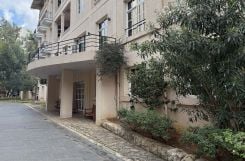
On one side of the campus, the Villa Rose houses the Institute for Finance and Governance and Executive Education, two activities closely linked to the business world. This is a more professional hub, where board meetings, conferences, and training for executives and senior managers are held.
On the other side are the school's research center and the residences, which host between 350 and 400 international professors each year. The campus also has 17 studios for accommodating them during their stay in Beirut. The main building and the MBA tower house the classrooms where the school's degree courses are taught. At the heart of the campus, the La Boussole restaurant has become a meeting place where generations who attend ESA cross paths.
Meetings and events take place in various areas of the campus, including the Henry and Nadège Obegi Garden, the Stéphane Attali Hall, the Fattal and Audi auditoriums, the multipurpose hall, and at SmartESA. The Rafic Hariri Center houses the classrooms for specialized master's programs, while SmartESA also has an incubator dedicated to start-ups.
The campus's activity is not limited to ESA alone. It also hosts partners such as the CCI France-Liban and France Médias Monde. The regional hub of France Médias Monde, specialized in digital content in Arabic, "illustrates the school's gradual openness to other fields, particularly journalism, to better understand the challenges of today and tomorrow," Maxence Duault notes.
For the director general, this evolution ultimately says something about ESA itself: the school is no longer just a place to earn a degree. It has become an ecosystem blending teaching, research, business support, entrepreneurship, and networking. A place which, after having changed its function several times over the course of its history, continues to reinvent itself and evolve with the times.
In partnership whith


 7 p.m. recap: Sharaa in Riyadh; Qassem signals openness to cooperation; Ben-Gvir: ‘We demolish, again and again’