


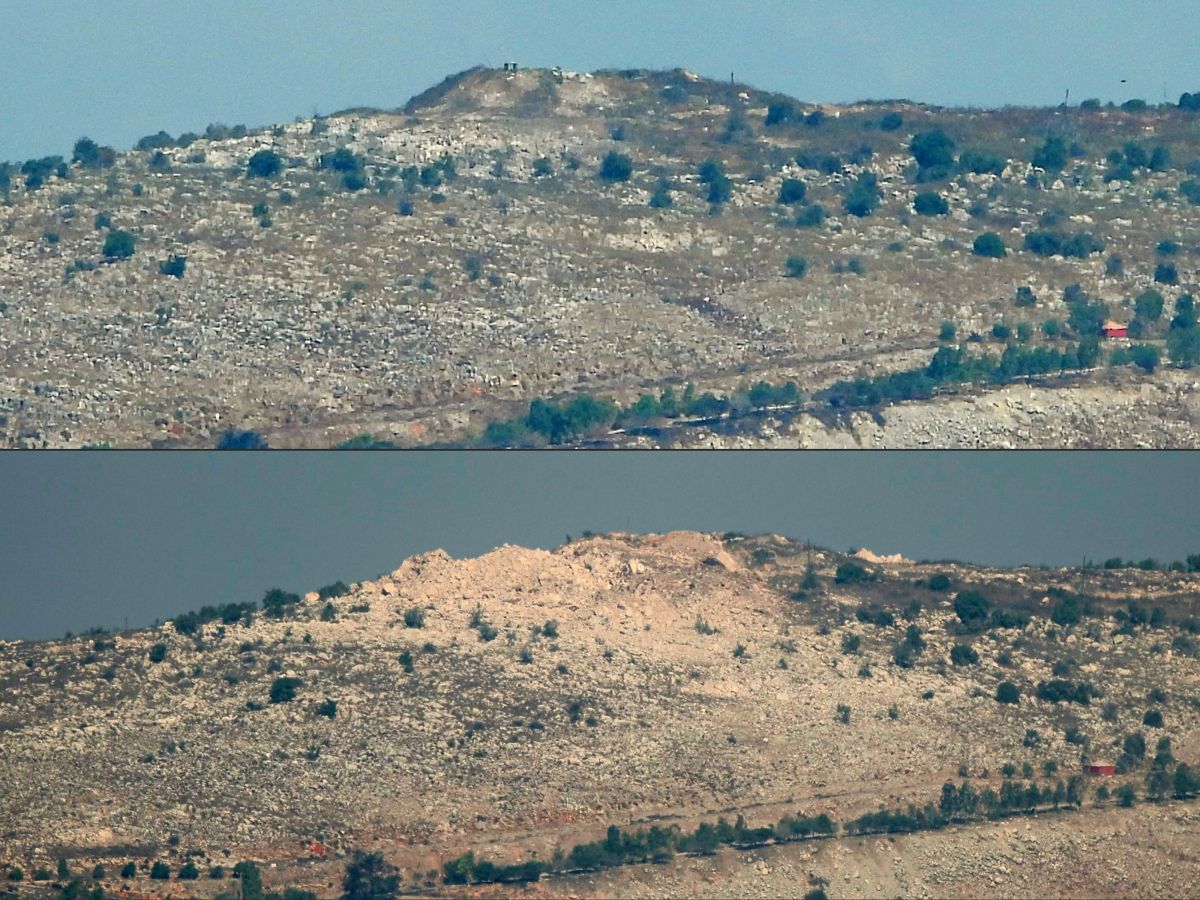
The Ali Taher hill, in southern Lebanon, on June 6, 2026 (top), and the aftermath of an Israeli demolition on Sept. 10, 2026, which triggered a 4.1-magnitude tremor (bottom). (Photo: AFP)






SOUTH LEBANON — At a time when Hezbollah is facing increasing pressure regarding its weapons, including north of the Litani, and initiatives to strengthen the state's presence in Shiite-majority regions are multiplying, Hezbollah and Amal on Monday called for the preservation of civil peace. A "red line," according to the two groups, which called for avoiding internal escalation and prioritizing dialogue.
"Civil peace constitutes a red line and a shared national responsibility. We reject all forms of incitement to hatred and discord," emphasized the two allied Shiite movements, Hezbollah and Amal, on Monday. "The handling of contentious issues must not be done through escalation, but through dialogue within institutions, in order to avoid deepening divisions that would threaten civil peace. This stage must be approached with a heightened sense of national responsibility and away from narrow calculations," stressed the leaderships of the two groups in a joint statement following a meeting between the president of Hezbollah's executive council, Ali Daamouche, and the executive president of the Amal movement, Moustafa Fawwani.
The Hezbollah-Amal duo also called on the state to assume its responsibilities, particularly to resolve economic and social crises, in order to strengthen Lebanon's ability to face upcoming challenges. They also reminded the state of its responsibilities concerning reconstruction, compensation for those affected (by the war), and the return of inhabitants to their villages in the South. "These issues cannot be postponed; they are a national priority that demands the rapid mobilization of official and popular resources," the statement insisted, inviting the state to "take advantage of the Arab and international support" it benefits from, to allow affected populations to return home.
"Lebanon cannot bear further paralysis or tensions and needs, now more than ever, understanding, constructive action, and pooling of efforts," concluded the statement from Amal and Hezbollah, which also called for prioritizing national interest, the protection of Lebanon, the revival of the state and its institutions.
These statements come as the Israeli army continues to target southern Lebanon, particularly the coastal village of Mansouri after the demolition of the Ali Taher hill (Nabatieh).
Last Saturday, President Joseph Aoun traveled to southern Lebanon where he reiterated the necessity of an Israeli withdrawal from occupied Lebanese territory, the return of forcibly displaced residents, and the reconstruction of destroyed homes and infrastructure.
Accompanied by army chief Rodolph Haykal, he visited the city of Nabatieh, just a few kilometers from Ali Taher, as a gesture of "solidarity" with the residents of this city.