


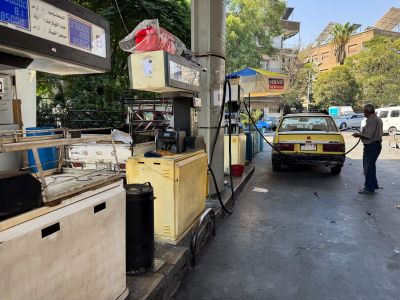
A man fills up his car at a gas station in Damascus on Sept. 14, 2026, following a recent increase in fuel prices that has sparked protests in several cities across Syria. (Credit: Firas Makdesi/Reuters)






Syrians protested Monday for the second consecutive day against the government in the north and west of the country, following a drastic increase in fuel prices due to the ongoing war in the Middle East, AFP correspondents reported.
These are the first protests of their kind since new President Ahmad al-Sharaa took power in December 2024. Under the Assad regime, protests were banned and a popular uprising-turned civil war was bloodily repressed.
An AFP correspondent saw protesters gathered at the outskirts of the city of Maaret al-Noomane, in Idlib province (northwest), where the main road was briefly blocked using burning tires.
"We want them to bring fuel prices back to their previous level. Winter is approaching, how is this poor people going to live and stay warm?" said Fateh Hamcho, a 67-year-old taxi driver, to AFP. Other protests took place in Hassakeh in the northeast, Atareb and Azaz in the north, and Khan Sheikhoun in the west of the country, according to AFP correspondents.
Syrian authorities announced a fuel price increase on Sunday, which had already sparked protests. Energy prices have climbed sharply since the United States launched a war against Iran, with Tehran notably retaliating by blocking the Strait of Hormuz, a major maritime route for oil and gas transport.
The price of diesel rose from 125 Syrian lira (about $1) to 175 Syrian lira, an increase of 40%, and the price of gasoline was raised by 26%.
According to the U.N., 90% of Syrians were living below the poverty line at the end of 2024 in a country where the minimum wage just exceeds $100.
The Syrian parliament is scheduled to question Energy Minister Mohammad al-Bachir on Thursday about the fuel price hike.
Speaking on state television, Abdul Hamid Salat, head of the media department at the Energy Ministry, said Sunday that the measure was "temporary," highlighting that Syria imports about 74% of its diesel needs and 81% of its gasoline.
Syria, ravaged by a long civil war, now produces only about 100,000 barrels of oil per day, far below the local demand, which is between 300,000 and 325,000 barrels per day, according to him.
 The 7 p.m. recap: Houthis advance, government announces counteroffensive; Iran raises stakes; Israeli shells hit close to journalists in south Lebanon
 2 Israeli soldiers injured in 'operational accident,' as army continues attacks in the South