


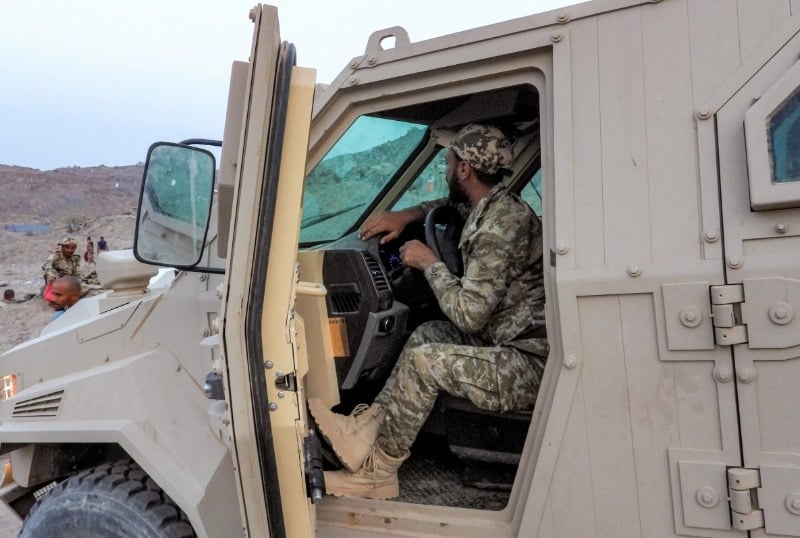
A fighter from Yemeni pro-government forces in an armored vehicle west of Taiz, Sep. 13, 2026. (Credit: AFP)






Yemen’s Iran-backed Houthis, emboldened by recent advances, again targeted military sites in neighboring Saudi Arabia on Monday, while Iran denied involvement in the conflict, which has opened a new front in the regional war, AFP reported.
In recent days, the Houthi movement has inflicted significant setbacks on Yemeni government forces and their Saudi ally, strengthening its control over the Bab el-Mandeb Strait, a strategic waterway linking Europe and Asia, following a lightning offensive. The Houthis have also targeted Saudi oil infrastructure, sending oil prices above the symbolic $100-per-barrel threshold.
On Monday, the Houthis claimed responsibility for another "large-scale" attack involving "dozens of ballistic missiles and drones" targeting King Khalid Air Base in Khamis Mushait, southern Saudi Arabia. A resident told AFP he saw "numerous missiles" fall on the military base and heard loud explosions.
"This is the first time there have been so many," he said, adding that the attack caused a fire "that lasted a very long time." The day before, Riyadh retaliated with around 50 airstrikes, according to the Houthis, who are a key part of the so-called "axis of resistance," a network of armed groups backed by Iran across the region. Saudi Crown Prince Mohammed bin Salman, the kingdom’s de facto ruler, met Monday in Jeddah with US Central Command chief Adm. Brad Cooper to discuss "the latest developments in the region," according to the official Saudi Press Agency.
'Position of strength'
Against this backdrop, Saudi Arabia requested the postponement of a meeting with Iran that was scheduled to bring together Gulf states in Oman on Monday, according to Iranian diplomats. "Invoking the Yemeni issue as a reason (for the postponement) is a false pretext," Iranian Foreign Ministry spokesman Esmail Baghai said at a press conference in Tehran.
"Iran does not interfere in Yemeni affairs," he said, arguing that the Houthis were "completely independent actors (who) make their decisions based on their own interests." The meeting was expected to focus on the future of the Strait of Hormuz, another key route for global oil shipments that Iran has been blocking for months.
"Despite strong pressure from the United States, Iran retains relative control over Hormuz," political analyst Maziar Khosravi said, adding that recent developments in Yemen "have established a new balance of power in the region and even internationally." "It therefore seems to me that Iran was going into this meeting from a position of strength," he told AFP, while Saudi Arabia faces mounting pressure.
'De-escalation has become an economic imperative'
The kingdom is caught between Houthi attacks and threats to its oil tankers in the two waterways surrounding its territory. Its East-West pipeline, a key route for exporting crude while bypassing the Strait of Hormuz, has also been halted following drone attacks originating from Iraq, according to Riyadh.
The Houthi advances have worsened "a crisis that the Gulf states already considered untenable. With Hormuz obstructed and Bab el-Mandeb increasingly vulnerable, de-escalation has become an economic imperative," said Ali Vaez of the International Crisis Group.
After years of relative calm, Yemen was drawn into the regional conflict in July following the US-Israeli offensive against Iran in late February. Fighting in western Yemen in recent weeks has killed hundreds of people and displaced nearly 86,000, according to the International Organization for Migration.
On Sunday, Yemeni government forces said they had recaptured several positions in the Taiz region and that "at least a dozen" Houthi fighters had been killed in airstrikes. A war between the Houthis and pro-government forces backed by Riyadh raged from 2014 to 2022, killing hundreds of thousands of people and plunging Yemen, the poorest country on the Arabian Peninsula, into a major humanitarian crisis.
 The 7 p.m. recap: Houthis advance, government announces counteroffensive; Iran raises stakes; Israeli shells hit close to journalists in south Lebanon
 2 Israeli soldiers injured in 'operational accident,' as army continues attacks in the South