


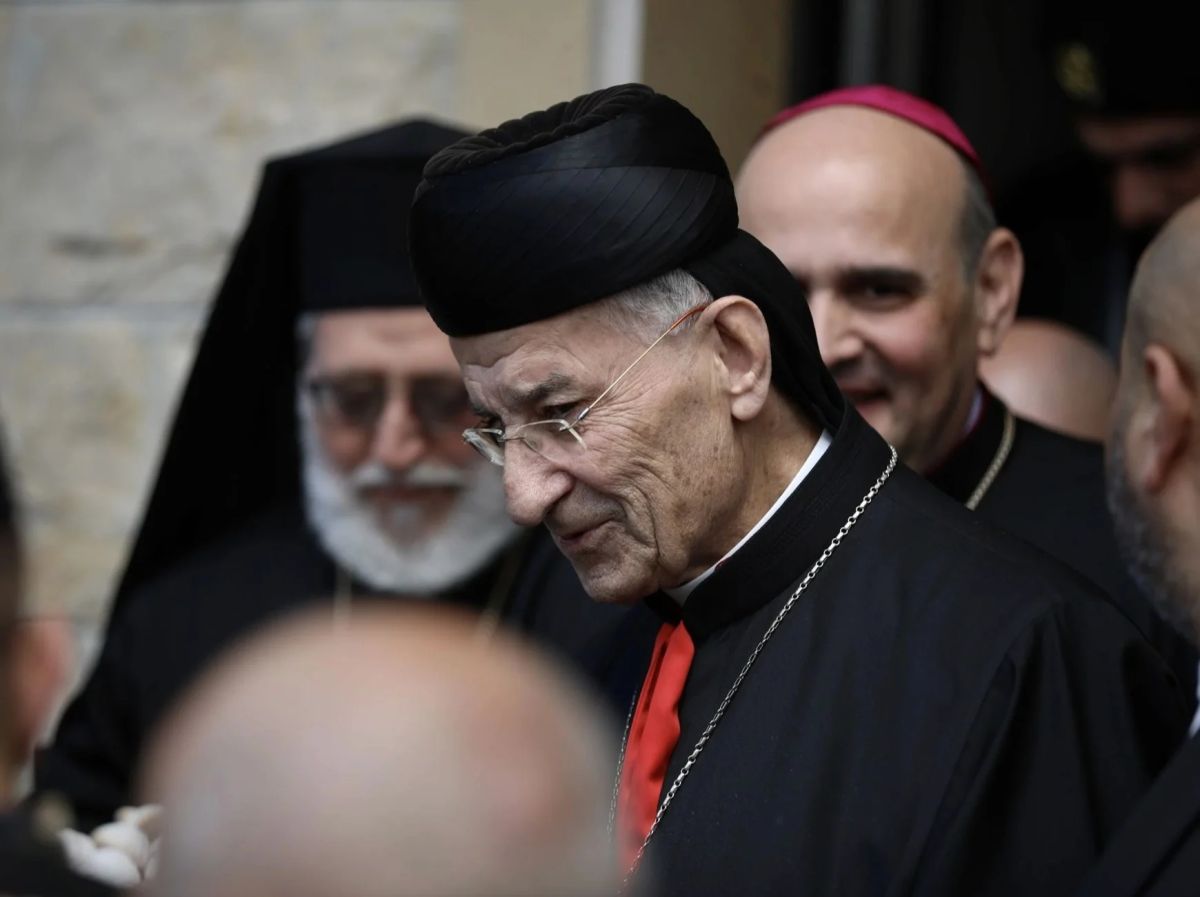
The Maronite Patriarch, Bechara Rai, on April 8, 2026 during a tour in Kawkaba, in the Marjeyoun district in South Lebanon. Archive photo Matthieu Karam/L'Orient-Le Jour






BEIRUT — Maronite Patriarch Bechara Rai called Sunday for an end to attacks in southern Lebanon and concrete guarantees to prevent renewed escalation, saying the security and rights of residents in the South were a national issue as Israel-Lebanon negotiations remained stalled.
"When a part of Lebanon is wounded, all of Lebanon is wounded," Rai said in his Sunday homily.
On Saturday, President Joseph Aoun, accompanied by Army commander Gen. Rodolphe Haykal, visited Nabatieh as law enforcement and army forces were gradually being deployed in the devestated city and warmly received by residents. The visit was dubbed a sign of “solidarity” with the city’s residents.
Rai also discussed negotiations between Tel Aviv and Beirut, saying they must "move from the stage of contacts and mediation to a clear approach, with defined objectives, leading to concrete results on the ground: cessation of attacks, withdrawal, and consolidation of stability through real guarantees preserving sovereignty and preventing a repeat of escalation ... Negotiations must not become an open-ended process with no prospect. On the contrary, they should be a means to achieve a clear solution, which preserves Lebanon's rights and ends the state of instability," he added.
During the summer, Israel and Lebanon held two sessions in Rome, under U.S. auspices, and Washington announced in mid-August a third meeting "early September," again in the Italian capital. The goal would be to introduce new Lebanese villages into the "pilot zones" in southern Lebanon, which would result in Israeli withdrawal from them, and set up a mechanism to verify the disarmament of Hezbollah in these areas. But during his visit to Nabatieh, the president said there were "no new negotiations with Israel for the moment." Planned for September, the talks between the two countries have been pushed back to October.
Rai also addressed the issue of state monopoly on weapons, saying that it was not "a matter of one camp's victory over another, nor a confrontation with any confession or community." "It is about establishing a single national authority and affirming the state's right to hold sovereign decision-making power and responsibility for the protection of all its citizens," he added.
Christian villages in the Bint Jbeil district
Following the cancellation of several humanitarian convoys intended for the still-inhabited Christian villages of Ain Ibl, Rmeish and Dibil in the Bint Jbeil district, which lie under the “yellow line” set by the Israeli army to demarcate what it calls its “security zone” — which it occupies — stretching over more than 600 square kilometers in southern Lebanon, Rai also voiced the residents’ “concern.”
He called for the movement of convoys to be facilitated, as well as the implementation of a “clear and permanent coordination mechanism, ensuring the free movement of residents, as well as the delivery of aid provided by humanitarian organizations and donors.”
The municipalities of Rmeish, Ain Ibil and Dibil issued an “urgent appeal” Friday for the “regular resumption of humanitarian convoys” serving the three border villages and the approximately 10,000 residents who still live there.
They said four convoys prepared this week had been canceled “despite the completion of the required procedures, without any clear and unified explanation provided by the relevant authorities.”
Mufti Qabalan denounces a “devastating national crisis”
For his part, Jaafari Mufti Ahmad Qabalan, who is known for his proximity to Hezbollah, accused the Lebanese authorities of abandoning southern Lebanon and serving the interests of Israel and the United States.
“We will not accept any compromise on our blood, our villages, our cities and our South, which suffers from the tragedy of the side agreements and security arrangements that prioritize the security of Tel Aviv over that of Lebanon and the South. The executive branch, subservient to the parties in power, Washington and the security corridors, plunges the country into the heart of a devastating national crisis. We will not remain silent in the face of the treacherous projects that threaten our very existence,” Qabalan said in a statement cited by the state-run National News Agency (NNA).
“National partnership begins and ends in the South. Without the South, there would be no nation, no political partnership, no popular solidarity, no historical existence. Abandoning the South in this way is the supreme betrayal,” he added.
The cleric also denounced “the worst political and national division,” accusing the government of treating the South “as a cemetery, a hunting list and a pretext for foreign interventionism.”
“Yet, patriotism demands that the executive branch be accountable to its people on issues of sovereignty and not to Tel Aviv,” Qabalan said.
He described the “best guarantee for the South and Lebanon” as that provided by the Shiite Amal movement and Hezbollah, while praising the role of Parliament Speaker and Amal leader Nabih Berry in his statement.
 Israeli army carries out demolition at Jabal Amel School in Houla as strikes continue