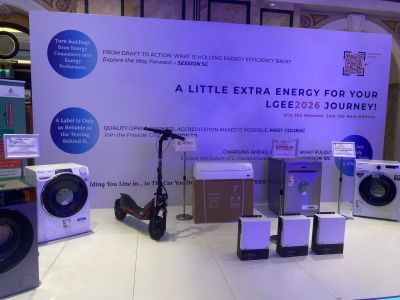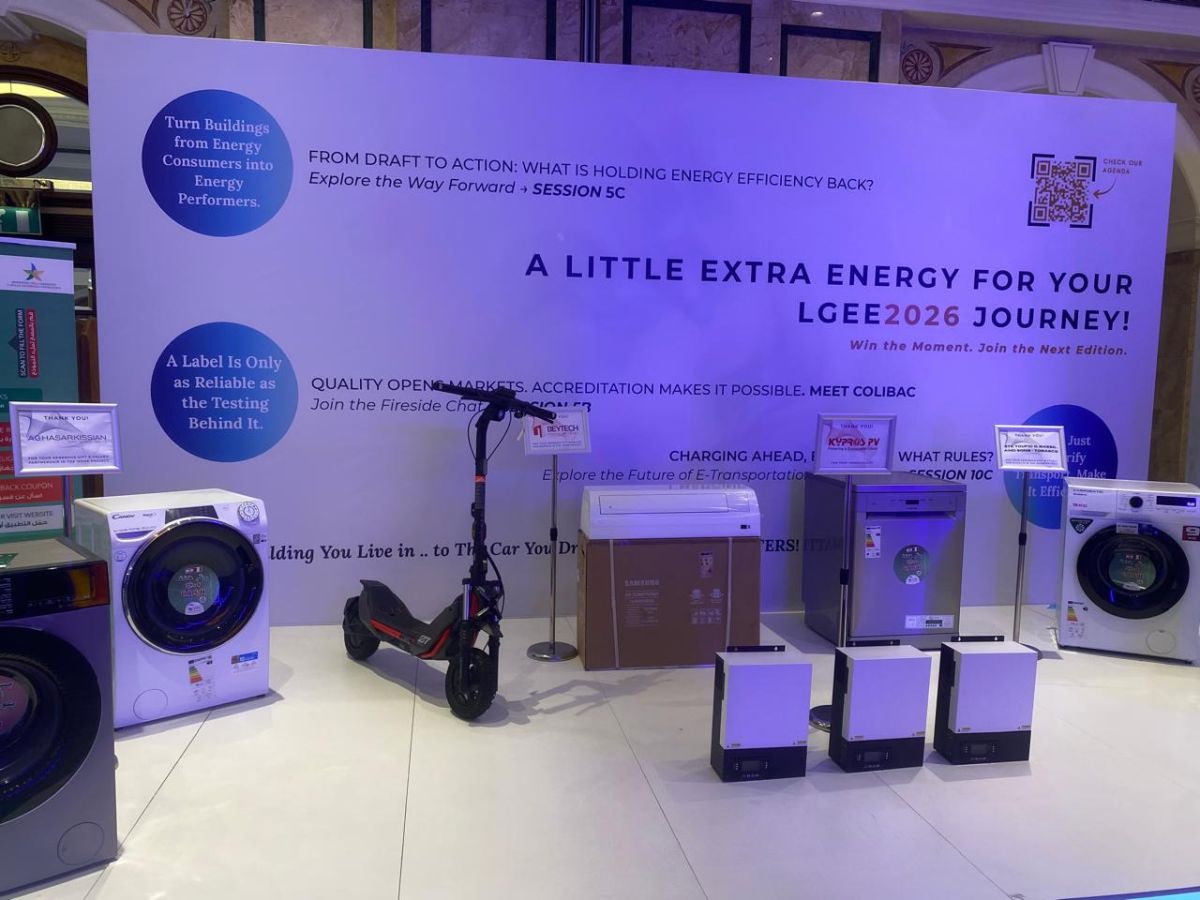
Inverters and energy-efficient devices, exhibited on the sidelines of the Lebanon Grand Energy Event 2026, on Sept. 10, 2026, at the Phoenicia Hotel in Beirut. (Credit: Alexander Haddad/L’Orient-Le Jour)






BEIRUT — The annual energy meeting, the Lebanon Grand Energy Event (LGEE), is bringing together regulators, donors, and companies from the sector in Beirut from September 9 to 11. Organized by the Lebanese committee of the World Energy Council, under the patronage of the presidency of the Republic, it counts among its national partners two public organizations: the Lebanese Center for Energy Conservation (LCEC), the national energy agency attached to the Ministry of Energy and Water, and the Electricity Regulatory Authority (ERA). The latter, provided for by Law 462 of 2002, only had its members appointed last year, by a decree dated September 30, 2025, naming a president, Marwan Jamal, and four members, for a single nonrenewable five-year term.
The first day focused in particular on hydrocarbons and their regulation. Former Environment Minister Nasser Yassine also estimated that financing the transition to renewable energy, mainly photovoltaic, would cost $6 billion over 5 to 6 years to reach the target of 5,700 megawatts across the entire country by 2030, according to al-Modon. A roundtable with the ERA noted that three wind licenses and eleven medium-capacity solar licenses have been issued.
On Thursday, in a session with the Lebanese Business Leaders Group (RDCL) on the seven-point reform plan presented by his ministry, Energy Minister Joe Saddi placed the issue within the geopolitical changes brought about by the war in Ukraine and the conflict between Iran and the United States. Lebanon is entering "a very delicate period," he said, calling on the country not to depend on a single source of supply.
Another session, with Electricité du Liban (EDL), the German development bank KfW, and the United Nations Development Programme (UNDP), presented the scenarios that the electricity sector must prepare for. EDL’s general manager, Kamal Hayek, named the rehabilitation of the hydropower fleet as one of the priorities, to maintain and optimize existing resources. He specifically mentioned the rehabilitation of the Nahr al-Bared plants and the upcoming expiration of the Nahr Ibrahim and Qadisha concessions. The project, financed by KfW, also covers the quality infrastructure of the solar sector, working with Libnor, the Lebanese standards agency, and with the Industrial Research Institute (IRI), the Lebanese agency for technical testing and certifications.
On Friday, debates will focus on oil price fluctuations linked to the Strait of Hormuz, green building certification, and the interconnection of renewable projects with Syria. The afternoon will be devoted to solar financing, battery storage, regulation of electric vehicles, and energy reconstruction in war-torn South Lebanon.
Speaking at the event will be, among others, Yassine, around an “energy community” model, former Lebanese ambassador to the United Arab Emirates Fouad Chehab Dandan, and President of the Council for the South, Hashem Haidar. Saddi will take part at 3 p.m. in a session with sector stakeholders, and Industry Minister Joe Issa al-Khoury will attend the closing session at 5 p.m., which will announce the next edition, scheduled for Sept. 8 to 10, 2027. Some of these sessions will be streamed online by the LCEC.