


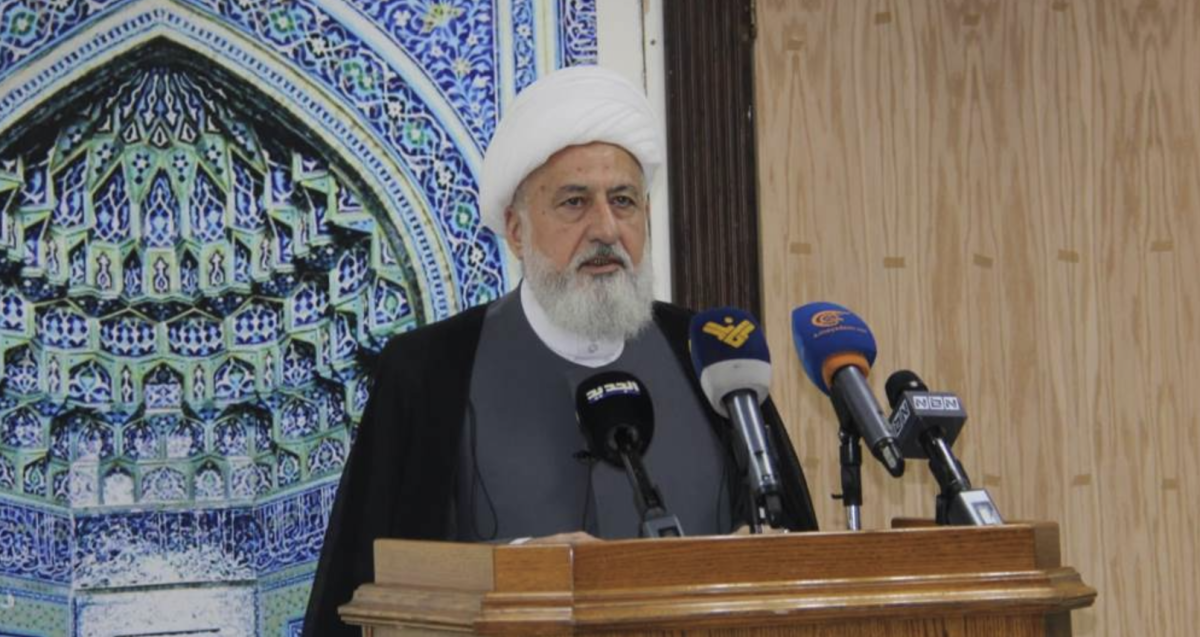
The vice-president of the Higher Shia Islamic Council, Sheikh Ali al-Khatib. (Credit: Archive photo NNA)






BEIRUT — The vice president of the Higher Shiite Islamic Council, Sheikh Ali al-Khatib, handed Iranian Foreign Minister Abbas Araghchi a note Friday in Tehran outlining the consequences of Israeli attacks on Lebanon and calling, in particular, for financial support for residents of south Lebanon. “We cannot forget Lebanon,” the Iranian foreign minister replied, assuring him of Tehran’s support.
During his meeting with the Iranian minister, the Shiite dignitary, who is close to Hezbollah, highlighted the situation of those displaced from south Lebanon, a “large number” of whom, he said, are now “without housing or work” after exhausting their savings over years of war. “They are now living in areas close to the zone occupied by Israel and exposing themselves to death and danger,” Sheikh Khatib said. He emphasized that “the agricultural regions and productive establishments are all at a standstill.” “We are counting on you after God. We are facing an external war and an internal plot, and we fear for our people in the next phase,” he added.
Sheikh Khatib also acknowledged “the difficult circumstances” currently facing Iran, while noting that Iranians “can hold out in their homes” and do not experience the kind of displacement suffered by part of the population of south Lebanon. “We are thus conveying the voice of Lebanon’s Shiites to you, and we fear that the Americans and the Israelis will achieve their objectives by exerting economic pressure on our population,” he said.
In response, Abbas Araghchi said Iranian officials were aware of the situation in Lebanon “through reports from the embassy and our brothers in Hezbollah and the Amal Movement.” The Iranian minister also referred to the memorandum of understanding between the United States and Iran, officially signed remotely in June by Donald Trump and Massoud Pezeshkian. “We have achieved a diplomatic victory thanks to the memorandum of understanding, first and foremost the cease-fire in Lebanon,” he said, accusing some parties of having “encouraged the Americans to violate what was agreed upon.” “We are trying and working to revive the memorandum of understanding, and our brothers in Lebanon believe that the solution lies in its implementation, but the circumstances are difficult,” Abbas Araghchi continued. “In any case, we cannot forget Lebanon, and our position is clear,” he added.
"We are 90 million. Let us consider that we are, with you, 95 million," the Iranian foreign minister finally told his interlocutor. "Rest assured that we stand by your side."
Two days after the war between the United States and Iran began on Feb. 28, Hezbollah carried out its first operation against Israel in more than 15 months, in retaliation for the killing of former Iranian Supreme Leader Ali Khamenei, triggering a resurgence of the war in Lebanon.
In mid-June, Washington and Tehran signed a memorandum of understanding whose first clause stipulates a halt to Israeli attacks on Lebanon. Since then, Hezbollah has said it is respecting the cease-fire, although Israel continues to carry out daily strikes on Lebanon and occupies more than 600 square kilometers of territory along the border. Beirut, which says it is not bound by the text, is negotiating directly with Israel over an end to the strikes and an Israeli withdrawal from south Lebanon. The latest round of negotiations, held in Rome in early August, did not, however, result in significant progress.

 7 p.m. recap: Houthis strike Riyadh airport again; Yemeni forces claim Bab al-Mandeb gains; Abbas postpones Palestinian polls