


We are wrapping up our live news blog. Good night, and see you tomorrow.
You can read our wrap-up on Israel's continued attacks on southern Lebanon here.
Iran: Pakistani army chief holds talks with President Pezeshkian
The powerful head of the Pakistani army, Field Marshal Asim Munir — whose country is acting as a mediator between Iran and the United States — held talks with Iranian President Massoud Pezeshkian in Tehran, Iranian state television reported.
The meeting took place after U.S. President Donald Trump held talks with Field Marshal Asim Munir last week, a source close to the discussions told AFP on Monday.
Pakistan played a very active mediating role in the drafting of a memorandum of understanding signed in mid-June, which was intended to end the conflict but which quickly fell apart.
In Tehran, the senior Pakistani officer also met with the Iranian chief negotiator and Speaker of Parliament, Mohammad Bagher Ghalibaf, as well as the Secretary of Iran’s Supreme National Security Council, Mohsen Rezai, state television had reported earlier.
Mansouri: the chairman of the municipal council condemns ‘systematic’ destruction and fears an Israeli occupation
Mansouri (Sour) has for some time been the target of a "campaign of systematic destruction," according to the town’s municipal council chairman, Haidar Mdaihli, who fears an Israeli occupation of the town.
The town is under constant attack from air strikes and artillery bombardments. Phosphorus shells have also struck most of its neighborhoods and the surrounding areas, the councilor told our correspondent in southern Lebanon.
Mdaihli reports having seen Israeli tanks moving from the Majdal Zoun area towards the southern sectors of Mansouri. He believes these movements could be a sign of an “attempted ground advance towards the town, as a prelude to further destruction and bombardment operations."
“One of the town’s neighborhoods was bombed today with white phosphorus, and a series of air strikes targeted a large number of houses, including villas and buildings constructed at great expense by emigrants originally from the town. Vast sections of these buildings have been razed to the ground,” he states.
Mdaihli emphasizes that Mansouri has now been deserted by its inhabitants. In his view, the only explanation for what is happening there is the “deliberate destruction of property belonging to residents and emigrants.”
He fears that these operations may constitute “a prelude to an occupation of the village, given its strategic position.” The village “offers a bird’s-eye view of the city of Sour and the coastline stretching as far as Adloun, south of Zahrani.”
Mdaihli claims to have contacted the commission responsible for the monitoring mechanism, the Lebanese Army and the parties concerned in order to “exert pressure to bring an end to the demolition operations.” These efforts “have not been successful,” despite Prime Minister Nawaf Salam’s visit to the area, where he witnessed the extent of the damage.
“Nearly 850 homes have been destroyed or seriously damaged, and 4,500 residents of Mansouri remain displaced,” laments the chairman of the municipal council, who questions the prolonged silence surrounding the town’s plight.
Bessent: Trump is calling leaders around the world to ask them to cease relations with Iran
US Treasury Secretary Scott Bessent says that Donald Trump is calling leaders around the world with specific requests that they cease their dealings with Iran, according to Reuters.
Series of Israeli bombings across southern Lebanon
Israel has carried out a series of bombings in southern Lebanon, reports our correspondent in the region.
It used explosives to destroy homes in Zawtar Sharqieh (Nabatieh), Houla, and Mais al-Jabal (Marjayoun), particularly in the Debbieh neighborhood.
Separately, an Israeli drone fired a stun grenade on rescue teams in Dohat Kfar Roummane, without causing any injuries.
Israeli military vehicles spotted moving around southern Lebanon
Movements of Israeli military vehicles were observed near the Ramta military post, in Shebaa, whilst artillery fire was directed towards Bastara, in the Hasbaya district.
Two Merkava tanks and two armored vehicles also made a foray from the Sammaqa military position in Kfar Shuba towards the Shanouh area via the southern slope, whilst heavy artillery was in action.
In the Bint Jbeil district, artillery fire was also reported. Yater was targeted, whilst two shells were fired towards the outskirts of Braasheet and Ainata.
Salam meets with delegation from Dhaira: Efforts continue to secure full Israeli withdrawal and create conditions for safe return
Prime Minister Nawaf Salam welcomed a delegation from the village of Dhaira (Sour), the Grand Serail said.
During the meeting, Salam emphasized that “the State will not abandon the inhabitants of Dhaira or other residents of the South in the face of the consequences of displacement.”
“We are exploring various options to resolve the housing issue, including the provision of rent allowances to displaced families. We will work to speed up the relevant procedures, alongside our efforts to secure a full Israeli withdrawal and create the conditions enabling the people of the South to return safely to their villages and lands,” he added.
At the end of the meeting, Ali Abou Samra, speaking on behalf of the delegation, said: “We outlined the difficult situation we are facing as a result of displacement and asked the Prime Minister to address the issue of housing. He assured us that he would look into the matter.”
US expands its threat of secondary sanctions relating to Iran
The U.S. has expanded its threat of secondary sanctions relating to Iran to target five key sectors, the Treasury Department has announced, as Washington seeks to impose a "decisive economic day" on Tehran, reports Reuters.
“The Treasury has taken action targeting five key sectors — digital assets, technology, gold, aviation, and maritime transport — which the Iranian regime uses in an attempt to prop up its ailing economy,” the department said in a statement.
U.S. Treasury Secretary Scott Bessent outlined the new measures at a press conference.
Israel carries out a major explosion in the town of Zawtar Sharqieh (Nabatieh)
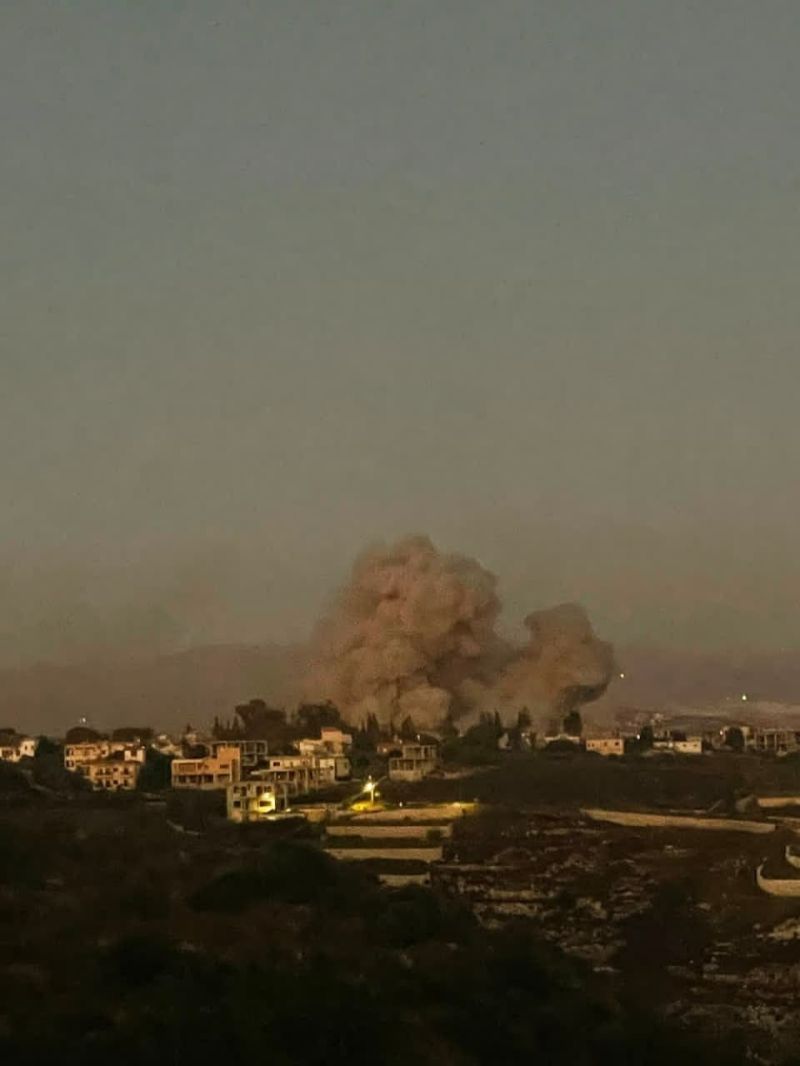
Photo sent by our correspondent in southern Lebanon, Muntasser Abdallah.
Israel carries out a major explosion in the town of Zawtar Sharqieh (Nabatieh).
Trump speaks with the head of Pakistan's army
Donald Trump spoke last week with the head of the Pakistani army, Field Marshal Asim Munir, whose country is acting as a mediator with Iran, a source close to the discussions told AFP.
This conversation took place before the influential field marshal traveled to Iran on Monday, and at a time when the U.S. president insists that all communication with Tehran has been cut off.
Pakistan played a very active mediating role in drawing up a memorandum of understanding signed in mid-June, which was intended to end the conflict but which quickly fell apart.
Washington is also set to unveil a new economic offensive against Iran and its trading partners today.
Saudi national shipping company confirms one of its vessels attacked in the Red Sea
The Saudi national shipping company Bahri confirmed in a statement that one of its vessels, the "Amzan," had been attacked in the Red Sea, according to Reuters.
UNIFIL: Any Israeli military presence north of Blue Line constitutes violation of UNSC 1701
The United Nations Interim Force in Lebanon (UNIFIL) said in a statement that it only recognizes the Blue Line and no other "lines" or "zones."
Israel has established what it calls a "buffer zone" in southern Lebanon, which includes dozens of villages currently occupied by the Israeli army.
"There has been a lot of talk about 'lines,' 'zones' and other terms when referring to the situation in south Lebanon right now. For the United Nations and UNIFIL, only one line is relevant: the Blue Line," the peacekeeping mission posted on X.
Established in 2000, the Blue Line is the “line of withdrawal” identified by the U.N., as a reference to confirm Israel’s withdrawal from Lebanese territory.
"Any Israeli military presence north of the Blue Line constitutes a violation of Security Council resolution 1701 and is monitored and reported by UNIFIL. Peacekeepers also monitor and report relevant activities by non-state armed actors within the Mission’s area of operations," UNIFIL added in its statement.
Israeli airstrike targets Byout al-Siyad
An Israeli airstrike has targeted Byout al-Siyad (Sour), according to our correspondent in the South.
Iran threatens 45 oil tankers with fines and confiscation amid escalation in the Strait of Hormuz
Iran said it had blacklisted 45 oil tankers that allegedly violated its rules governing passage through the Strait of Hormuz, and announced that it would take action against any vessel transferring cargo with those ships, further escalating its threats over the strategic waterway, Reuters reports.
The designated vessels could face fines, detention and cargo confiscation, according to a statement posted Sunday evening on X by the Persian Gulf Strait Authority, a newly established Iranian body tasked with managing the strait.
The list of restricted vessels includes very large crude carriers, liquefied natural gas (LNG) tankers, liquefied petroleum gas (LPG) carriers, as well as vessels transporting refined petroleum products, among others.
Some of the vessels named are owned by ADNOC Logistics and Shipping (ADNOC L&S), a United Arab Emirates company, its subsidiary Navig8 Tankers, as well as Bahri, Saudi Arabia’s national shipping company.
The Iranian post on X added that any vessel involved in ship-to-ship cargo transfers with the designated ships could also be added to the blacklist.
Israeli warplanes carry out strikes on Mansouri
Israel just carried out two new strikes on the village of Mansouri (Sour).
Moreover, an Israeli D9 bulldozer has once again moved toward an area located between the villages of Haris and Haddatha (Bint Jbeil).
Yemen’s Houthi rebels claim attack on Saudi oil tanker in the Red Sea
Yemen’s Iran-aligned Houthi rebels claimed responsibility for an attack earlier in the morning on a Saudi oil tanker off Yanbu, a strategic Saudi port on the Red Sea, as part of a blockade they had announced against the Saudi fleet.
The attack, carried out using “a ballistic missile,” “caused a fire aboard the vessel and prompted several other ships in the targeted area to flee,” Houthi military spokesperson Yahya Saree said in a statement.
There was no immediate confirmation from Saudi Arabia.
Salam says efforts ongoing to secure full Israeli withdrawal, create conditions for safe return while meeting delegation from Dhaira
Prime Minister Nawaf Salam received a delegation from the southern village of Dhaira (Sour district), the Grand Serail reported.
Salam stressed during the meeting that “the state will not leave the people of Dhaira or other residents of the south to face the burdens of displacement alone."
"We are considering various options to address the housing issue, including providing rental allowances to displaced families, and we will work to expedite procedures in this regard, alongside our efforts to secure a full Israeli withdrawal and create the conditions that would allow the people of the south to safely return to their towns and land," the Prime Minister added.
After the meeting, Ali Abu Samra, speaking on behalf of the delegation, said: “We presented the difficult situation we are facing as a result of displacement and asked the Prime Minister to address the issue of housing. He assured us that he would look into it.”
US Treasury to expand scope of secondary sanctions against Iran, Reuters reports
The U.S. Treasury is expected to expand the scope of secondary sanctions it can impose on entities and countries that maintain commercial ties with Iran, as the Trump administration seeks to increase economic pressure on Tehran, a source familiar with the plans told Reuters.
The measure is intended as a final warning to countries to end their trade relations with Iran, with the aim of pressuring Tehran to end the conflict that has lasted nearly six months and paralyzed the Strait of Hormuz as well as Gulf energy exports, the source said. The source spoke on condition of anonymity because they were not authorized to discuss the matter publicly.
U.S. Treasury Secretary Scott Bessent is expected to announce further details on the Iran-related measures at a press conference at 1 p.m. US Eastern Time (5 p.m. GMT).
According to the source, Bessent also plans to present a broader overview of the economic pressure campaign against Iran, which he and President Donald Trump have described as an “economic D-Day.” He is also expected to make clear to countries that they must choose to align with the United States or risk having some of their key companies and entities cut off from the dollar-based financial system.
Two booby-trapped drones explode between Haris and Haddatha
Two Israeli booby-trapped drones have exploded between Haris and Haddatha (Bint Jbeil district). Moreover, Israeli artillery shelling has targeted Wadi Slouqi.
A small Israeli drone has also dropped an explosive grenade in the vicinity of the Dabsha area in Dohat Kfar Roummane (Nabatieh district).
In the Sour district, intermittent machine-gun fire has targeted Mansouri.
Trump says Iran is 'completely collapsing' ahead of economic sanctions announcement
U.S. President Donald Trump said on his Truth Social platform that Iran was “completely collapsing,” just hours before the details of US economic sanctions against Tehran were due to be announced.
“IRAN IS COMPLETELY COLLAPSING!!!” the US president said, as US Treasury Secretary Scott Bessent had announced the previous day an “economic D-Day” against Iran for Monday, referring to the Allied landings in France in 1944.
Israeli bulldozers demolish temporary school complex recently built in Mais al-Jabal's outskirts
Israeli bulldozers demolished a temporary school complex in the Doubieh area on the western outskirts of Mais al-Jabal (Marjayoun district), according to our correspondent in the South. The complex was built and inaugurated by the Mais al-Jabal municipality after the latest war, in cooperation with the Council for the South and the Jabal Amel Union of Municipalities, with support from Iraqis. Israeli forces also brought in a truck loaded with explosives and began booby-trapping several houses in the area in preparation for demolishing them.
Meanwhile, continuous Israeli artillery shelling has been targeting the village of Mansouri (Sour). Moreover, a fire broke out in the outskirts of Houla (Marjayoun) as a result of the Israeli airstrike that targeted the area earlier.
Israeli warplanes carry out strikes in Mansouri and Houla's outskirts
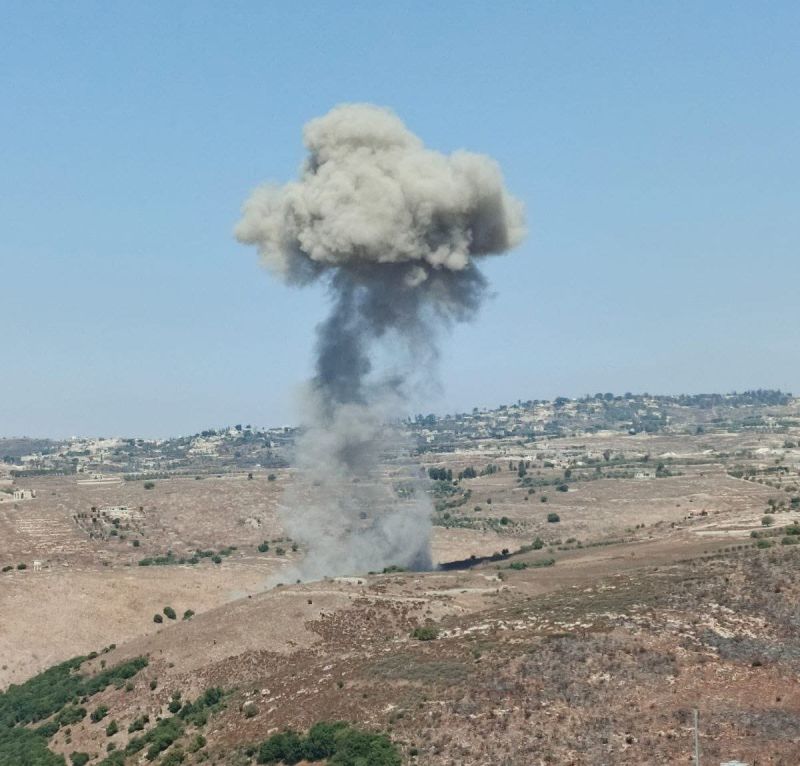
Israeli airstrike targets Houla's outskirts. (Credit: Photo received from Muntasser Abdallah)
Israeli warplanes have carried out strikes targeting the outskirts of Houla toward Wadi Slouqi (Marjayoun district) and the village of Mansouri (Sour), according to our correspondent in the South.
Our correspondent also reported that Israeli bulldozers are damaging roads in an area between Haddatha and Haris (Bint Jbeil).
Israeli army carries out detonation in Taybeh, fires artillery shells on houses in outskirts of Mais al-Jabal
The Israeli army has carried out a detonation in the area of Abou Makna in the village of Taybeh (Marjayoun district).
In parallel, Israeli artillery shelling has targeted several houses in the area of Doubieh in the western outskirts of Mais al-Jabal (Marjayoun). Israeli gunfire has also targeted the same area.
Meanwhile, in the Sour district, a small Israeli drone has dropped a stun grenade in the village of Mansouri.
Iran's currency drops to record low, tracking websites show
Iran's currency has dropped to a record low of more than 2,000,000 rials per U.S. dollar, two websites tracking the free market rate showed, according to Reuters.
Israeli army fires artillery shells at Mansouri, carries out detonation in Kfar Tibnit
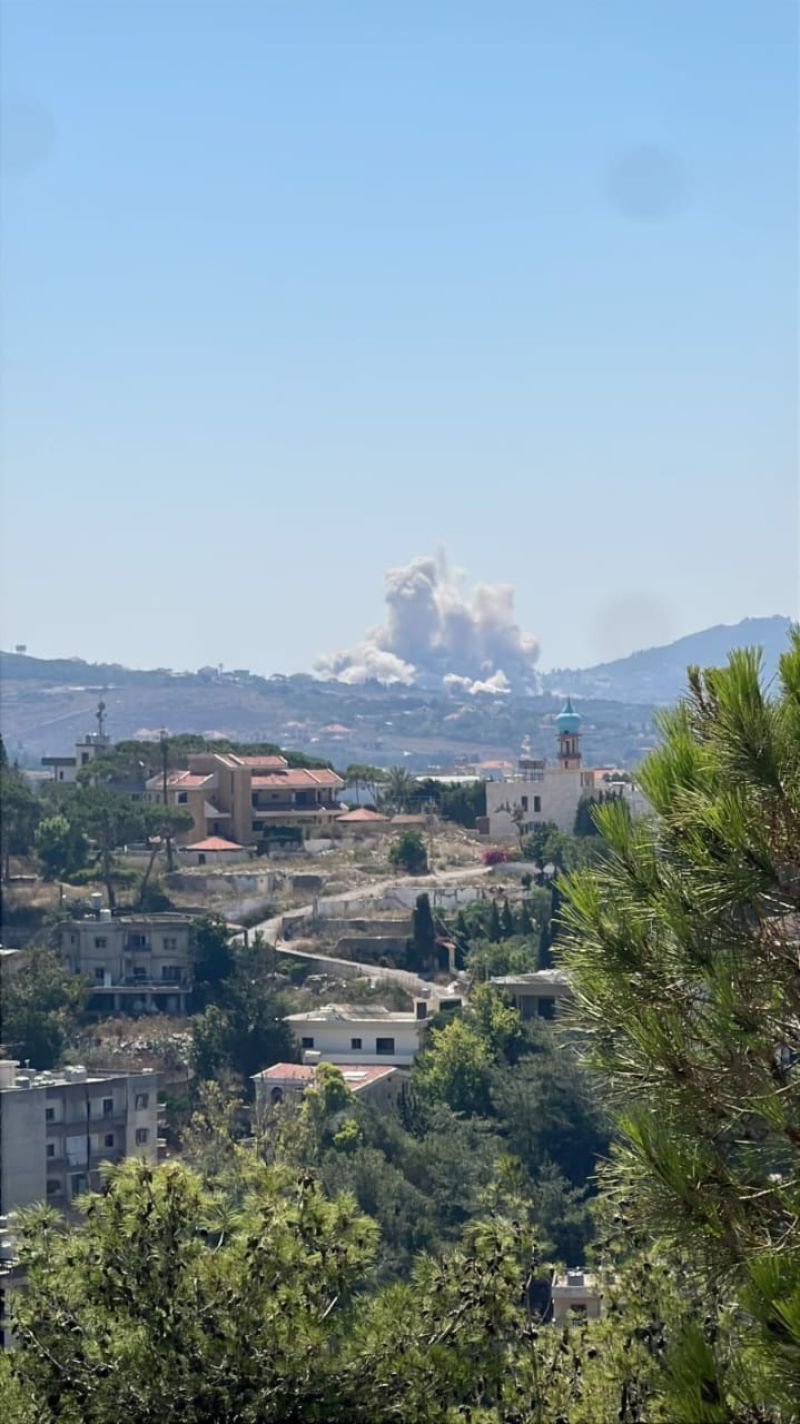
Israeli detonation in the village of Kfar Tibnit (Nabatieh). (Credit: Photo received by Muntasser Abdallah)
Israeli artillery shelling has targeted the village of Mansouri (Sour district), according to our correspondent in the South.
Earlier, the Israeli army carried out a detonation in the village of Kfar Tibnit (Nabatieh).
Iran warns of 'consequences' for countries joining US economic sanctions
Iran’s Foreign Ministry has warned that there will be “consequences” for countries that join the U.S. economic pressure campaign against the Islamic Republic.
“Necessary warnings have certainly been issued, as any complicity with America in implementing its aggressive actions against Iran will undoubtedly have its own consequences,” Foreign Ministry spokesman Esmail Baghaei said during a weekly press conference, ahead of Washington’s expected announcement later in the day of new measures aimed at isolating the Iranian economy.
Pakistani army chief spoke with Trump last week ahead of expected Tehran talks
Pakistan's army chief Asim Munir spoke with U.S. President Donald Trump last week, Reuters reported citing three Pakistani sources, days before Munir was expected to hold talks in the Iranian capital of Tehran today. It was unclear what Munir and Trump discussed.
The call, which has not been previously reported, came as the U.S. threatened to roll out major economic sanctions targeting Iran and its trade partners.
Tanker catches fire off Saudi Arabia after being hit by an 'unknown projectile'
A tanker caught fire off the coast of Saudi Arabia after being hit by an “unknown projectile,” according to the United Kingdom Maritime Trade Operations (UKMTO).
“A company reported that a tanker had been struck by an unknown projectile, causing a fire on the ship’s main deck. All crew members are safe ... and no environmental impact has been reported,” UKMTO said, adding that the incident occurred 63 nautical miles west of Yanbu. British maritime security firm Vanguard Tech said a Saudi-flagged vessel had been hit by a missile and caught fire.
Yemen’s Iran-backed Houthi rebels have regularly targeted Saudi vessels since announcing a maritime blockade of the kingdom in late July. Riyadh supports Yemen’s government in the conflict, which has entered a new phase following the regional war triggered by the Israeli-American offensive against Tehran on Feb. 28.
After Tehran closed the Strait of Hormuz, the port of Yanbu became the main outlet for Saudi oil, while the Bab al-Mandeb Strait, at the southern end of the Red Sea, became a crucial passage for maritime traffic.
Southern Lebanon: 2 bodies recovered after strike on Dohat Kfar Roummane
Two men killed Sunday in an Israeli drone strike on Dohat Kfar Roummane (Nabatieh) were found dead Monday in the rubble, according to our correspondent Mountasser Abdallah. The bodies of the two men, Hassan Chokr and Ahmad Roumani, were taken to a hospital in Nabatieh this morning. Their relatives had reported them missing the previous day.
Meanwhile, the Israeli military set fire to several homes in Khiam (Marjayoun). Black smoke rising from one of the village’s neighborhoods could be seen from a distance, according to witnesses. New explosions were heard shortly afterward in Khiam, in one of the town’s western neighborhoods. The successive blasts could be heard from afar.
Shortly before 10 a.m., the Israeli military destroyed homes in the Deir neighborhood of Houla (Marjayoun).
Patriot missiles redeployed to Crete amid Iranian threats
A battery of Patriot missiles was being transferred from the island of Karpathos, in eastern Greece, to Crete due to Iranian threats targeting U.S. bases in Europe, Greek media reported.
The redeployment began Sunday morning, when the battery left the port of Karpathos by barge, several Greek media outlets reported, publishing images showing the truck-mounted missile batteries at the port awaiting embarkation.
The Patriot batteries will be transported to Crete, to the Souda military facility, which hosts the largest U.S. and NATO military base in the eastern Mediterranean.
According to Greek media, the redeployment follows reports that Iran was considering attacks on U.S. military targets in Europe if President Donald Trump escalates the conflict over the Strait of Hormuz.
Greece’s Defense Ministry has not commented on the matter.
Read more here.
Washington to announce details of its 'financial offensive' against Iran today
U.S. Treasury Secretary Scott Bessent is due to hold a press conference Monday on how the United States plans to further increase economic pressure on Iran, nearly six months after the start of the war.
On Sunday, he said the United States would launch the “largest financial offensive ever” against Iran, calling it an “economic D-Day,” a reference to the name given to the Allied landings in Europe during World War II. According to Bessent, the United States is “entering the final phase” in its confrontation with Iran, with the Trump administration seeking to “cut off all the economic lifelines” allowing the Iranian regime to remain in power.
Bessent had already vowed last week that Washington would “bring down the Iranian regime” with the new sanctions, prompting a series of condemnations from Tehran. Washington has called on other governments, notably Beijing, to join efforts to isolate Iran’s economy. But China, a strategic economic partner of Iran, criticized the initiative, saying that U.S. “sanctions and pressure” would not resolve the conflict in the Middle East.
Among Iran’s major trading partners is also the United Arab Emirates, which announced Tuesday that it would suspend “all trade exchanges and financial transactions” with Iran until further notice.
Oman’s foreign minister to visit Tehran Tuesday, Pakistan’s army chief Monday
Oman’s Foreign Minister Sayyid Badr Albusaidi will travel to Tehran on Tuesday to continue discussions between Iran and Oman over the Strait of Hormuz, Iranian Foreign Ministry spokesman Esmaeil Baghaei said, according to Reuters.
On Sunday, Baghaei said that Pakistan’s army chief, who has acted as a mediator between the United States and Iran, would travel to Tehran on Monday.
Artillery fire hits Houla at dawn after tense night in southern Lebanon
The village of Houla, Marjayoun, came under Israeli artillery fire at dawn, our correspondent in southern Lebanon, Mountasser Abdallah, reports.
The night was preceded by several Israeli attacks, including demolitions in Majdal Zoun (Sour), Taybeh (Marjayoun) and Haddatha (Bint Jbeil), where houses were also set on fire; airstrikes on Qsayr (Marjayoun); artillery fire on the outskirts of Srebbine and Braasheet (Bint Jbeil) and Mayfadoun (Nabatieh); and machine-gun fire on Shihine (Sour).
In the Nabatieh region, where the Israeli military is particularly focused on the strategic Ali Taher ridge, the Israeli Air Force bombed a house near Dabsheh hill and the village of Dohat Kfar Roummane, which was also targeted with artillery fire.
The previous day, our correspondent reported, the Israeli Air Force carried out airstrikes on three villages; 12 others were targeted by artillery fire, including two with white phosphorus munitions; and four were targeted by drones. Demolitions were carried out in four villages, while houses were set on fire in a fifth.
Already have an account? Login here
You have reached your article limit
Add L'Orient Today to your syllabus.
Subscribe for $0.5/month for 3 months.
This article is only available to L’Orient Today subscribers.
Already have an account? Login here
