



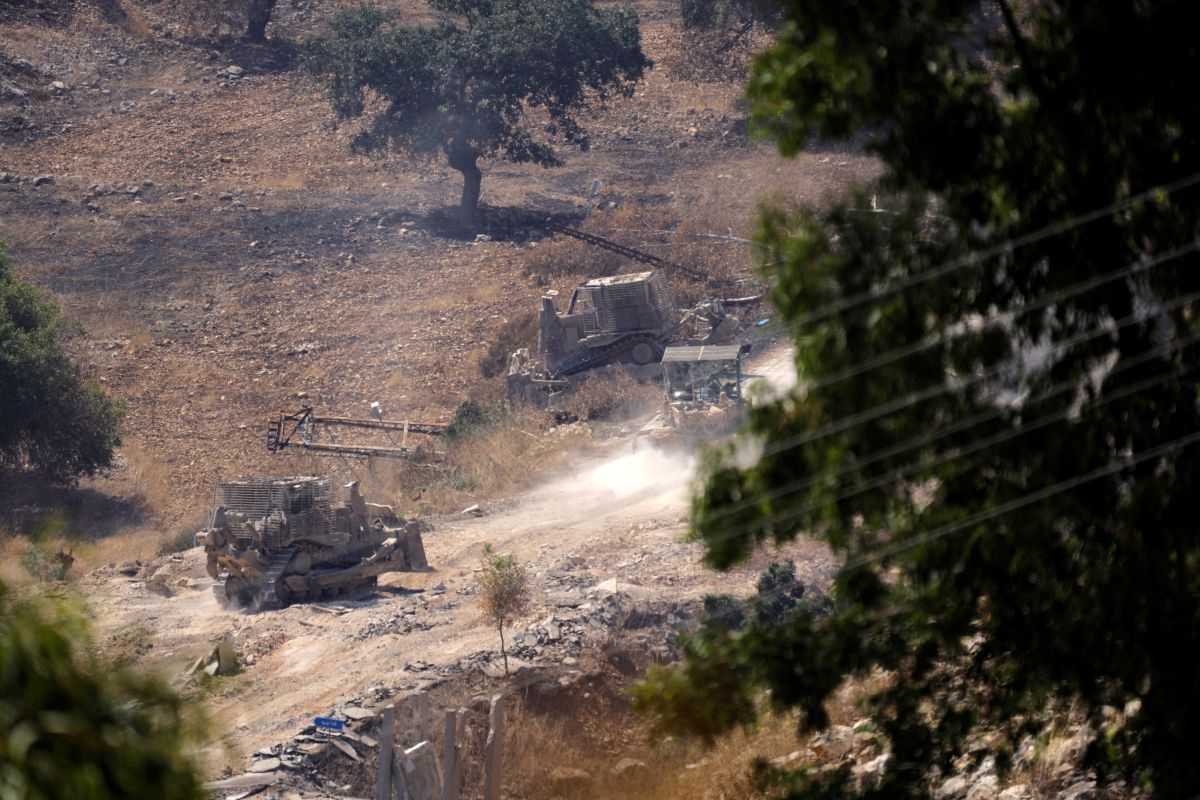
A photograph taken from the southern Lebanese village of Shaqra shows an Israeli military diggers gathered along a road in the nearby area of Wadi al-Slouki on Aug. 21, 2026. (Credit: Ammar Ammar/AFP)






SOUTH LEBANON — Saturday night into Sunday was one of the most violent in recent days in southern Lebanon, with intense Israeli airstrikes, artillery fire and dozens of demolition operations in border villages, according to our regional correspondent.
The Ali Taher ridge, a strategic height in the Nabatieh region where a Hezbollah base is reportedly located, has remained at the center of the attacks for several weeks, as well as diplomatic efforts aimed at preventing a broader offensive. The Israeli army carried out several strikes using heavy, high-explosive missiles on Ali Taher and the nearby Dabsheh area.
Dozens of artillery shells, some containing white phosphorus, were also fired at the ridge and Dohat Kfar Roummane, sparking several fires. Overnight airstrikes also hit homes on the outskirts of Nabatieh Fawqa, below Ali Taher, causing significant damage. A resident of Ansar, several kilometers from the ridge, described the explosions as “enormous,” saying they felt as though they had occurred just 100 meters from his home.
Israeli artillery shelling continues in south Lebanon
Israeli artillery fire continued across southern Lebanon on Sunday.
The Israeli army set fire to homes and property in Qantara in the Marjayoun district. Artillery shelling also targeted Mansouri in the Sour district and the outskirts of Adsheet al-Qsair in Marjayoun.
Israeli military vehicles were observed moving through Haddatha in the Bint Jbeil district, while an Israeli drone dropped explosive materials over the Ali Taher forest area in Nabatieh.
The Israeli army also carried out a series of demolitions overnight targeting houses and buildings on the western outskirts of Mais al-Jabal, as well as in Qantara and Taybeh in the Marjayoun district, and Kounin and Haddatha in Bint Jbeil. The operations continued Sunday near Mansouri in the Sour district and in Kounin, while a new explosion was reported early Sunday afternoon in Zawtar Sharqieh in the Nabatieh district.
Artillery fire also targeted an area between Beit Yahoun and Braasheet in Bint Jbeil, as well as the outskirts of Mais al-Jabal. Near Haniyeh in the Sour district, an Israeli drone dropped incendiary material, sparking a large fire that was later brought under control. A Merkava tank also fired twice toward Mansouri, while an Israeli drone dropped a stun grenade on a bulldozer in Yater, Bint Jbeil, without causing casualties.
Rodolphe Haykal in Rome
Against this backdrop of renewed tensions, Lebanese Army Commander-in-Chief Rodolphe Haykal traveled to Rome on Sunday morning, days after Lebanese President Joseph Aoun visited the Italian capital.
Haykal’s visit comes despite the lack of major progress during the latest round of direct talks between Beirut and Tel Aviv in Rome in early August. The talks are part of a framework agreement to establish “pilot zones” where the Lebanese Army is expected to disarm Hezbollah.
The implementation of the “pilot zones” plan remains on hold, however, amid the lack of progress in the latest round of negotiations.
Reporting contributed by our regional correspondent, Muntasser Abdallah.