



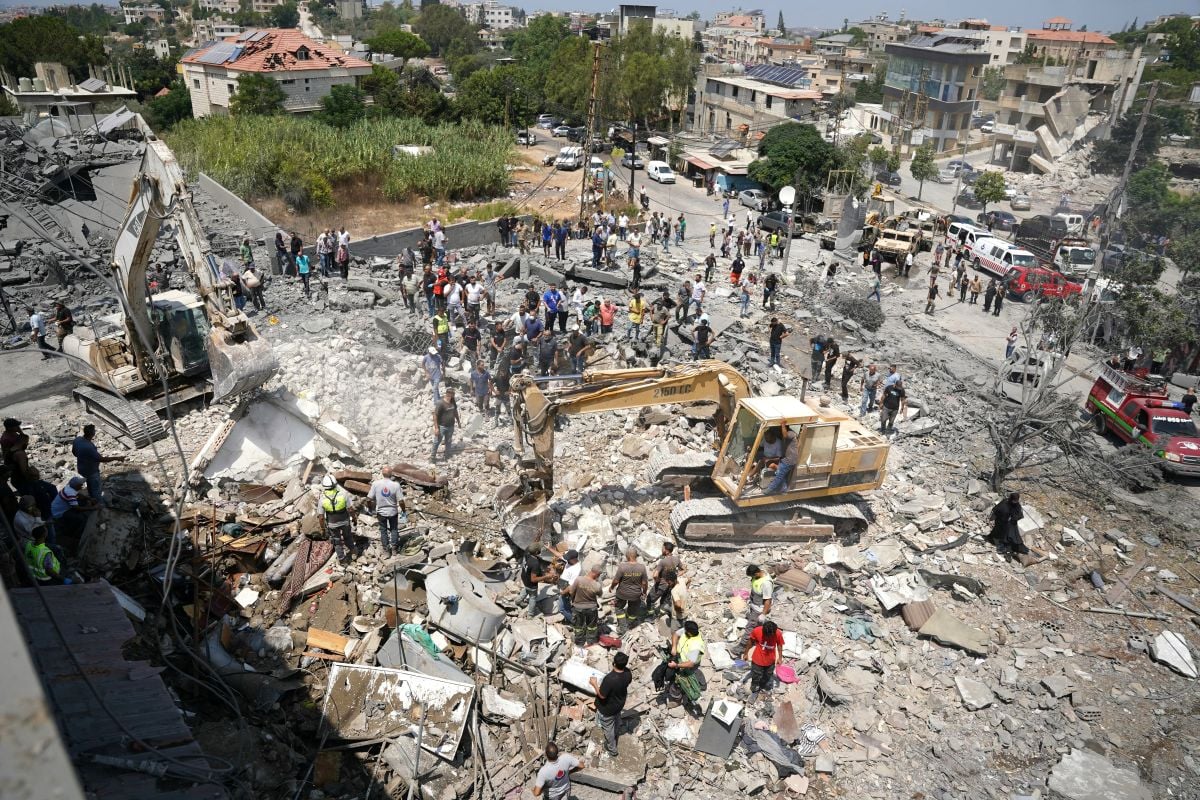
Construction machinery, rescue workers and residents search the site of an Israeli airstrike that targeted a neighborhood in Deir Zahrani, southern Lebanon, Aug. 15, 2026. (Credit: Abbas Fakih/AFP)






BEIRUT — Following the deadly Israeli escalation in southern Lebanon, which killed 11 people, including women and children, Israel on Sunday threatened to repeat its attacks and said it had killed two Hezbollah operatives in its strikes: one from the Badr unit in Deir Zahrani and another from the al-Radwan unit in Ansar.
Israeli Defense Minister Israel Katz stated on X that Israel would settle accounts with its "enemies on all fronts.” “No debt will go unpaid, on any front. We will forcefully defend our soldiers and our citizens,” the minister wrote in a brief message on X.
Appearing to send mixed signals to its Israeli ally, Washington this time “placed full responsibility for Israel’s presence on Lebanese territory” on Hezbollah. “This is precisely why Hezbollah must be disarmed and dismantled,” said a State Department spokesperson, according to statements relayed by the Israeli media outlet I24News.
“Hezbollah has been the main obstacle to Lebanon’s economic recovery, the only stain on its international reputation, and the greatest threat to the country’s security and stability,” he said. Yet just a few days ago, the same State Department criticized remarks by Israel Katz in which he claimed that Israel would not “withdraw” from occupied territories in southern Lebanon, deeming such statements “inconsistent with the commitments made under the framework agreement” reached in June between Lebanon and Israel.
Moreover, the U.S. administration has reportedly “accepted Israel’s explanations regarding Hezbollah’s actions” that justified Saturday’s deadly strikes, according to Israeli media outlet Haaretz. According to the office of Israeli Prime Minister Benjamin Netanyahu, the escalation was in response to a “drone attack” against Israeli soldiers in southern Lebanon, in which three soldiers, including an officer, were seriously injured. The pro-Iranian Hezbollah party-militia, however, did not claim responsibility for any attacks.
The State Department further stated Sunday that Washington “will continue to support” the framework agreement, putting the onus on the Lebanese Army, whose entry into the “pilot zone” of Zawtar Gharbieh at the end of June was thwarted by the return of Israeli forces to the area. “The pilot zone process remains the only viable path to lasting peace and security for Lebanon and Israel. We look forward to the Lebanese Army completing security operations in the initial pilot zones, and once these operations are verified, the process will be expanded,” said the spokesperson. He added, “Disarming Hezbollah is an integral part of this process.”
Strategic Ali Taher ridge under Israeli fire
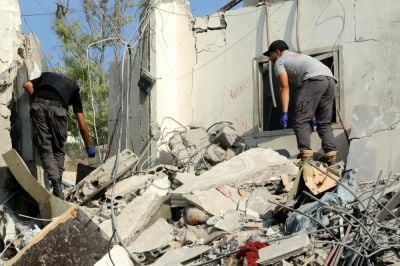
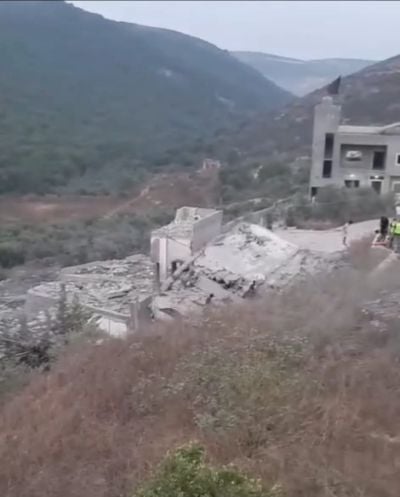
After announcing on Saturday that it had killed a senior member of the al-Radwan force in Ansar, the Israeli army on Sunday justified its deadly strike on a building in Deir Zahrani, which killed four people on Saturday morning, by saying it had targeted and killed Abu Hassan Alaa, a high-ranking commander of Hezbollah’s Badr unit, according to a statement by an Israeli army spokesperson on X.
According to available information, the Badr unit focuses on intelligence gathering and reconnaissance missions. For the Israeli army, his death “strikes a blow to the unit’s command capabilities.” He was targeted, the army wrote, “in response to the terrorist Hezbollah operation against Israeli army forces” on Saturday. Abu Hassan Alaa allegedly “took part in the implementation of numerous attack projects against Israeli forces” in southern Lebanon. “In recent years, this man has commanded several combat zones of the terrorist Hezbollah as part of clashes against Israeli army forces,” the army added.
In addition, Israeli forces concentrated their strikes from Saturday night into Sunday morning on the heights of the Nabatieh region, especially the strategic Ali Taher ridge that Israel is reportedly seeking to control, according to our correspondent in southern Lebanon.
The attacks also targeted a region farther south, on the heights of Jezzine district. The occupying forces, among other actions, fired white phosphorus shells on the heights of Ali Taher, conducted airstrikes there and fired machine guns from a helicopter. Late Sunday afternoon, the Israeli army resumed its attacks on these hills, dropping explosive materials on them.
In the same area, air raids targeted during the night Dohat Kfar Roummane and the Tahra and Dabsheh hills overlooking this village, with artillery fire coming from Habboush. The operations then extended into the so-called Jabal al-Rafii area, on the outskirts of Sojod, on the Rihan heights in Jezzine district.
Israeli attacks continued overnight in other sectors of southern Lebanon. At 1:40 a.m., fighter jets targeted an area between Qantara and Deir Siryan in Marjayoun district. Earlier, artillery fire hit the village of Mansouri, Wadi Zibqine toward Shehine (Sour district), as well as Wadi Hujeir on the outskirts of Touline (Marjayoun district). The Israeli army also carried out a explosion in the area between Kounin and Tiri, in Bint Jbeil district. In the early morning, it carried out a large-scale demolition in the village of Majdal Zoun, in the Sour district, according to our correspondent. In the same area, an Israeli Merkava tank fired several shells at the village of Mansouri (Sour district), while artillery fire reached Bani Hayyan (Marjayoun district).
Meanwhile, the municipality of Tayr Debba (Sour district) denied rumors circulating on social media that Israel had threatened to strike a house in the village, calling on residents not to be influenced by rumors and to rely on official sources.
Reporting contributed by our correspondent in the South, Muntasser Abdallah

