


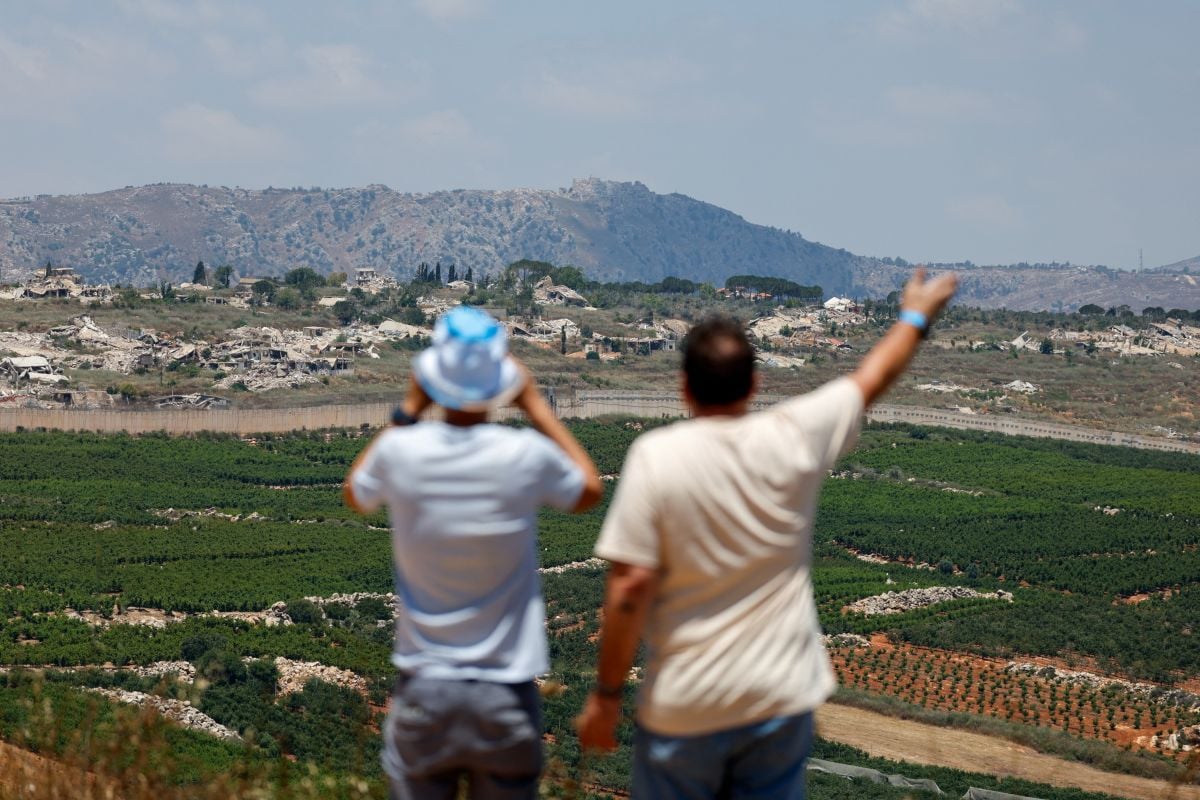
A person gestures near the Israel-Lebanon border as Israeli people look towards Lebanon, after the two countries signed a framework agreement following U.S.-mediated talks, in Metula Israel, June 27, 2026. (Credit: Amir Cohen/ Reuters)






BEIRUT — A video showing four women from the Israeli settler movement Uri Tzafon swimming in the Hasbani River in southern Lebanon has circulated widely on social media over the past 24 hours. It marks the second incursion this month by members of this far-right Israeli movement, which brings together several Israeli settler families and advocates for the establishment of settlements in Lebanon.
In a statement released Tuesday alongside the video, the movement said its "activists" remained in the area for about an hour, during which they walked around the river before swimming in it. It claimed that Israeli soldiers later arrived in a military vehicle and ordered them to leave. The group said its members complied before being stopped by Israeli police. Neither the Israeli military nor the police has publicly commented on the incident.
The movement justified the incursion by arguing that "the Hasbani River is located near the village of Ghajar, long divided by the former border, whose artificial separation was only recently abolished."
The group was referring to the northern part of Ghajar, which lies beyond the Blue Line but was effectively annexed by Israel in July 2023 after a fence was erected separating it from the rest of Lebanon. The village, which Israel occupied in the July 2006 war, straddles the U.N.-demarcated Blue Line (the de facto border between Lebanon and Israel) as well as the Israeli-annexed Syrian Golan Heights. The locality is disputed by Lebanon, Syria and Israel.
Uri Tzafon argued that "it is unacceptable that the adjoining river and the sources of the [Lebanese] Wazzani [River], which constitute an important source of the Hasbani, are not also open and accessible to Jews."
The incident comes as the Israeli army occupies more than 600 square kilometers of southern Lebanon, an area it describes as a "security zone," despite a fragile cease-fire. According to recent statements by Israeli Defense Minister Israel Katz, the area will be "cleared of its Lebanese residents."
Uri Tzafon — whose name means "Awaken, wind from the north" in Hebrew — seeks to push Israel's northern border to the Litani River, about 30 kilometers north of the Blue Line. Several figures on Israel's far right have advocated for the creation of settlements in Lebanon. In May, Israeli National Security Minister Itamar Ben Gvir said Israel had a "settlement plan for Lebanon."
However, this remains a minority position within Israel. Most Israeli officials maintain that Israel has no territorial ambitions in Lebanon and say the military occupation in the South is intended solely to ensure the security of residents in northern Israel.

 7 p.m. recap: Houthis strike Riyadh airport again; Yemeni forces claim Bab al-Mandeb gains; Abbas postpones Palestinian polls