






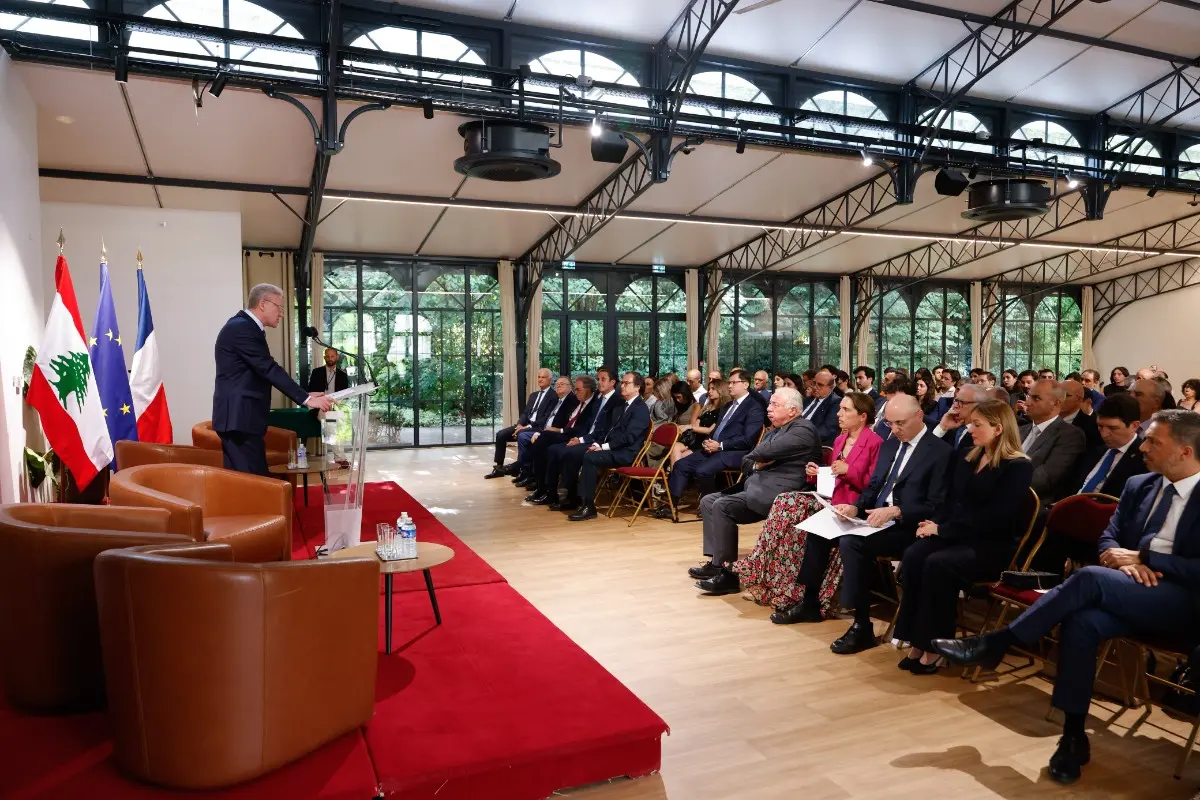
Foreign Minister Joe Rajji at a conference organized by the French Senate on July 16, 2026. (Credit: NNA)






Lebanese Foreign Minister Joe Rajji said Thursday that the government's decision to restore the state's monopoly on arms, notably through the disarmament of Hezbollah, was not dictated from abroad but reflected a national and sovereign will.
Rajji was speaking at a conference organized by the French Senate on the theme "Solidarity with Lebanon: Local Authorities at the Heart of the Franco-Lebanese Partnership," at the invitation of Senate President Gérard Larcher.
"The decision to end Hezbollah's military presence was not a response to external pressures nor the result of diplomatic negotiations, but the expression of a purely national will and a deep conviction: The state cannot fully regain its credibility and prestige as long as armed organizations operate outside its constitutional authority," the minister said.
"Lebanon has chosen to rebuild a fully sovereign state whose authority is free of ambiguity, a state that alone holds the decision over foreign policy and national security and that alone exercises the right to use legitimate force. Lebanon no longer acts in response to constraints imposed by circumstances, but according to a clear vision that considers sovereignty indivisible, that national decision-making cannot be delegated, and that the monopoly on legitimate force can belong only to the state," he said.
"This choice requires courage and sometimes calls for difficult decisions, but it is an irreversible choice, for it expresses a deep desire of the Lebanese to reclaim their state: a state that is no longer a stage for settling others' conflicts, nor an advanced defensive line serving external interests, nor a bargaining chip used during discussions held far from Beirut," he continued.
"We therefore welcome any partner who contributes to strengthening the Lebanese state, and we reject anyone who seeks to take its place. Decisions relating to war and peace, national security and foreign policy are today made in Beirut, and in Beirut only," the minister added.
Rajji also described as "courageous and historic" the Lebanese government's decision to reject the path of war and engage in direct negotiations with Israel, which are currently underway in Rome, "with the aim of transforming the current fragile ceasefire into a more lasting cessation of hostilities agreement, ultimately leading to an Israeli withdrawal from the territories occupied by its army in southern Lebanon."

 8 p.m. recap: Israel again threatens Beirut’s south suburbs; 2 ships hit near Hormuz; Riyadh football matches canceled