


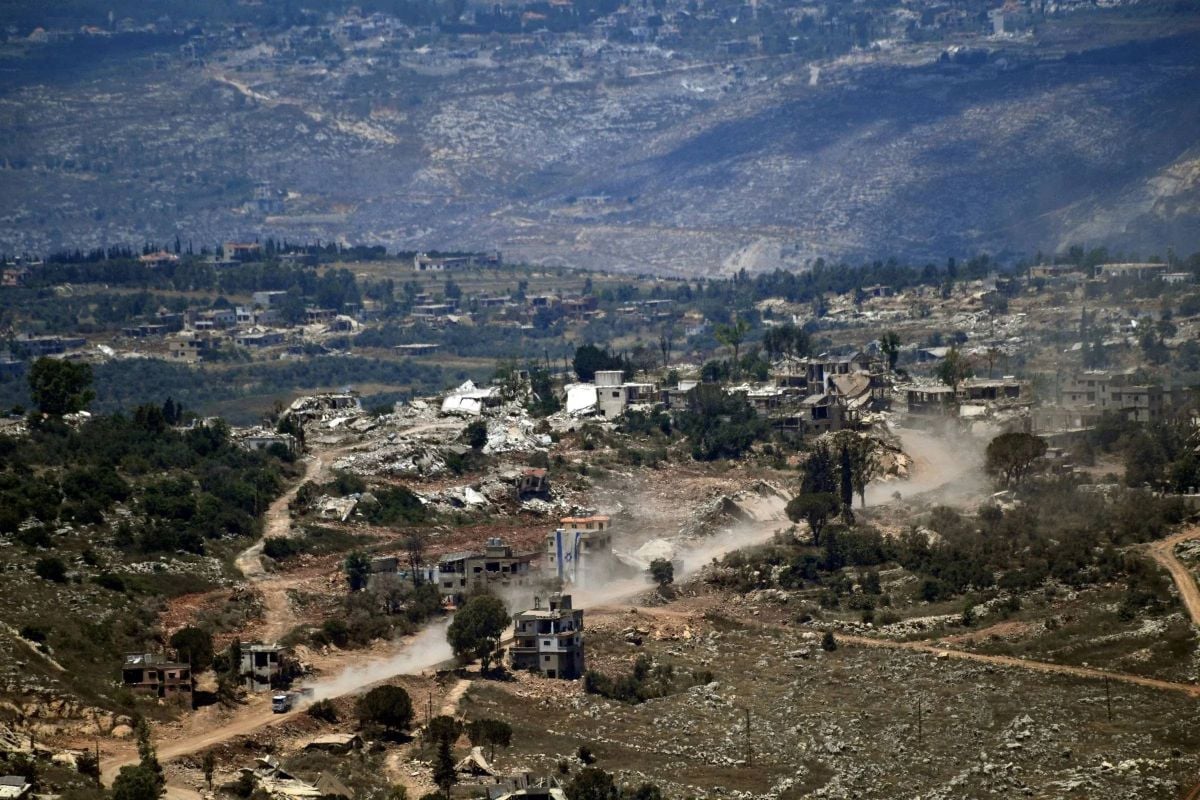
Israeli military vehicles and an Israeli flag are seen in a village in southern Lebanon near the border, as viewed from northern Israel, on June 18, 2026. (Credit: Gil Eliyahu/Reuters)






SOUTH LEBANON — The “Gathering of the People of the Southern Border Villages” issued an open appeal on Monday addressed to the Lebanese president, Lebanese officials, international bodies, and humanitarian organizations, calling for urgent action over what it described as the ongoing destruction of border communities in southern Lebanon.
The appeal comes as the Israeli army continues its demolition campaign in the South, blowing up houses and across Marjayoun and Bint Jbeil districts.
In its statement, the group said: “What is happening in the border villages can no longer be ignored,” accusing Israel of continued “bulldozing, destruction, demolition, and burning” affecting homes, public and private institutions, infrastructure, cultural and historical sites, agricultural lands, and natural resources.
The group also said the situation has resulted in “environmental and soil pollution, demographic changes, and the alteration and erasure of the geographic and topographic features, identity, landmarks, and maps of these villages.”
The statement warned against reports and concerns regarding the creation of a buffer zone, settlements, or a prolonged military presence. It also said that “the current situation gives the impression that the war has ended, while the existence of a border strip containing more than 60 fully occupied villages is gradually being forgotten.”
On April 19, the Israeli army outlined the parameters of an “advanced security zone” it intends to impose in south Lebanon before a permanent cease-fire. According to L’Orient Today's data, the area spans around 602 square kilometers, roughly 5.8 % of Lebanon’s territory, and includes 62 towns and villages. The plan effectively bars residents from returning home to these areas.
Calling on Lebanese authorities, the United Nations, and international organizations to intervene, the group demanded action to stop what it called “this unprecedented devastation, which is taking place before the eyes and ears of the entire world.”
The appeal called for the withdrawal of Israeli forces, the return of residents to their villages, reconstruction efforts, compensation for affected people, and housing assistance for displaced families.
“Since the Israeli enemy claims that its withdrawal depends on the villages being free of weapons and armed groups, we hold it to the same condition it has imposed: it must withdraw from the border villages it occupies, because these villages are free of weapons and armed personnel," the statement said.
The group proposed that the Lebanese Army enter the occupied border villages following a withdrawal, saying the process should begin “from the south toward the north” with a gradual transfer of security responsibilities alongside the return of residents and reconstruction.
Pilot zones are designated gradual test areas in south Lebanon where the Lebanese Armed Forces (LAF) deploy to exercise exclusive control, replacing occupying Israeli forces. These zones prohibit all armed groups (including Hezbollah) to operate there.
The group also appealed directly to president Joseph Aoun, stating: “As the person constitutionally authorized to negotiate with the enemy, [he should] immediately halt these negotiations if the enemy does not commit to stopping all acts of bulldozing, burning, and demolition.”
"Every hour of delay in this action means further erasure of these villages from the land and map of Lebanon," the statement concluded.
On June 26, 2026, Lebanon, Israel, and the United States signed a 14-clause Trilateral Framework Agreement in Washington, D.C., aimed at restoring Lebanese state authority, disarming non-state armed groups (including Hezbollah), and achieving a sequenced withdrawal of Israeli forces from southern Lebanon.
However, Israel continues to occupy a significant portion of southern Lebanon, and is maintaining a "buffer zone." While negotiations and framework agreements for the gradual deployment of the Lebanese Army are underway, border towns in the Bint Jbeil and Marjayoun districts continue to face airstrikes and systematic demolitions. Overnight, the Israeli army bombed several buildings in southern Lebanon in the districts of Bint Jbeil and Marjayoun. Explosions were heard in the town of Bint Jbeil and in Haddatha, where houses were also set on fire. A large explosion took place between Deir Siryan and Qantara.
Negotiations between Lebanon and Israel are scheduled to take place in Rome on Wednesday and Thursday.

 7 p.m. recap: Sharaa in Riyadh; Qassem signals openness to cooperation; Ben-Gvir: ‘We demolish, again and again’