






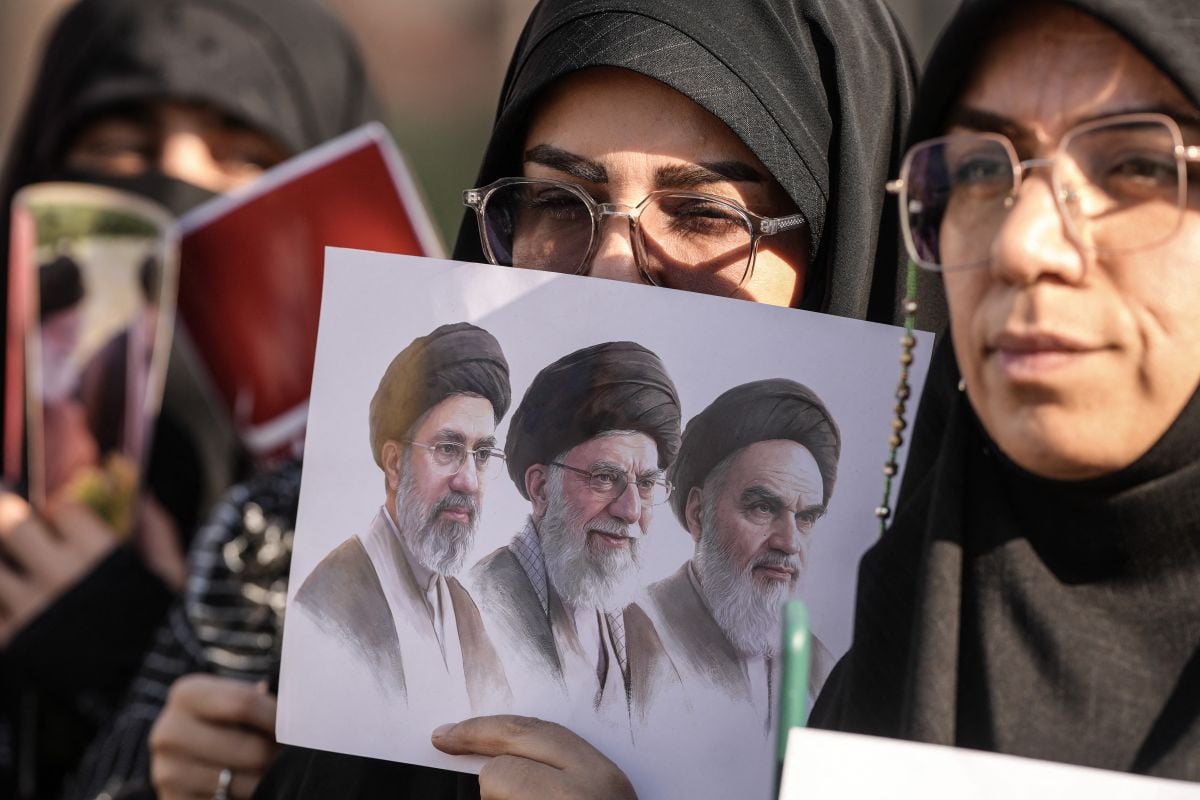
Mourners hold up a poster depicting (from right to left) the founder of the Islamic Republic, Ayatollah Ruhollah Khomeini, the slain Supreme Leader, Ayatollah Ali Khamenei, and the current Supreme Leader, Mojtaba Khamenei, during Ali Khamenei's funeral procession in Najaf, Iraq, on July 8, 2026. Photo Qassem al-Kaabi / AFP Mourners hold a placard depicting (from R) the late founder of the Islamic Republic, Ayatollah Ruhollah Khomeini, slain supreme leader Ayatollah Ali Khamenei, and current supreme leader Mojtaba Khamenei during a funeral procession for Ayatollah Ali Khamenei in Najaf on July 8, 2026. Crowds thronged the streets of Najaf on July 8 as the coffin of Khamenei moved through the holy city in a procession devoted to Iraq, home to Shia Islam's most sacred shrines. Iran began six days of public funeral ceremonies for Khamenei on July 4, including a dedicated day to neighbouring Iraq, a Shia powerhouse with close ties to Tehran. (Photo by Qassem al-KAABI / AFP)






Iran’s ambassador to the United Nations, Amir Saeid Iravani, warned that his country would no longer consider itself bound by the memorandum of understanding concluded in June between Iran and the United States if Washington “continues to fail to meet its obligations,” according to state television.
Ayatollah Mojtaba made the remarks in a written message dated Friday but released Saturday, speaking publicly for the first time since the state funeral of his father and predecessor, Ali Khamenei, who was buried Thursday.
U.S. military ‘ready’
“I say to our martyred leader that we swear to avenge his pure blood and that of all the martyrs of these two wars,” Mojtaba Khamenei wrote. Appointed supreme leader in March, he has not appeared in public since then. “This revenge is the will of our nation, and it must inevitably be carried out.” “These criminals, whose names appear on a list, will go to their graves still wishing for a peaceful death in their beds,” he added.
On Friday, Donald Trump accused Iran of plotting to assassinate him, returning to his hard-line rhetoric by once again vowing to annihilate the country.
“The U.S. military is ready … for a period of one year, which could be extended, to decimate and completely destroy all regions of Iran,” the U.S. president wrote on Truth Social. He added that “1,000 missiles” were “aimed at the Islamic Republic,” with “thousands more” available. The tougher rhetoric followed this week’s exchange of strikes, which has since subsided.
Diplomatic maneuvering
The United States struck Iran on two consecutive nights beginning Tuesday after accusing Tehran of carrying out attacks on three commercial vessels in the strategic Strait of Hormuz, through which one-fifth of global hydrocarbon trade passed before the war. According to Iran’s Health Ministry, 17 Iranians were killed and 115 wounded.
While Washington says it targeted military sites, Tehran accuses the United States of also striking civilian infrastructure to prevent Iranians from attending Khamenei’s funeral. Iran, for its part, targeted Kuwait, where at least one person was injured, as well as Bahrain and Qatar.
Mohammad Bagher Zolghadr, head of Iran’s Supreme National Security Council, warned Friday that his country would respond to “any attack” on its infrastructure, including by targeting Israel.
As both sides hardened their rhetoric, mediators continued efforts to revive diplomacy.
A Qatari delegation arrived in Iran on Friday, according to a local media outlet. On Saturday, Iranian Foreign Minister Abbas Araghchi met with his Omani counterpart, Badr al-Busaidi, to discuss the Strait of Hormuz, according to Araghchi’s office.
According to Axios journalist Barak Ravid, Qatari officials are also participating in the talks in Muscat, where negotiators could announce the opening of a “middle corridor” through international waters in the strait.
Donald Trump has agreed to continue talks, despite saying the ceasefire was “over.” A source close to the Iranian negotiating team told the Fars news agency that one of the issues still to be resolved was “transit through the Strait [of Hormuz] under the conditions sought by Iran.”
Tehran blocked the strait in response to the U.S.-Israeli attack on Iran on Feb. 28 that triggered the war. It now allows only a single shipping lane along its coastline and rejects any return to the prewar situation, when passage was free, even though the law of the sea guarantees unimpeded freedom of navigation.
According to Axios and Politico, Washington informed Tehran that it had until Saturday to publicly commit to no longer attacking ships in the Strait of Hormuz.

 8 p.m. recap: Israel again threatens Beirut’s south suburbs; 2 ships hit near Hormuz; Riyadh football matches canceled