







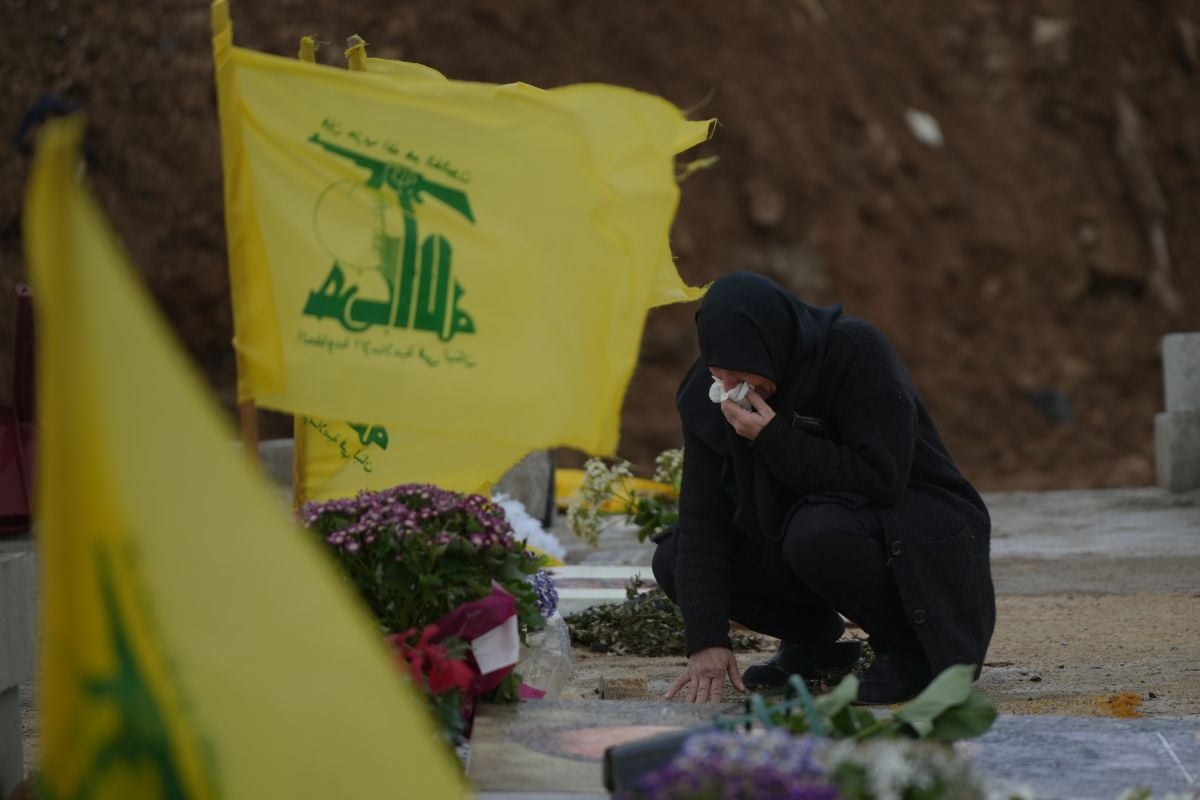
A woman weeping on the grave of a Hezbollah member, in a temporary cemetery in Choueifat, south of Beirut, on March 29, 2026. (Credit: Archive photo Mohammad Yassine/L’Orient-Le Jour)






BEIRUT — After the war with Israel ended, Hezbollah started searching for the remains of its fighters in the hardest-hit areas, two sources affiliated with the party told L'Orient-Le Jour.
Because many of the bodies could not be recovered immediately — particularly in areas heavily bombed or occupied by the Israeli army — they decomposed, making identification difficult.
The party launched a large-scale DNA identification operation "some time ago," without specifying either the number of bodies involved or the number of tests already carried out.
"This is a routine procedure. Israel used very powerful weapons. When residents returned to their villages after the war, they did not recognize some bodies. Some remains were found in an advanced state of decomposition. DNA tests are therefore carried out to identify the individuals before the funerals," a Hezbollah spokesperson told L'Orient-Le Jour. He also noted that bodies "that are not very damaged" are not subjected to these tests.
Access to bombed regions
A source within the Islamic Health Committee, affiliated with Hezbollah, confirmed that recovery and identification operations are underway. "With the end of the war, we were able to access regions we couldn't reach during the Israeli bombardments, like Nabatieh and its surroundings, Mayfadoun, or Shoukin (Nabatieh). We're clearing the roads and recovering the remains," the source explained, emphasizing that these operations are conducted with several laboratories in coordination with the Ministry of Health. According to the source, DNA analysis is performed when the state of the remains does not permit visual identification before returning them to families and burying them.
Contacted by L'Orient-Le Jour, the Health Ministry was not immediately available for comment.
The identification operations are part of ongoing searches since the cease-fire with Israel took effect, despite Israel's daily violations of the agreement. In recent days, Hezbollah has buried dozens of its fighters each day.
This is not the first time Hezbollah has relied on DNA testing. Following the 2024 war with Israel, Hezbollah launched a large-scale operation to recover and identify the remains of its members.
Because many bombed areas were inaccessible during the fighting, numerous bodies remained trapped under the rubble for weeks, making identification impossible without genetic analysis. According to the daily al-Akhbar, more than 1,000 DNA tests were carried out to identify bodies or human remains that were recovered.
