


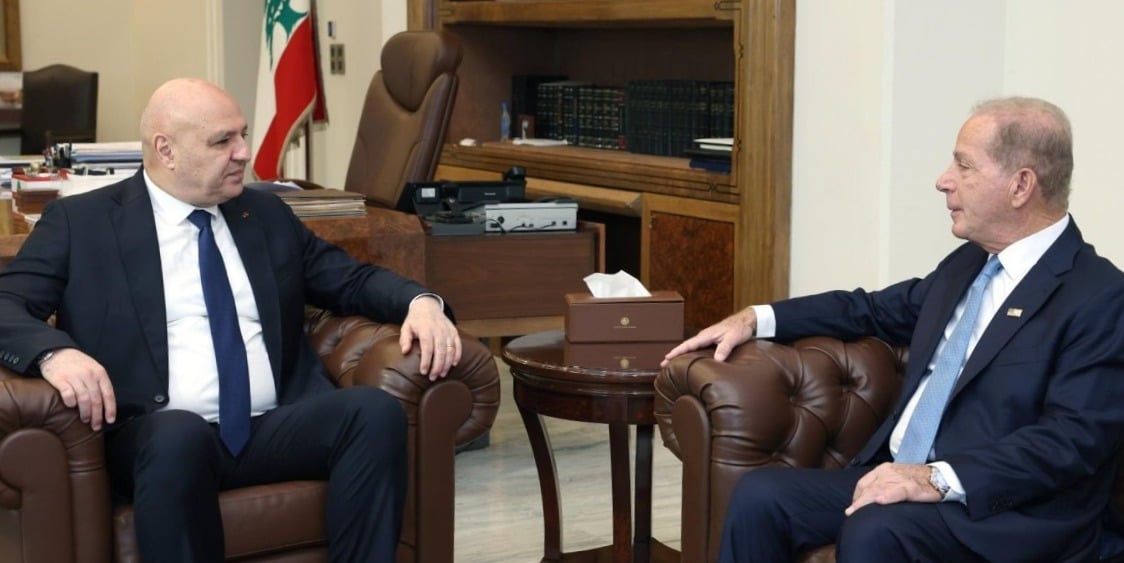
The United States ambassador to Lebanon, Michel Issa (on the right), received by President Joseph Aoun, at Baabda Palace on July 9, 2026. (Credit: NNA)






BEIRUT — The United States was at the center of a flurry of diplomatic activity in Beirut on Thursday. President Joseph Aoun received U.S. Ambassador to Lebanon Michel Issa, who said the president's visit to Washington later this month "reflects President [Donald] Trump's interest in Lebanon and his desire to promote security and stability there, as well as to end the suffering of the Lebanese people."
In a separate interview with the pan-Arab daily Asharq al-Awsat, published Thursday, Aoun reiterated that he had "no choice but to seek U.S. assistance" in an attempt to put an end to the war in Lebanon, once again defending the direct negotiations with Israel, conducted under Washington's auspices, whose next session is scheduled to take place in Rome on July 14 and 15.
Issa also met with Prime Minister Nawaf Salam and Parliament Speaker and Hezbollah ally Nabih Berri.
As the memorandum of understanding signed in mid-June between the United States and Iran — whose first article provides for a cease-fire in Lebanon — appears increasingly fragile, an Iranian delegation led by Deputy Foreign Minister Vahid Jalalzadeh met with Deputy Prime Minister Tarek Mitri and discussed "the future of the Iran-U.S. agreement and its regional consequences, particularly for Lebanon," according to the state-run National News Agency (NNA).
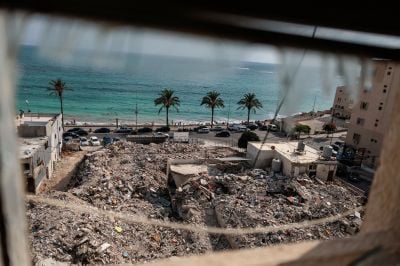
'No vacuum' in the 'pilot zones,' says Issa
Speaking from Baabda, Issa said that "preparations are underway" to implement the provisions of the framework agreement concluded on June 26 between Israeli and Lebanese officials in Washington, and that a U.S. military delegation would arrive "in the coming days in Beirut" to coordinate the practical arrangements for its implementation. "It is essential that no vacuum be created as Israeli forces withdraw from the areas concerned," he stressed, adding that the date for the start of implementation would be determined after the planned coordination meetings with the U.S. military.
Under the framework agreement reached during the fifth round of direct talks between Lebanon and Israel, the Lebanese Army is to deploy to two "pilot zones," around Froun (Bint Jbeil district, in the central sector) and the village of Zawtar (eastern sector, north of the Litani River), in parallel with the Israeli withdrawal, and dismantle Hezbollah's infrastructure there.
Regarding the new round of negotiations, scheduled to take place in Rome on July 14 and 15, the ambassador said the choice of venue was for "purely technical reasons related to the travel" of the various delegations. Lebanon had initially rejected the idea of holding negotiations with Israel outside Washington, fearing this would give Tel Aviv greater leeway to increase its demands and pressure. Beirut ultimately agreed after receiving U.S. assurances confirming Washington's participation in the talks and the continuation of its role as mediator and sponsor of the negotiation process.
According to Issa, the meeting in Rome will primarily focus on organizational and operational matters and is expected to lead to the creation of "specialized working groups tasked with implementing the agreed arrangements, which may require the involvement of legal or technical experts depending on the issues being addressed," he said. Several additional sessions will then be held "in Rome or other capitals" to continue the discussions, Issa added.
During his meeting with Salam, the ambassador discussed the initial stages of the Israeli withdrawal from the pilot zones in the south, ahead of the deployment of the Lebanese Army. According to our information, Beirut made Israel's withdrawal from the two designated "pilot zones" a condition for holding the talks in Rome.
Aoun looks to Washington as Rajji and Mitri insist on Lebanon's sovereignty
During his meeting with the U.S. ambassador, President Aoun stressed the need to "consolidate the cease-fire in southern Lebanon and pressure Israel to end its military operations and comply with the provisions" of the framework agreement. He also called on Israel to "put an end to the bombardments and demolition operations" in the occupied localities of southern Lebanon.
In his interview with Asharq al-Awsat, the president said he "wants the U.S. administration to help us recover all of our territory." "There is no need to stress how important it is for us to maintain good relations with the United States and to make the most of President Donald Trump's stated willingness to help us," he said. At a time when the Israeli army refuses to withdraw from the nearly 620 square kilometers it occupies in southern Lebanon, Aoun said he wanted to "present the reality on the ground in southern Lebanon" to the U.S. president, as well as the "risks of maintaining the current situation or returning to escalation."
For his part, Lebanese Foreign Minister Joe Rajji wrote, following a meeting in Nicosia with Cypriot President Nikos Christodoulides, that the framework agreement "has demonstrated to everyone, and first and foremost to Iran, that the negotiations are exclusively Lebanon's responsibility and can only be decided by the Lebanese state," in a message posted on his X account. "I also stressed that the state remains firmly committed to pursuing this path," he said. The Cypriot president, meanwhile, said that "Lebanon is enjoying, perhaps for the first time in fourteen years, remarkable international attention," and "urged the Lebanese not to let this favorable opportunity pass," according to Raggi's post.
In Beirut, Mitri emphasized during his meeting with the Iranian delegation Lebanon's desire "to free itself from any occupation or hegemony." The Iranian deputy foreign minister also delivered to Berri a message from Iranian President Massoud Pezeshkian and Iranian Foreign Minister Abbas Araghchi, stressing that "Iran continues to stand by Lebanon." As of late afternoon, Jalalzadeh had not met with either Aoun or Salam.
