






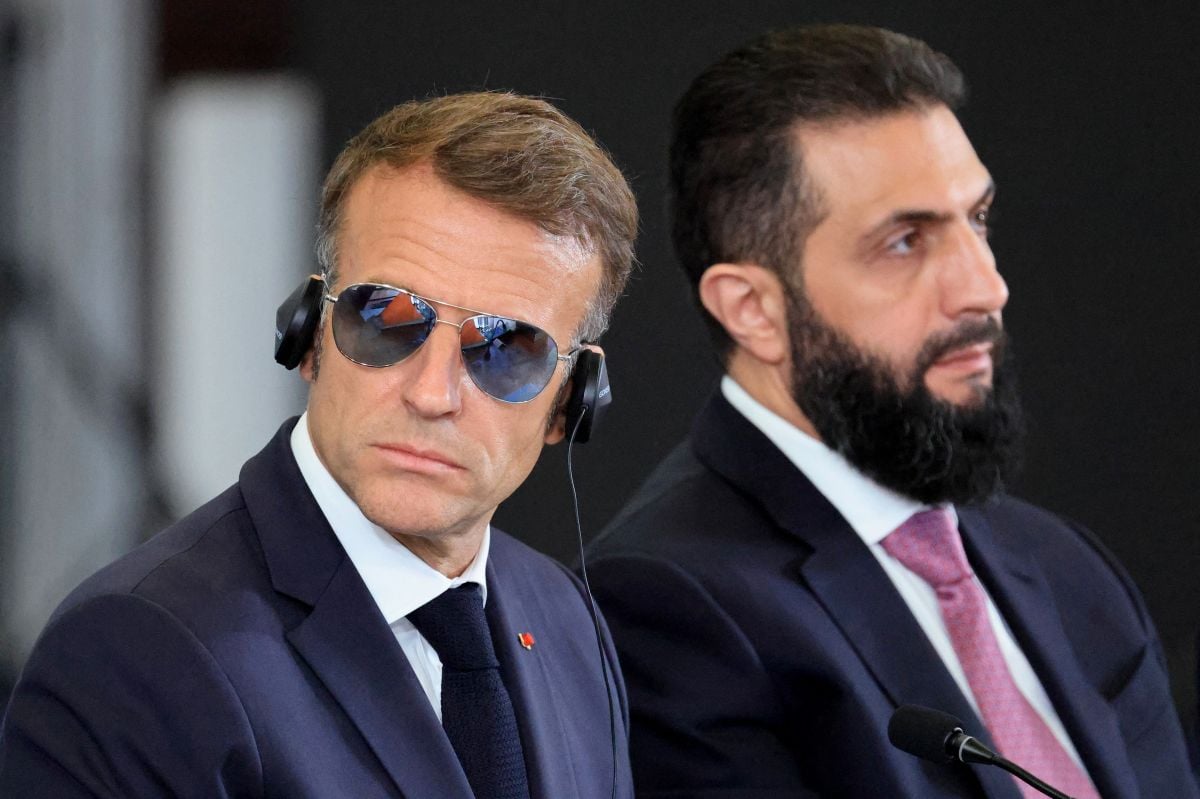
French President Emmanuel Macron (left) listens to the translation, alongside Syrian President Ahmad al-Sharaa, as he takes part in the economic forum dedicated to the reconstruction of Syria and strategic corridors, in Damascus, on July 7, 2026. (Credit: Ludovic Marin/AFP)






BEIRUT — Syrian President Ahmad al-Sharaa and French President Emmanuel Macron on Tuesday said they want to see Syria regain its role as a regional energy and logistics hub, highlighting the country's strategic importance following the disruption of shipping through the Strait of Hormuz.
Their discussions also focused on Israeli violations and the presence of Israeli troops in southern Syria, as well as the situation in Lebanon, with Sharaa reaffirming his support for Lebanese sovereignty and state institutions.
The two heads of state also announced the opening of a new phase in relations between their countries, with the conclusion of an agreement providing for the appointment of ambassadors by both sides and a commitment to expand political, economic and security cooperation following their talks in Damascus.
Opening an economic forum at the presidential palace alongside Macron, Sharaa said he hoped France would become Syria's "first partner" in the country's reconstruction.
"The Hormuz crisis has underscored the importance of Syria's geography, which gives it a vital role as an indispensable crossroads for global corridors," the Syrian president said.
"We want France to be our first partner on this journey."
"The strategic partnership we are laying the foundations for today with France — from the development of ports and air transport to the energy, water and healthcare sectors — is the model we seek for our relations with Europe and with the rest of the world," Sharaa added.
"After 14 years of war, Syria faces multiple challenges in terms of stabilization and reconstruction, and the opportunities and interests of French companies are aligned with those challenges," Macron said, speaking alongside a delegation of French business leaders.
France returns to Syria, with Lebanon in the background
Beyond reconstruction, the French president said one objective of the partnership was "to make Syria, over the long term, a regional hub where new logistics chains, energy routes and data corridors can be developed," helping reduce the risks posed by geopolitical crises such as those affecting the Strait of Hormuz, which Iran closed during its war with the United States.
Among the French executives accompanying Macron were Rodolphe Saadé, chairman and CEO of global shipping giant CMA CGM, and Patrick Pouyanné, CEO of TotalEnergies. Several agreements were signed during the visit.
"What we ask of you today is to build and develop genuine, organic partnerships with the Syrian private sector," Sharaa said, expressing hope that the visit would mark the beginning of a new phase of economic cooperation between Syria and France.
Israeli attacks 'not acceptable'
During a press conference with his Syrian counterpart, Macron said it was "necessary that a genuine state of law succeed dictatorship" in Syria, where an Islamist coalition has been in power since the fall of Bashar al-Assad in late 2024.
This "will allow the construction of a new Syria and its prosperity," he added, saying he stood alongside him to "express our confidence in the Syrian people and in your work to bring peace, security and prosperity."
He also said that the two bomb attacks that took place in Damascus during his visit should not "destabilize" Syria, calling for "continued firmness on security."
"I think we must both stand alongside those who were injured, continue to be uncompromising on security — and you are doing so here — but we must not allow ourselves to be destabilized regarding the importance of the path we are on. So we move forward," the French president said alongside his Syrian counterpart, who praised his "courage" for maintaining his visit despite the explosions.
On the regional level, the Syrian president called on France to play an "active role" in ending "systematic Israeli aggressions" in Syria since the fall of the former regime. He condemned continued Israeli violations in the south of the country, saying they "undermine the security and stability of the entire region," and reaffirmed the need for Israel to withdraw from occupied territories.
According to him, lasting regional stability requires "Israel’s respect for the 1974 disengagement agreement as well as its withdrawal from the areas occupied since Dec. 8," following the fall of the Assad regime, according to the official Syrian news agency Sana.
Israeli forces had crossed the 1974 cease-fire line between the occupied Golan Heights and Syria, entering the demilitarized zone monitored by the United Nations. They have since established nine permanent bases in the area.
Macron, for his part, said that Israeli "incursions," "interference" and "strikes" in neighboring countries were "not acceptable."
Speaking about Lebanon, the Syrian president said Syria and France shared support for Lebanese sovereignty and state institutions.
"Syria’s stability is inseparable from Lebanon’s, and vice versa," he said, adding that Damascus was working to secure the shared border with Lebanon while supporting the Lebanese state and its legitimate institutions, enabling them to strengthen their authority and effectively address the challenges facing the country.
The French president also announced that his country would return to the Syrian people more than 50 million euros in assets seized by French courts from the ill-gotten wealth of Rifaat al-Assad, uncle of ousted President Bashar al-Assad.
"More than 50 million euros in assets illegally acquired by the family of the former dictator ... will be returned to the Syrian people to finance concrete development projects in the country," Macron said. The document signed by the foreign ministers of the two countries mentions the sum of 51 million euros.
The Syrian and French presidents finally announced, following their talks, the opening of a new phase in Franco-Syrian relations. They agreed to appoint ambassadors to their respective countries and pledged to strengthen political, economic and security cooperation.
The French Embassy in Damascus closed in 2012, one year after the outbreak of the Syrian conflict. Following Bashar al-Assad’s fall and Sharaa’s rise to power at the end of 2024, Paris appointed a chargé d’affaires without reopening the embassy.
