


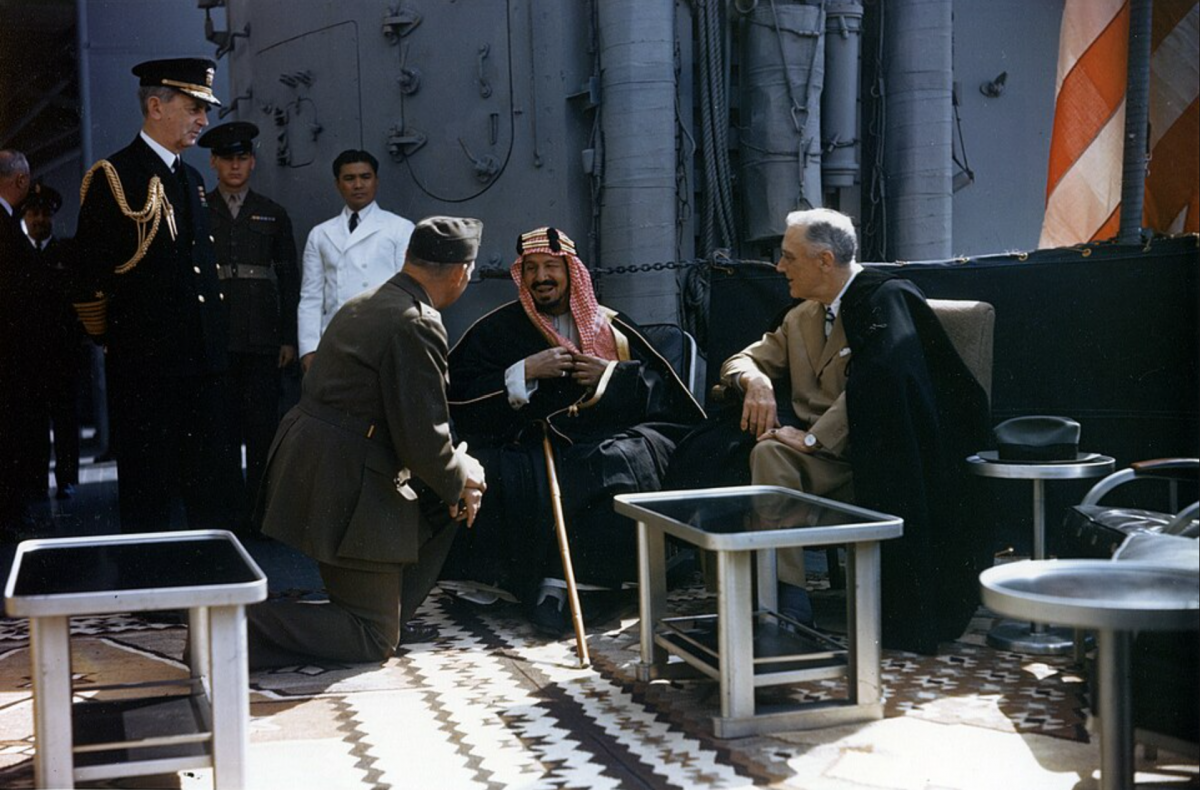
Then American President Franklin D. Roosevelt meets Abdulaziz Ibn Saud aboard the USS Quincy (CA-71) on the Great Bitter Lake, on Feb. 14, 1945. (Credit: U.S. Navy photo)






At the end of the 18th century, American ships crossing the Mediterranean encountered the corsair states of North Africa — Algiers, Tunis, Tripoli and Morocco — which had long imposed tribute payments on European powers in exchange for safe passage. At first, like the Europeans before them, Washington paid. The young republic negotiated, dispatched envoys, paid tribute and tried to protect its trade through diplomacy. Thomas Jefferson, who had long opposed this practice, inherited the issue upon becoming president.In 1801, Tripoli declared war on the United States following a dispute over these payments. For the young American power, the conflict remained limited in scale but considerable in symbolic significance. It was one of the first times the United States projected its power far from its shores. This war gave rise to one of the...
At the end of the 18th century, American ships crossing the Mediterranean encountered the corsair states of North Africa — Algiers, Tunis, Tripoli and Morocco — which had long imposed tribute payments on European powers in exchange for safe passage. At first, like the Europeans before them, Washington paid. The young republic negotiated, dispatched envoys, paid tribute and tried to protect its trade through diplomacy. Thomas Jefferson, who had long opposed this practice, inherited the issue upon becoming president.In 1801, Tripoli declared war on the United States following a dispute over these payments. For the young American power, the conflict remained limited in scale but considerable in symbolic significance. It was one of the first times the United States projected its power far from its shores. This war gave rise to one of...

 7 p.m. recap: Netanyahu seeks mastermind behind Flydubai incident; Washington sanctions 2 French nationals; Ben Gvir's 'I want to kill you' threat
