


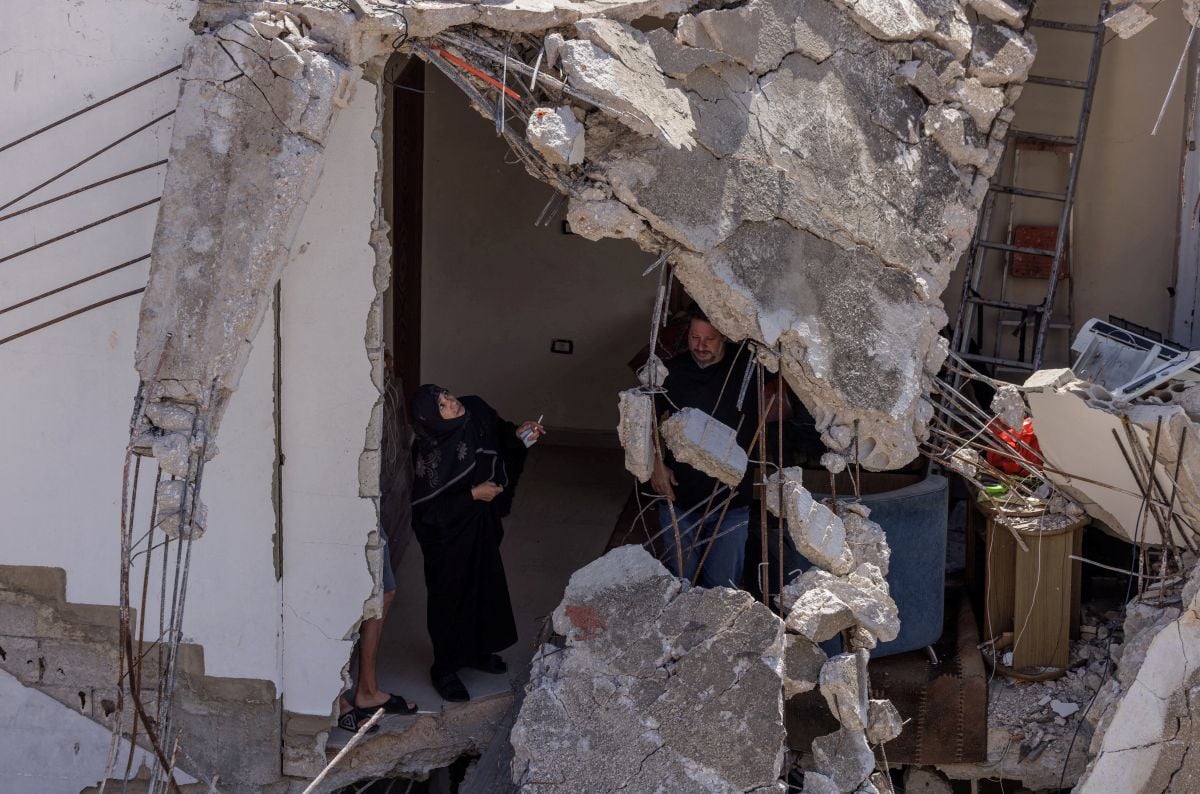
Akarem Chakaron, 61, a forcibly displaced Lebanese woman who survived an Israeli airstrike on her home while she was inside, looks up at the destruction as she stands in what she says is the living room of her damaged house after returning to Nabatieh following the U.S.-Iran deal, in Nabatieh, Lebanon, June 24, 2026. (Credit: Zohra Bensemra/Reuters)






BEIRUT — The framework deal signed between Israel and Lebanon last month “threatens to betray war crimes victims in Lebanon,” Human Rights Watch said in a report Friday.
“Parts of the text appear to be aimed at preventing victims of serious international crimes from seeking justice before international forums. Others seem to acquiesce to the prolonged and indefinite forced displacement of tens of thousands of residents of vast swathes of southern Lebanon occupied by Israeli forces,” Human Rights Watch said in the statement.
Israel and Lebanon signed the U.S.-brokered agreement on June 26 aimed at restoring control of the country to the Lebanese Army with a conditional, and far from guaranteed, Israeli withdrawal from southern Lebanon.
“Time and time again we have seen civilians in Lebanon pay the price for successive cycles of conflict and serious violations and crimes under international law with no accountability,” said Amnesty International’s Secretary General Agnes Callamard.
“Victims of war crimes and other violations deserve justice. Any agreement that fails to center their rights to justice, accountability, and reparations will falter underneath the very impunity it builds.”
“Not only does this agreement risk further entrenching impunity, but it includes a clause that signals that political expediency outweighs the fundamental rights of those who have suffered atrocious violations,” said Lama Fakih, program director at Human Rights Watch. “It risks denying justice to victims at a time when mounting evidence points to repeated unlawful Israeli attacks causing extensive civilian harm and widespread destruction.”
Since Oct. 8, 2023, Israel has killed more than 8,700 people, including at least 569 children and 357 medical workers, in Lebanon, based on data collected by Lebanon’s Health Ministry. Israel has also repeatedly targeted and killed journalists covering its war on Lebanon.
"Hundreds of thousands of people remain displaced in Lebanon following displacement orders issued by the Israeli military, which has also occupied nearly 600 square kilometers of Lebanon’s border villages, prohibiting residents from returning," the report said.
The deal includes a security annex outlining a progressive Israeli troop withdrawal, from "pilot zones" in southern Lebanon, with the Lebanese Army tasked with managing the areas and disarming Hezbollah.
The agreement has caused deep political divisions across Lebanon. It is actively supported by "sovereignist" factions as a path to peace and state authority, while the Hezbollah-Amal alliance, Parliament Speaker Nabih Berri, and many other parties, groups, and individuals categorically reject it, many warning it could lead to a form of civil strife.
For several weeks, the Lebanese authorities have been emphasizing the importance of direct negotiations between Israel and Lebanon to preserve the "cease-fire" and secure the Israeli withdrawal from the Israeli-occupied South.
Meanwhile, the Hezbollah-Amal alliance and its supporters maintain that the current cease-fire in Lebanon, however fragile, is the result of the Memorandum of Understanding signed between Iran and the U.S. due to Iranian pressure. They fully reject the U.S.-brokered talks between Lebanon and Israel, of which the resulting framework agreement has been critiqued by Human Rights Watch and five other human rights organizations for betraying the victims of Israel's war crimes.

 1 p.m. recap: Salam in Nabatieh; up to 10,000 more US troops heading to Middle East