






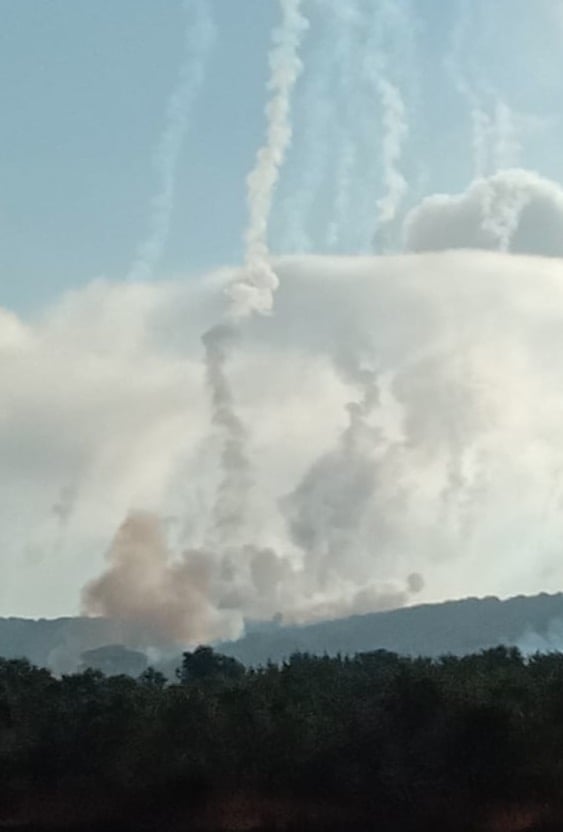
Smoke rises from Ali al-Taher Hill in Nabatieh after intense Israeli bombardment on Sunday, Aug. 31, 2026. (Credit: Muntasser Abdallah/L'Orient Today)






SOUTH LEBANON — Hezbollah on Friday denied Israeli allegations that it had captured the strategic Ali Taher mountain ridge south of Nabatieh, after an Israeli military spokeswoman announced the “takeover” of a position that had been at the center of fighting before last week’s cease-fire. Hezbollah said its fighters “remain deployed” in the area, implicitly responding to a New York Times claims that dozens of Hezbollah militants were trapped in tunnels beneath the mountain.
In a statement, Hezbollah “categorically denied” Israeli military claims that it had taken control of Ali Taher. The group said there was no Israeli military presence in the area, which remains “under the control of Hezbollah fighters.” It added that its fighters were “on maximum alert” and ready to “repel any attempt at advance or incursion” by Israeli forces.
Israel claims it seized Ali Taher
In a post on X, Ella Waweya, the Israeli military’s Arabic-speaking spokeswoman, said from what she described as a tunnel in Majdal Zoun, in the Sour district, that “the equation has changed. Ali Taher hill, where you were hiding, is now under the total control of our forces.”
“The base on this hill will no longer pose a threat to Israel,” she added.
Israeli media said that Hezbollah’s Badr unit operated from a network of tunnels beneath the heights. “This ‘impregnable fortress’ fell in a few days,” Waweya alleged.
According to our correspondent in southern Lebanon, Israeli forces remain positioned around the mountain, but there has been no confirmed information regarding the capture of the strategic ridge.
The Israeli invading troops have been trying for several weeks to seize Ali Taher after capturing Beaufort Castle. The hill holds both symbolic and strategic value. Located north of the Litani River, it overlooks much of southeastern Lebanon, including Beaufort Castle and the surrounding valley, as well as the Nabatieh district and even Iqlim al-Tuffah and the Rihan Heights in the Jezzine district.
The Israeli army has remained positioned around the hill since the cease-fire took effect last Saturday but has not attempted to advance farther. It has repeatedly prevented residents of nearby villages from approaching the area through strikes and gunfire.
Israel accuses Hezbollah of turning the hill and its surroundings into a military command center in southern Lebanon, outside the operational area of the U.N. Interim Force in Lebanon (UNIFIL) and beyond the zone where the Lebanese Army had begun disarming the group.
Israeli analysts cited by the New York Times claimed the tunnel complex beneath the hill was built with Iranian assistance over more than 20 years.
Fighters trapped without food or water, NYT says
Several Hezbollah fighters, including members of the elite Radwan force, are reportedly trapped in underground tunnels at the strategic Ali Taher Hill near Nabatieh, according to reports by The New York Times and Israeli media.
Cited by the Times, the Israeli army claims that "thousands" of its soldiers have surrounded a "Hezbollah underground fortress beneath the hills of southern Lebanon," trapping dozens of fighters who are reportedly running out of food and water.
"We assume they are trapped and looking for a solution," a military spokesperson said, adding that they are waiting to see whether the fighters "must fight us, surrender, or wait for a change in the situation, whether it be a cease-fire or an Israeli withdrawal."
According to Israeli media, contacts are underway to secure the fighters' safe exit, but the Israeli government reportedly opposes that option and would prefer their surrender. Israel considers the incident a way to clear the tunnels and the area of Hezbollah's military infrastructure. The fighters themselves reportedly prefer to remain underground while awaiting a solution.
Israeli truce violations: airstrikes and farmers kidnapped
Israeli fighter jets carried out strikes in the Nabatieh district for the first time since the cease-fire, as well as near Beit Yahoun in the Bint Jbeil district.
Several machine-gun attacks and artillery strikes were also reported across other parts of southern Lebanon, though no injuries were reported.
Separately, an Israeli drone dropped leaflets over the town of Mansouri in the Sour district, warning residents not to approach Israeli soldiers “so as not to put themselves in danger.”
In the eastern sector, Israeli forces detained eight farmers in Ain Arab in the Marjayoun district, including four Lebanese — Ali Ibrahim, his two sons Ahmad and Mohammad, and Ali al-Raja — as well as four Syrian nationals, our correspondent reported, citing local sources. They were released the next day.
A loud explosion was also heard in Ain Arab, though its cause remains unclear. It was not immediately known whether it resulted from the demolition of houses or another military operation. The incidents come amid heightened tensions in the border town following Israeli warnings to residents, repeated incursions and other military movements in the area in recent days

 8 p.m. recap: Israel again threatens Beirut’s south suburbs; 2 ships hit near Hormuz; Riyadh football matches canceled