



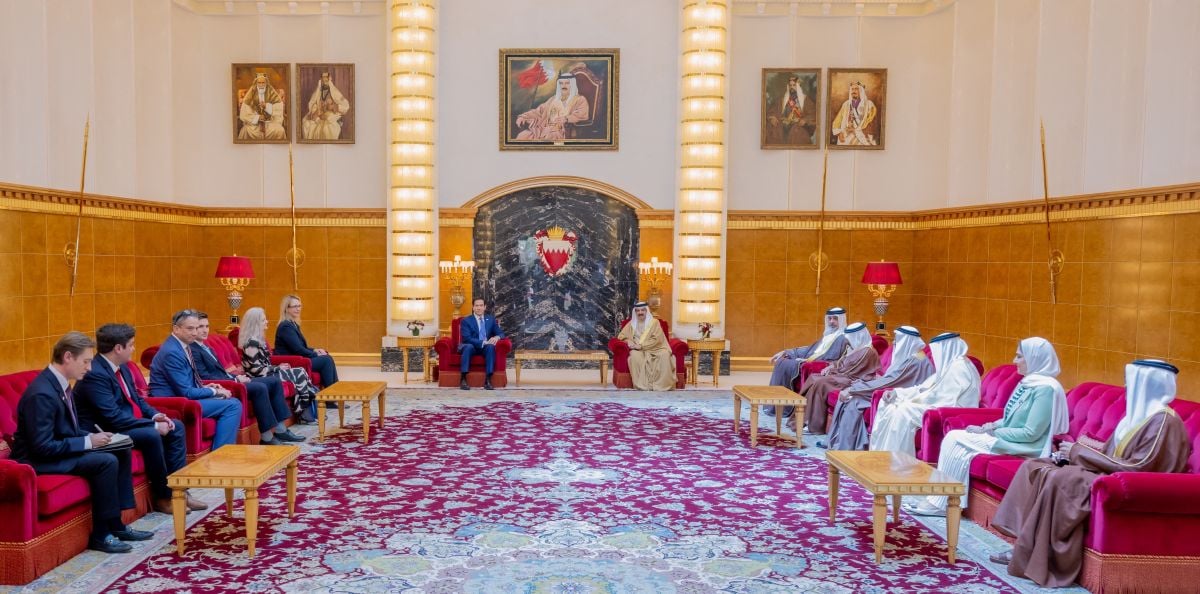
U.S. Secretary of State Marco Rubio meets with Bahrain's King Hamad bin Isa Al Khalifa at Al-Sakhir Palace in Zallaq, Bahrain, on June 25, 2026.(Credit: Bahrain News Agency/Reuters)






The United States and the Gulf Cooperation Council (GCC) countries reaffirmed Thursday in Manama their commitment to "the sovereignty, security, stability and territorial integrity of Lebanon," calling for the disarmament of non-state armed groups and welcoming ongoing negotiations between Beirut and Tel Aviv under U.S. mediation.
The joint ministerial meeting between the GCC and the United States was co-chaired by U.S. Secretary of State Marco Rubio and Bahrain's Foreign Minister Abdullatif bin Rashid Al-Zayani, the current chairman of the GCC Ministerial Council.
The meeting was attended by the foreign ministers of the Gulf countries, as well as GCC Secretary-General Jassem Al-Budaiwi.
In a joint statement, the participants applauded the bilateral talks between Israel and Lebanon, saying they aim to "create the necessary conditions for the conclusion of a lasting peace and security agreement between the two countries."
They stressed the need to "preserve the negotiation process and not link it to other conflicts."
The ministers also supported an "approach to restore security, expand the authority of the Lebanese state and demarcate permanent borders."
They said that "Lebanon's full sovereignty cannot be achieved as long as non-state armed groups retain military capabilities outside the authority of the state," calling for the disarmament of these groups and the restoration of the state's monopoly on force, while stressing the importance of supporting the Lebanese Army.
The Islamic Republic, Hezbollah's sponsor, has made the Lebanese issue one of the key points in its negotiations with the United States, while Lebanon and Israel are conducting their own direct talks under U.S. auspices in Washington.
On June 17, the United States and Iran signed a memorandum of understanding ending hostilities on all fronts in the region, including in Lebanon. The document states that both parties "are committed to guaranteeing Lebanon's sovereignty and territorial integrity."
The issue of Israeli withdrawal is also at the heart of discussions in Washington, notably with the proposal to create "pilot zones" from which Israelis would withdraw in exchange for the deployment of the Lebanese Army.
More broadly, the meeting in Manama focused on major regional issues.
The ministers praised the signing of the memorandum of understanding between the United States and Iran on June 17, while calling for continued negotiations to "prevent Tehran from acquiring nuclear weapons under any circumstances" and to contain "its ballistic activities, drones and support for proxy groups in the region."
They also stressed the strategic importance of the Strait of Hormuz, where freedom of navigation was described as "essential to regional and global security," rejecting any attempt to restrict or control maritime passage.
On Syria, the participants "expressed their support for the Syrian people to build a stable, safe, inclusive and sovereign state, fully integrated into its regional environment, and affirmed their commitment to Syria's sovereignty, unity and territorial integrity."
They called for a transition that includes the fight against terrorism, the restoration of public services and the voluntary return of refugees.
Regarding Gaza, the ministers reiterated their support for the comprehensive plan presented by U.S. President Donald Trump to end the conflict, and Rubio welcomed the participation of GCC countries in stabilization and reconstruction efforts.
The ministers also called for the "disarmament of non-state armed groups" in the Palestinian enclave and the transfer of "responsibility to an independent technocratic Palestinian civil committee."
The statement also condemned attacks by pro-Iranian groups in Iraq against the interests of the Gulf countries, calling on Baghdad to strengthen state control over weapons and ensure the security of diplomatic missions.

 7 p.m. recap: Houthis strike Riyadh airport again; Yemeni forces claim Bab al-Mandeb gains; Abbas postpones Palestinian polls