







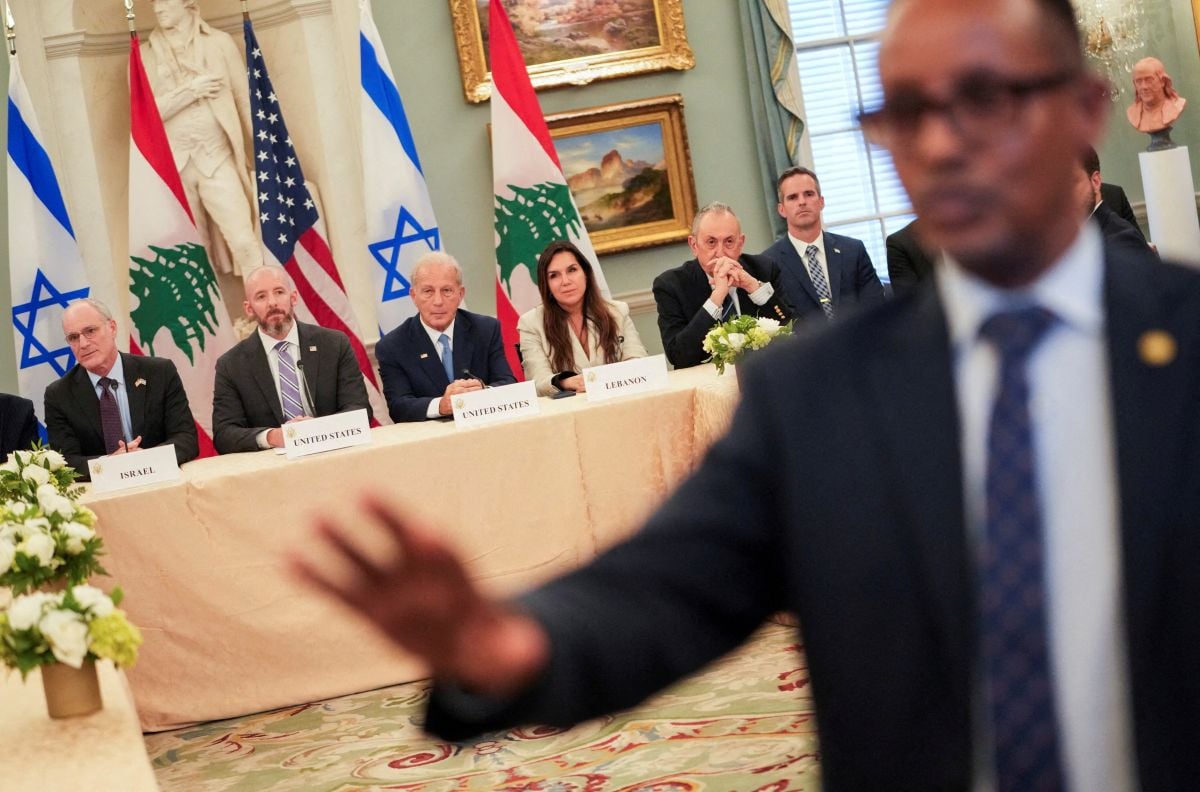
Israeli Ambassador to the U.S. Yechiel Leiter and Lebanese Ambassador to the U.S. Nada Hamadeh, accompanied by State Department Chief of Staff Daniel Holler and U.S. Ambassador to Lebanon Michel Issa, attend a meeting between Israeli and Lebanese delegations hosted by the United States, June 3, 2026. (Credit: Nathan Howard)






BEIRUT — Contradictory signals have emerged from the fifth round of direct negotiations between Lebanon and Israel, held Wednesday in Washington.
After a first day of political-level talks, the latest round brought together military delegations, focusing on the issue of ''pilot zones'' from which Israel is supposed to withdraw to allow the deployment of the Lebanese Army.
The army would then dismantle Hezbollah infrastructure in these areas and prevent its return. However, disagreements quickly emerged, with Lebanon accusing Israel of wanting the process to begin in areas it does not actually occupy.
A sign of the tension, the Lebanese delegation left the meeting room to avoid being photographed alongside the Israelis.
According to our information, the Lebanese military delegation insisted that the implementation of the ''pilot zones'' begin in areas occupied by Israel south of the Litani River. They warned that if these conditions are not met, the army’s deployment could create internal tensions, stressing that this is a Lebanese matter to be handled by national institutions.
Hezbollah, for its part, refuses to disarm north of the Litani and rejects the principle of ''pilot zones,'' seeing it as a way to continue dismantling its arsenal in non-occupied areas. Parliament Speaker Nabih Berri has called for expanding the zones at the district level. According to an official source, Lebanon supports this proposal but fears it will be rejected by Israel.
The Lebanese delegation also stressed the need for strict implementation of the cease-fire, as Israeli forces continue strikes — albeit at a lower pace — while seeking to retain freedom of action against any ''threat.''
This round of talks comes days after the announcement of a Lebanese ''deconfliction cell'' involving Iran, the United States, and mediators from Qatar and Pakistan. The move was sharply criticized by Israel, whose ambassador in Washington warned the talks could head toward a ''catastrophe.''
U.S. Ambassador to Lebanon Michael Issa also said new difficulties had emerged during the discussions.
Members of the Lebanese delegation also refused to be photographed with their Israeli counterparts. A photo published during the talks showed empty seats on the Lebanese side, while the Israeli delegation was fully present.
The move was praised by Druze leader Walid Joumblatt, who reiterated that the Lebanese Army is solely responsible for the country’s security and warned against any attempt to alter its doctrine.
Despite the disagreements, U.S. pressure is expected to keep the talks going on Thursday, and they could lead to a declaration of intent outlining the next steps.
President Joseph Aoun said the negotiations must remain separate from U.S.-Iran talks and stressed the need to consolidate the cease-fire, ensure Israel’s full withdrawal, deploy the Lebanese Army in the south, allow displaced residents to return, secure the release of detainees, and begin reconstruction.
Prime Minister Nawaf Salam also said Lebanon joined the talks as the ''least costly option,'' but insisted the goal remains a full Israeli withdrawal. He added that Beirut will not accept any continued Israeli presence, ''neither at five points nor at two.''
On Hezbollah’s disarmament, Salam said the issue is internal and tied to commitments under U.N. Resolution 1701 and the Taef Agreement.
U.S. Secretary of State Marco Rubio said Israel’s presence in Lebanon is linked to Hezbollah attacks and that progress depends on the Lebanese Army’s ability to secure these zones.
On the Israeli side, Prime Minister Benjamin Netanyahu has ruled out any withdrawal from southern Lebanon while in office, while Defense Minister Israel Katz has said Israel would not withdraw even if the United States requested it.