


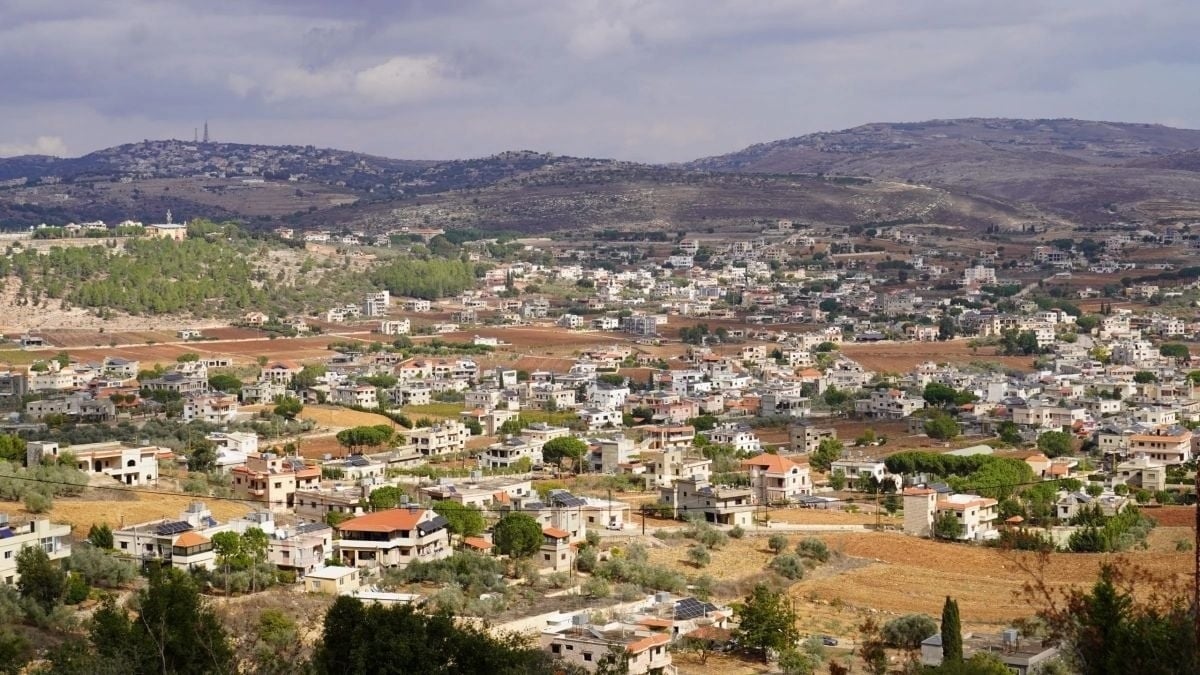
View of Rmeish, Bint Jbeil, in southern Lebanon, on Nov. 16, 2025. (Credit: Tea Ziadeh/L'Orient-Le Jour)






SOUTH LEBANON — Living conditions are deteriorating in three still-inhabited Christian villages in Israeli-occupied South Lebanon, the NGO Medecins Sans Frontieres (MSF) has warned, citing worsening difficulties in accessing water and healthcare, as Ain Ibl, Dibil and Rmeish — like other border towns — remain encircled by Israeli forces despite the cease-fire.
These villages are among the few still populated in the border area where the Israeli army has unilaterally established an occupied so-called “buffer zone.” Although fighting between Israeli occupying forces and Hezbollah has stopped in the area for nearly a week, thousands of residents in these localities remain cut off from the rest of Lebanon due to the massive destruction of roads and infrastructure leading to the South, and the drip-feed arrival of humanitarian aid, hampered by the security situation and Israel’s regular firing on vehicles in the south despite the cessation of hostilities.
These communities are “trapped, cut off from essential services, and severely limited in their movement and access to basic necessities,” MSF warns. “Residents describe living in uncertainty, with delays of several days to obtain emergency medical care and very limited access to healthcare, markets, and essential services,” says Guilherme Botelho, emergency coordinator for the international NGO, in a statement. “Months of attacks and restrictions have largely isolated these communities, forcing thousands of residents to cope daily with limited access to healthcare, water and other essential services,” adds Botelho.
One of the “main concerns is access to water.” In all three villages, infrastructure is damaged or out of service. In Dibil, “the main water source is inaccessible” and “the pumping and distribution system is down,” forcing families to depend on expensive water trucks. In Ain Ibl, “the main well is out of service.” In Rmeish, only one of two wells is still operating. Residents fear the situation will worsen if repairs cannot be safely carried out. “The destruction of water infrastructure has serious consequences. Families are paying higher and higher prices for supplies, while vulnerable people are finding it even harder to meet their needs,” explains Yara Thebian, deputy coordinator at MSF.
The Israeli army has systematically demolished entire villages in the border area, including vital infrastructure. In Dibil, Israeli military vehicles notably destroyed solar panels used to operate a private water pump that supplies potable water for daily use.
Beyond water, MSF notes “limited access to care,” increased “mental health” needs, rising cost of living and “deteriorating living conditions.” Residents report high anxiety after months in isolation, while healthcare facilities operate under difficult conditions. Access to emergency care remains critical. “The villages depend on local primary care,” while transfers for specialized care are severely slowed by movement restrictions, with delays that can reach up to 72 hours or more, sometimes with serious consequences.
For residents of Rmeish, Dibil, and Ain Ibl, access to water and healthcare is a “matter of survival,” MSF says.
 Israeli army carries out demolition at Jabal Amel School in Houla as strikes continue