






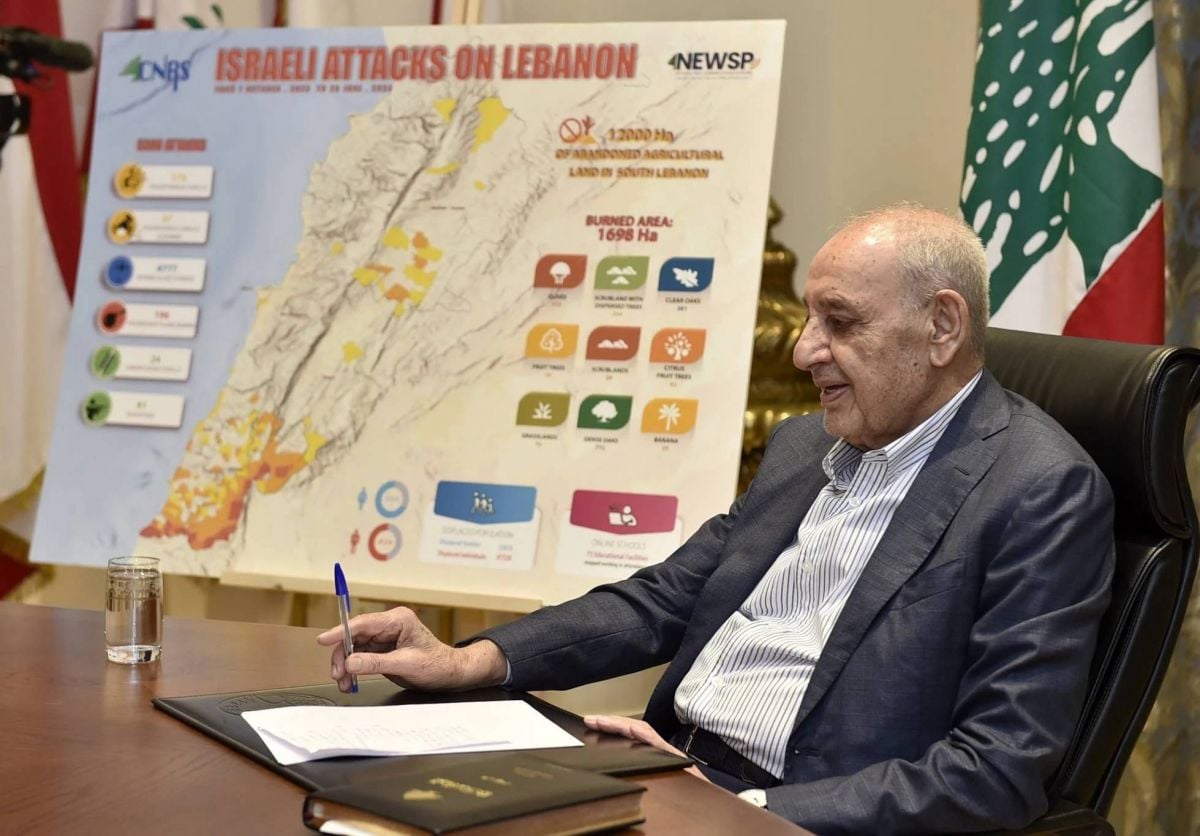
The Speaker of Parliament, Nabih Berri, in his office in Ain al-Tineh during the visit of French diplomat Stéphane Séjourné, April 28, 2024. Photo Mohammad Yassine/L'Orient-Le Jour






BEIRUT — Speaker of Parliament and Head of the Amal Movement, Nabih Berri said Monday in the pan-Arab daily al-Sharq al-Awsat that the "ideas" of President Joseph Aoun and Prime Minister Nawaf Salam are "different" from his own, while clarifying that he is in "constant contact" with the two branches of the executive.
At a time when the Amal-Hezbollah tandem is pleased with the so-far precarious "cease-fire" in Lebanon, secured Sunday by Tehran following its negotiations with Washington, and on the eve of the resumption of direct talks between Lebanon and Israel, Hezbollah's key ally clarified that he does not believe "there is a problem [with Aoun and Salam], as long as we are united by the same priorities."
Berri then listed these priorities that the Lebanese state is putting forward in its direct negotiations with Israel: "the withdrawal of Israel from the South, the deployment of the Lebanese Army, the return of residents to their towns and villages, the release of prisoners, as well as the development of a reconstruction plan for what has been destroyed, with Arab and international support."
According to our information, the head of the Iranian delegation to the negotiations, Mohammad Bagher Ghalibaf, assured Berri that Iran, while working to consolidate the cease-fire, is also continuing its efforts toward an Israeli withdrawal. Although largely observed since Sunday, the cease-fire was repeatedly violated on Tuesday by the Israeli army, which killed at least two people in Nabatieh Fawqa, and struck a car in Braasheet (Bint Jbeil).
'We hope the cease-fire holds thanks to U.S. pressure'
Berri said he was satisfied with the "efforts that led to the cease-fire, hoping that it holds." "It depends on Israel's willingness to comply, in return for Hezbollah's commitment, because it is not acceptable to negotiate under the pressure of fire," he continued, adding that it was Israel that had "requested" a cease-fire after particularly bloody days in southern Lebanon last Friday and Saturday.
"We hope the cease-fire holds thanks to U.S. pressure, and we welcome any effort, regardless of origin, aimed at pressuring Israel to end its war of aggression against Lebanon," he added.
The speaker of Parliament also said he appreciated "the welcome given by the Lebanese — across all communities and parties—to their displaced brothers who were forced to leave their homes following the systematic destruction of their villages by Israel."
He also reaffirmed his rejection of so-called "pilot zones" in southern Lebanon, one of the proposals emerging from negotiations between Tel Aviv and Beirut to guarantee the Israeli withdrawal, but which, in his view, would take "two years or more" to delimit, thus keeping "the South under fire." "The solution," he said, "lies in adopting a timetable for the withdrawal from each district of the South, in exchange for the deployment of the army."
Berri affirmed that "the withdrawal of Israel from any district — let's take Sour as an example — must go hand in hand with the deployment of the army, to enable the return of the displaced to their villages, provided this return is limited to residents of the concerned district, and so forth."
He added that "the Israeli withdrawal from this district will coincide with its disarmament." And he asserted: "This is the commitment I have made on behalf of Hezbollah: to clear the area south of the Litani River of all weapons, provided that Israel also respects this commitment."
The Lebanese file seems to have made progress in the Iranian-U.S. negotiations, even before advancing in the Lebanese-Israeli talks under U.S. sponsorship. According to some observers, the negotiations held in Washington, which resumed Tuesday afternoon, now appear as an extension of the Iranian-U.S. dialogue.
