



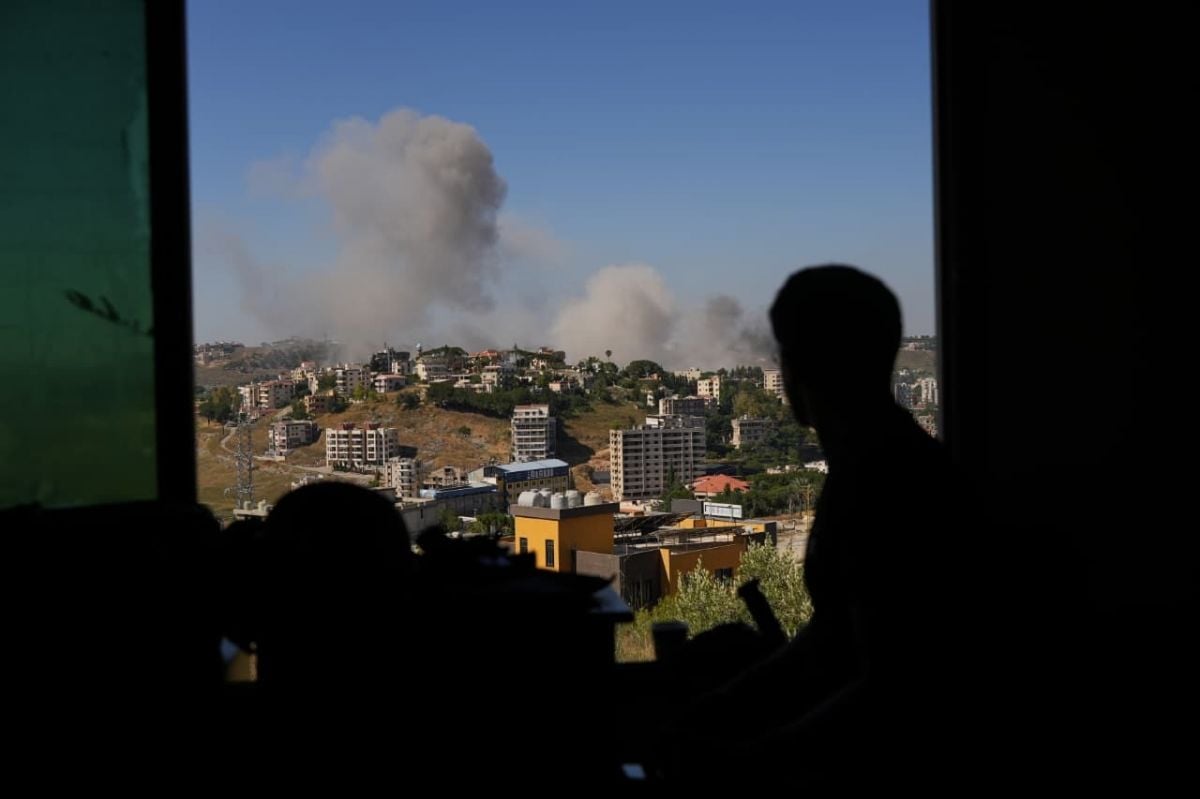
People standing in front of a window watch an Israeli strike on Nabatiyé el-Tahta, June 20, 2026. Photo Mohammad Yassine/L'Orient-Le Jour






Several Hezbollah officials on Saturday defended the Shiite group's response to what they described as Israeli violations of the cease-fire reached Friday between the two sides, as negotiations between Iran and the United States were set to begin. The Israeli army, meanwhile, justified its intensive bombardment of southern Lebanon by citing Hezbollah fire on positions it continues to hold in the area.
Hezbollah MP Hassan Fadlallah said the Iran-backed group had the ‘’right’’ to respond to Israeli attacks, as Israel continued to strike Lebanon despite the cease-fire announced the previous day.
’’There is talk of a cease-fire. What matters to us is that the enemy fully and completely respects this cease-fire and does not attempt to attack our country and our villages or occupy new positions,’’ Fadlallah said during a commemoration ceremony in Jnah, in Beirut's southern suburbs, for a victim of Israeli strikes. He added that ‘’the resistance [Hezbollah] has every right to confront this enemy when it attacks us, because it is the aggressor and the occupier.’’
Fadlallah also said the ‘’resistance’’ would continue to confront any Israeli advances and that the cease-fire did not imply acceptance of a continued Israeli presence on Lebanese territory. According to him, the memorandum of understanding provides for a 60-day negotiation period during which Iran and the United States are expected to implement agreements relating to Lebanon. He said Iran would not accept a final agreement if Israel failed to withdraw from Lebanese territory.
50 projectiles
An Israeli military official told Reuters that Hezbollah fired more than 50 projectiles at Israeli forces in southern Lebanon overnight. In response, the Israeli army carried out strikes against what it described as Hezbollah targets. The military added that stability could be restored in Lebanon and Israel if Hezbollah ceased violating the cease-fire agreement.
In his speech, Fadlallah argued that Iran had honored its commitments to Lebanon by making a cease-fire, an end to the war and an Israeli withdrawal priorities in negotiations. Tehran had even suspended talks and a prospective international agreement to defend Lebanon's interests, he said, describing the move as ‘’a lesson in loyalty and respect for commitments.’’
He further accused Israel of trying to compensate for its failure to achieve its objectives, namely taking control of southern Lebanon, destroying the resistance and eliminating its presence, by targeting civilians.
According to Fadlallah, Hezbollah fighters on the Ali al-Taher hill, which Israeli forces have sought to capture for several days and reportedly attempted to seize again overnight, ‘’inflicted heavy losses on the Israeli army, preventing it from advancing and taking control of the area.’’
On Friday, Israeli forces reportedly lost at least four soldiers in a Hezbollah attack near the hill, prompting Israeli National Security Minister Itamar Ben-Gvir to call for all of Lebanon to ‘’burn.’’
’Delicate and dangerous’ phase
Other Hezbollah officials echoed similar messages earlier Saturday.
Speaking at a funeral in Ghobeiry, in Beirut's southern suburbs, Hezbollah MP Ali Ammar said Friday's attack ‘’cost the lives of dozens of officers and soldiers of the Zionist enemy,’’ leading Israel to intensify its bombardment of Lebanon.
Ammar said the current period was ‘’delicate and dangerous’’ and required ‘’more than ever cohesion among us, and unity in the face of the enemy and the consequences of the aggression, as well as the political situation affecting living conditions.’’
At a separate ceremony in Hay al-Sellom, south of Beirut, Baalbek MP Hussein Hajj Hassan said ‘’Iran has demonstrated to the entire international community, and especially to Arab and Muslim peoples, that it is a model of loyalty to its commitments.’’ He reiterated that Tehran would not sign any framework agreement unless Lebanon's interests were a priority.
Hajj Hassan also criticized the Lebanese authorities' plans to continue direct negotiations with Israel, arguing that previous agreements had failed to prevent Israel from expanding its military operations in Lebanon. Neither Hezbollah nor its ally, the Amal Movement, recognize those talks.
Amal MP Kassem Hachem said the continuation of Israeli attacks ‘’confirms the aggressive nature of a state that has never respected and will never respect resolutions, laws, norms and international conventions.’’ He added that the escalation following the U.S.-Iran memorandum of understanding places greater responsibility on the states involved in the agreement, which he said was intended to establish stability in the region, beginning with Lebanon.
