





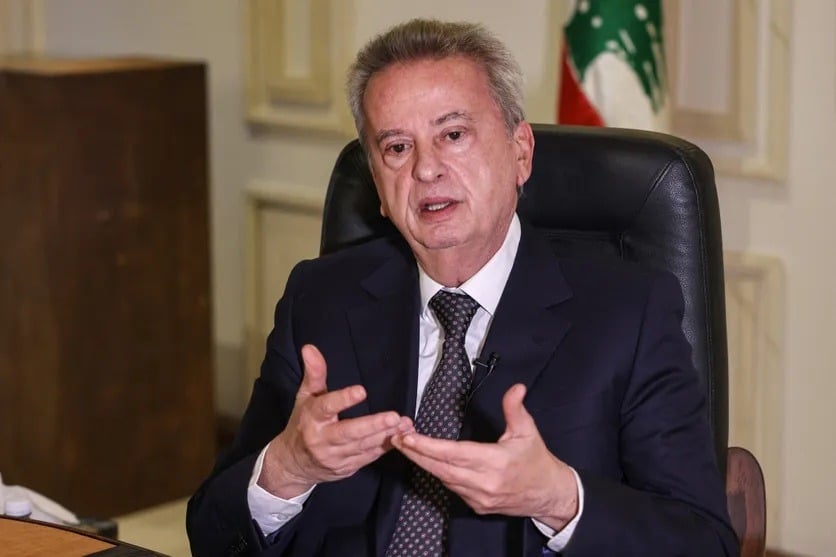
Riad Salameh, then governor of the Banque du Liban in December 2021. (Credit: Joseph Eid/ AFP)






BEIRUT — Two days after former Banque du Liban (BDL, Central Bank) governor Riad Salameh was questioned at his residence in Safra (Kesrouan) by Deputy General Prosecutor at the Court of Cassation Samaranda Nassar as part of an alleged illicit enrichment case, Salameh's lawyer, Wassim al-Ghawi, denounced what he described as "distorted media leaks concerning the investigation," insisting that such information "could only have come from one of the people present during the interrogation," which took place on June 17, 2026.
Nassar had been tasked with the investigation by Public Prosecutor at the Court of Cassation Rami al-Hajj.
“Contrary to what has been reported, the investigation established that the amounts mentioned — totaling $266 million — are inaccurate and in no way constitute commissions. They were loans granted by the Banque du Liban, as part of its role, to preserve monetary and financial stability in the context of the 2010 global financial crisis,” al-Ghawi said in a statement, referring to figures reported by several Lebanese media outlets.
Al-Ghawi added that “following these loans, and after their full repayment, the Banque du Liban recorded profits of $33 million thanks to this operation, which today is the basis of the lawsuit filed by the central bank against its former governor.” He, declined to reveal “further details in order to preserve the confidentiality of the investigation.”
The case against Riad Salameh and Samir Hanna, former chairman and CEO of Bank Audi Group, was referred to the public prosecutor in January by current central bank governor Karim Souhaid.
While details remain closely guarded within both judicial and BDL circles, the case reportedly concerns securities subscribed to by the BDL in private companies, allegedly backed by shares held in Bank Audi. Lebanon's Code of Money and Credit prohibits the central bank from investing in private entities, as its role is to safeguard financial stability rather than engage in commercial activity.
Al-Hajj decided that Salameh would be questioned at home after reviewing reports from a medical panel attesting to the former governor's deteriorating health. Accompanied by a court clerk, Nassar conducted the session in the presence of Salameh's lawyer.
Addressing Salameh's health, his lawyer stated that it “was confirmed by several specialists and forensic doctors, including one appointed by the Banque du Liban itself at the request of the judiciary.”
“These leaks, if accurate, could have constituted a breach of investigative secrecy. But, given that they are false, they represent only an attempt to pressure the judiciary and influence the course of the investigation, while seeking to mask the absence of any factual or legal basis to the complaint filed by the central bank against its former governor,” al-Ghawi said.
He added that the complaint concerns a decision taken by the Banque du Liban's Central Council in 2010 — not by Salameh personally — and argued that the decision ultimately benefited the central bank rather than causing it harm.

 Evening recap: Netanyahu announces West Bank offensive; 7 killed in Jordan church shooting; tents burned in south Lebanon
 US strike on Iran this weekend? ‘Absolutely,’ says Barrack; ‘I have no idea,’ says Trump