







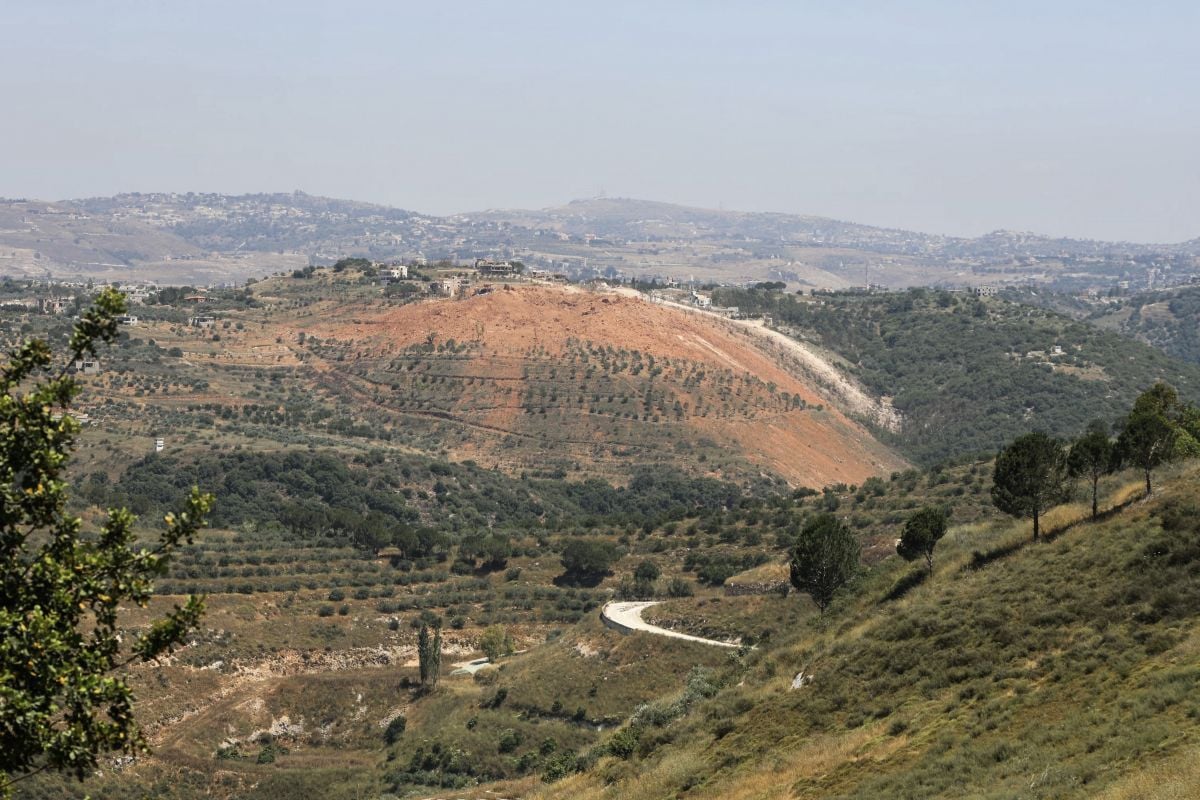
A photograph taken from the southern village of Ghandourieh on June 16, 2026, shows debris scattered around a crater reportedly left by the Israeli detonation of a Hezbollah tunnel network in Qantara. (Credit: Kawnat Haju / AFP)






BEIRUT — Israel is currently engaged in "stubborn negotiations" with the United States to maintain the deployment of its forces in southern Lebanon, where it is attempting to take control Ali Taher heights on the outskirts of Nabatieh and occupies a "buffer zone" of about 600 square kilometers along the border.
Two Israeli officials, including one close to Prime Minister Benjamin Netanyahu, told Reuters on condition of anonymity that negotiations are underway between Washington and Tel Aviv so that the Israeli army can maintain its "deployment" in southern Lebanon.
This comes as the protocol agreement between Iran and the United States calls for a halt to hostilities in Lebanon and a commitment from both sides to "guarantee [its] territorial integrity and sovereignty." One of these Israeli sources indicated that Israel would not back down from its positions, particularly regarding the maintenance of forces deployed south of the Litani River.
A second Israeli official said the outcome of the talks would ultimately depend on the willingness of U.S. President Donald Trump to "force the issue," especially by threatening Israel with consequences if it does not respect the terms of the protocol agreement concluded with Iran. According to this source, everything will depend on Trump's decision to apply — or not — direct pressure on Israel to comply with the commitments set out in this agreement.
Speaking from the G7, Trump said he had a "amazing partnership" with Benjamin Netanyahu, describing their disagreement over Lebanon as a "minor dispute."
Regarding "We have a little dispute about Lebanon," Donald Trump acknowledged from Evian, as the Iranians demand that Israel cease its attacks on Hezbollah in Lebanon. "It's a small piece of the puzzle," but a "very noisy one," he added.
On the ground, three people were killed in two Israeli drone strikes on the outskirts of Nabatieh, in Zibdin (west of the city) and Kfar Tibnit (southeast), according to information from our correspondent. Two people, a Lebanese and a Syrian, were also injured in Beit Yahoun, in the Bint Jbeil district, when a drone from the Israeli army dropped a bomb near civilians in the village.
In recent hours, Israeli attacks have focused on the Nabatieh region, while exchanges of fire have occurred between the occupying forces and Hezbollah. During the night, our correspondent reported that Hezbollah attempted to shoot down an Israeli helicopter with machine guns as it was conducting a reconnaissance mission near the strategic Ali Taher hill, which overlooks the entire region and which the Israelis are trying to control. The helicopter was targeted by a surface-to-air missile, forcing it to withdraw from the area, according to local sources. Several missiles were also fired at Israeli vehicles near Kfar Tibnit. Hezbollah has not claimed responsibility for these attacks. Also in this region, the towns of Kfar Roummane, Habboush and Kfar Joz were targeted overnight by artillery fire, causing fires. At midnight, Israeli forces fired machine guns toward the Wadi al-Slouki area and the outskirts of the town of Houla (Marjayoun).
The Israeli army, for its part, announced Thursday morning the death of one of its soldiers the previous day in an incident in southern Lebanon in which seven other soldiers were wounded. The soldier, a 29-year-old staff sergeant, "fell in battle in southern Lebanon," the Israeli army said in a statement, without specifying the location of the incident.