







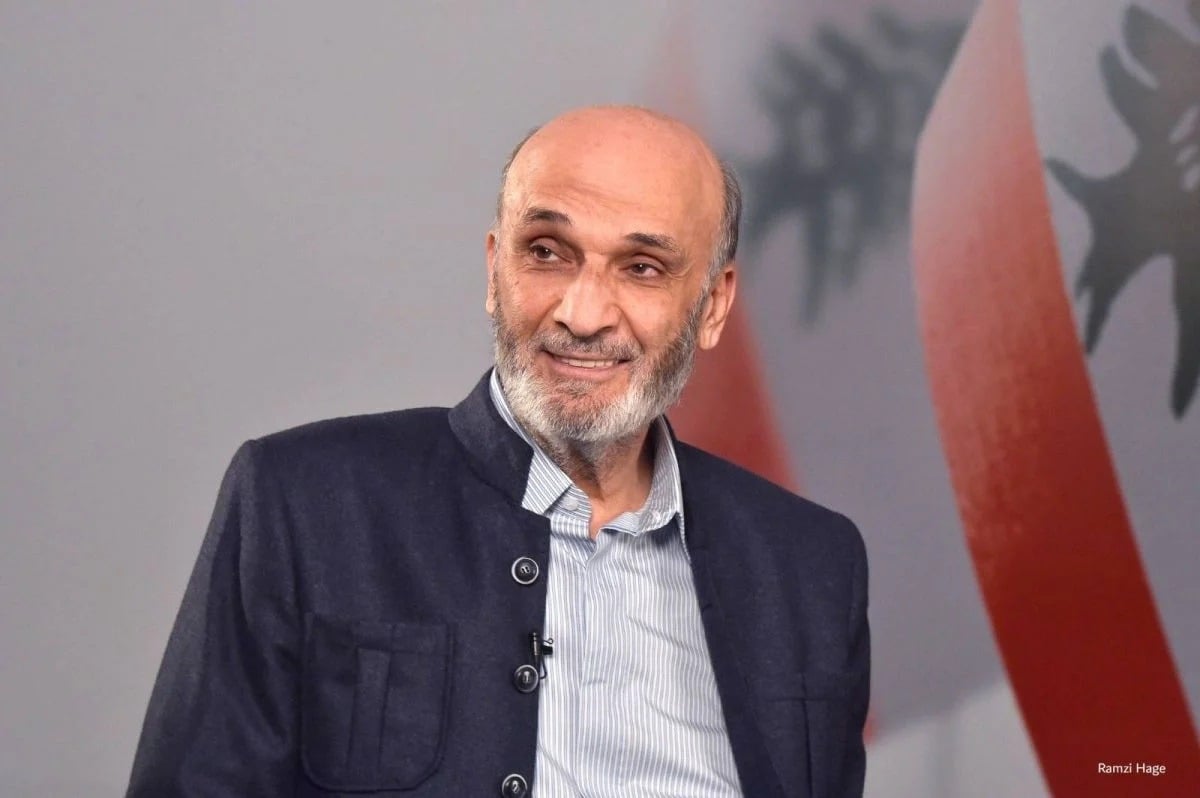
The leader of the Lebanese Forces, Samir Geagea. (Credit: Photo distributed by his communication office)






BEIRUT — Samir Geagea said Wednesday that ''the legal and legitimate authority in Lebanon is that of the president and the government,'' calling ''unacceptable'' any accusations of treason against the executive amid ongoing talks with Israel, warning that suspending them could worsen the security situation.
In an interview with Radio Liban Libre, Geagea rejected criticism aimed at Lebanese authorities following the talks with Israel. "It is absolutely unacceptable to accuse the government, which represents the majority of the Lebanese people, of treason," he said, warning against stopping the process. "If the negotiations stop, Israel will continue its war on a broader scale, and Hezbollah will assist it in this war," he stated.
Addressing Iran's role in the region, the LF leader questioned the recent rhetoric presenting Tehran as a decisive supporter of Lebanon against Israel. He recalled, notably, the 2024 war and the death of Hezbollah leader Hassan Nasrallah in an Israeli attack, pointing out that "despite all the strikes, Iran did not react and did not lift a finger to support the party."
Geagea advocated for the continuation of the diplomatic path, considering that the only power capable of putting pressure on Israel remains the United States. "The only one capable of stopping Israel is the American, who has shown a willingness to exert pressure to end the war," he said, also mentioning possible support from Arab and European countries.
The Christian leader finally argued that Hezbollah's "validity had expired" several years ago, and highlighted the losses linked to the conflict, estimating that "since the start of the war to support Iran, the human losses have reached about four thousand dead and eleven thousand wounded." "Lebanon cannot economically bear this cost," he said.
On March 2, Hezbollah drew Lebanon into the war in support of Iran, after attacks carried out by the United States and Israel. Israeli strikes have since killed 3,666 people, according to the latest figures from Lebanese authorities. Israel still occupies part of southern Lebanon along the border and has advanced deeper into Lebanese territory as never before in nearly the last 30 years since the beginning of this new conflict.
A cease-fire agreement was reached at the end of the fourth round of negotiations between Lebanon and Israel in Washington, on June 2 and 3. The speaker of parliament, Nabih Berri, as well as his ally Hezbollah, rejected this agreement, calling it "unjust."
Hezbollah is firmly opposed to the principle of direct negotiations with the Israel, and has repeatedly criticized President Joseph Aoun.
The delegations of both countries are scheduled to meet again on June 22.
