






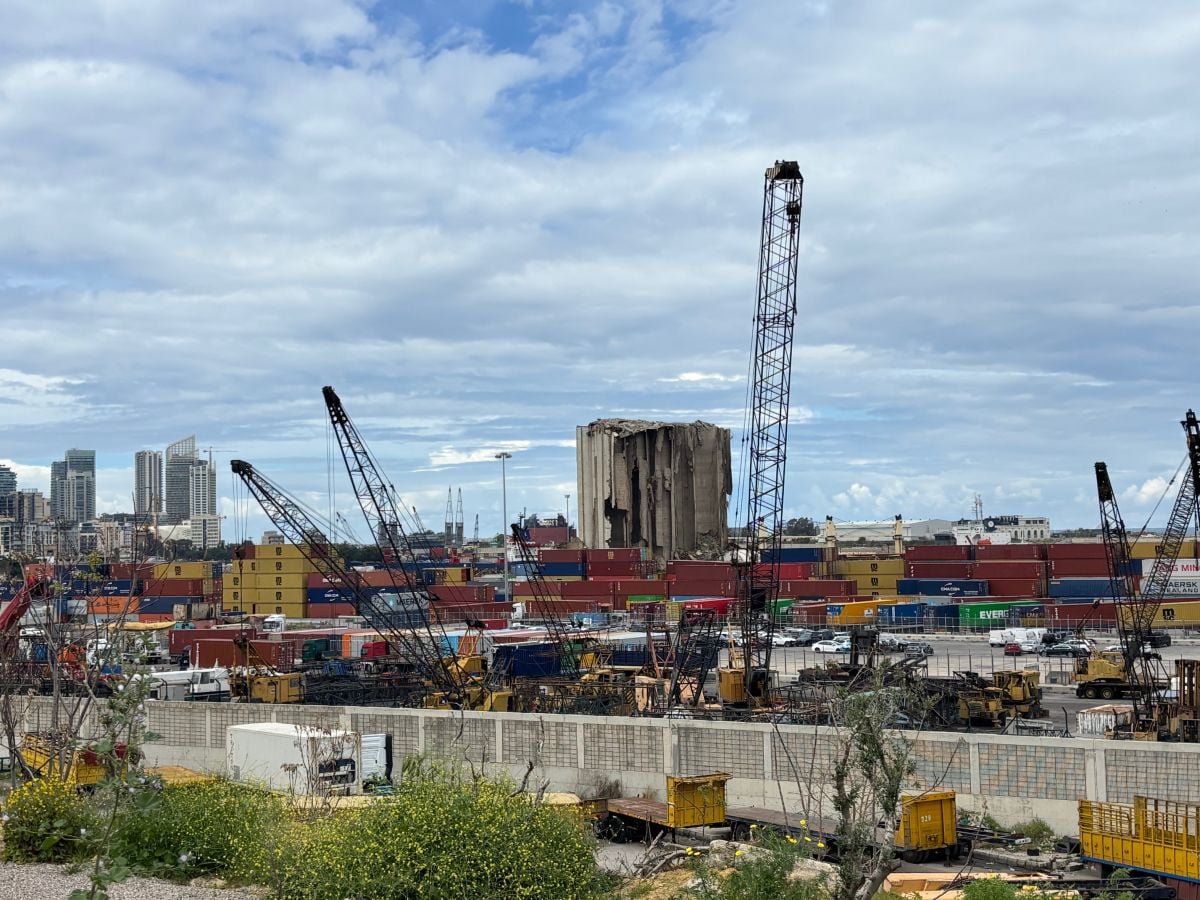
The Beirut port area, still bearing the scars of the August 4, 2020 explosion, on May 6, 2026. (Credit: Philippe HAGE BOUTROS / L’Orient-Le Jour)






The Purchasing Managers’ Index (PMI), which measures sentiment in Lebanon’s private sector, fell in March as expected, dropping for the first time in several months below the 50-point threshold that separates expansion from contraction. The decline is attributed to the war that has been ongoing since March 2 between Hezbollah and Israel, briefly interrupted in mid-April by a temporary cease-fire intended to pave the way for a broader but still uncertain settlement of the conflict, unfolding alongside the war triggered by Israel and the United States against Iran.
However, rather than continuing its sharp decline, the index published at the beginning of each month by Blominvest Bank rebounded slightly in April, rising from 47.4 to 48.2 points. This signals a milder contraction than expected, even as Lebanese businesses continue to suffer the repercussions of the regional war on exports, as highlighted at the end of April by the Association of Lebanese Industrialists.
According to the index breakdown cited by Fadi Osseiran, general manager of Blominvest Bank, the sub-index for new export orders fell to its lowest level in six years, at 30 points.
“The war in Lebanon is generally severe enough to push the BLOM Lebanon PMI into contraction territory. So what can be said when it is combined with a regional war?” he said in a statement accompanying the April report. He added, however, that the month was partly supported by “a partial recovery in domestic orders, which offset part of the decline and was helped by a slight economic reprieve in April due to the [albeit incomplete] cease-fire.” As a result, “the pace of contraction in output was less pronounced,” he noted.
The output sub-index rose from 44.9 to 47.4 points, while new orders increased from 44.9 to 46.5 points. In contrast, the new export orders sub-index fell sharply from 41.8 to 30 points. A full assessment of the decline remains difficult, as Customs data has so far only been published for the first two months.
“If the war drags on, its impact risks worsening: output contraction would lead to significant job cuts [the employment sub-index fell from 49.9 to 49.6 points between March and April] and a sharper rise in prices [+17.26% year-on-year at the end of March, according to the Central Administration of Statistics]. This is why ending the war and insulating the country from regional tensions are essential,” Osseiran added.
Reflecting widespread pessimism, the 12-month expectations sub-index continued to deteriorate, falling from 25.2 to 19.22 points in a single month.
The PMI is based on surveys of purchasing managers at 400 local companies. A reading below 50 indicates contraction, while a reading above 50 signals expansion. The larger the monthly movement, the stronger the contraction or growth it reflects.
Several economists already estimate that the war could shrink GDP by 12% to 16%, a forecast also shared by the Institute of International Finance.

 Evening recap: Netanyahu announces West Bank offensive; 7 killed in Jordan church shooting; tents burned in south Lebanon
 US strike on Iran this weekend? ‘Absolutely,’ says Barrack; ‘I have no idea,’ says Trump