





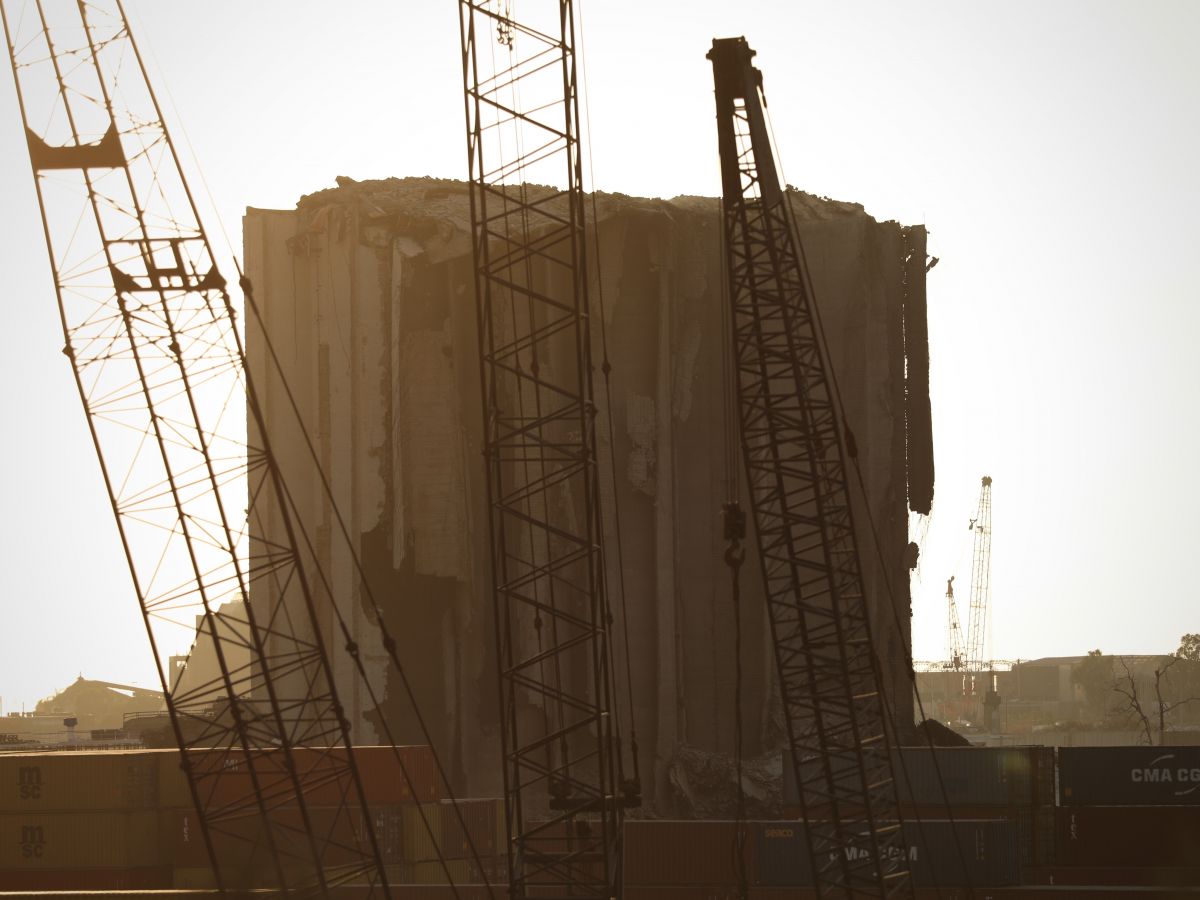
The destroyed silos of the port of Beirut, on August 4, 2025, five years after the deadly double explosion. (Credit: Matthieu Karam/L'Orient-Le Jour)






BEIRUT —The Association of the Families of the Victims of the Beirut Port Explosions said on Monday that justice remains "suspended between obstruction and denial."
"Amid the rubble of crises besieging our homeland, the crime of the Beirut Port explosion of August 4, 2020, remains the gravest truth, the wound that has not healed, and the justice that remains suspended between obstruction and denial," the association said in a statement released on the fourth of every month. In the statement, the families said that "the truth is deliberately besieged," while stressing that "no force is capable of burying this crime."
They called on the competent courts to rule on the motions for recusal and removal concerning Judge Tarek Bitar, questioning why these motions "have remained unresolved for two years, if not longer."
The families also congratulated the new prosecutor general at the Court of Cassation on his appointment, saying he is "known for his integrity" and expressing hope that he will carry their cause "in his conscience," as did his predecessor, Judge Jamal Hajjar.
Meeting on Thursday in a Cabinet session at Baabda Palace, in the presence of the head of state, Joseph Aoun, the government of Nawaf Salam appointed Ahmad Rami Hajj as prosecutor general at the Court of Cassation, succeeding Jamal Hajjar, who retired last Saturday.
Refusing to allow their case to become "a forgotten file," the families demanded "a free, independent, and courageous justice, ... the lifting of immunities for those responsible ..., as well as the revelation of the full truth, without division or dilution."
Addressing the international community, they argued that "the world's silence is an indirect participation in erasing the truth," and called for "genuine support for the process of justice." "This cause is not only that of the victims’ families, but concerns the entire homeland," they concluded, addressing "all Lebanese."
On Aug. 4, 2020, one of the largest non-nuclear explosions in history devastated much of the Lebanese capital, killing more than 220 people and injuring 6,500. The blast was triggered by a fire in a port warehouse where several tons of ammonium nitrate had been stored without proper safety measures, despite repeated warnings to the highest authorities, who are accused of negligence.
 3 p.m. recap: Washington to evacuate 'non-essential' staff from Riyadh embassy; Iran threatens to hit US bases in response to Hormuz escorts