



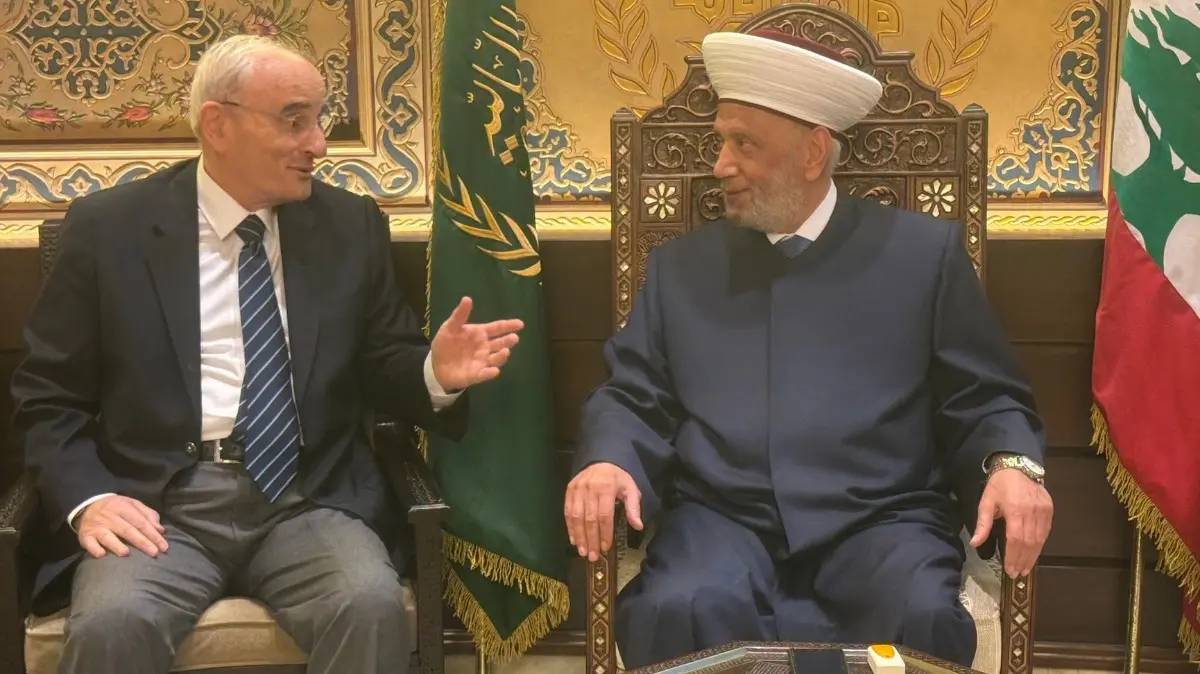
The Minister of Defense, Michel Menassa, and the Mufti of the Republic, Abdellatif Deriane, at Dar al-Fatwa on April 29, 2026. Photo Ani






BEIRUT —Defense Minister Michel Menassa met Wednesday with the mufti of the Republic, Abdel Latif Derian, and later with the vice president of the Higher Shiite Council, Ali al-Khatib, in a bid to “help unite the country around a common position in these difficult circumstances,” as Lebanon “can no longer bear any more,” according to remarks reported by the National News Agency (NNA).
These rare meetings come amid mounting political tensions over talks with Israel aimed at ending the war, which has killed 2,534 people in Lebanon since March 2, the day Hezbollah entered the regional conflict. President Joseph Aoun has come under direct fire from Hezbollah over his role in this context. According to Israeli military intelligence, he is also facing security threats.
'The country can no longer bear any more'
After his meeting with Sheikh Ali al-Khatib, who is known to be close to Hezbollah, Menassa — himself considered close to the head of state — strongly denounced the actions of the Israeli army. "We are facing a criminal enemy who respects neither laws nor rules nor sanctity. An enemy driven by hate, who kills women and children, desecrates sanctuaries and violates Islamic and Christian holy sites," he said.
The minister also defended the opening of direct negotiations with Israel, an unprecedented move since 1983. “If negotiations are held, it will be for Lebanon, not at its expense. We will negotiate, but we will not bargain,” he asserted, echoing comments made this week by the Lebanese president. “Leaning toward peace means making peace, not making concessions. We cannot negotiate abroad while sinking into chaos at home,” Menassa added.
For his part, Ali al-Khatib warned against any “individual initiative,” calling for “national consensus on all matters.” While voicing support for the president and respect for “the presidential institution,” he stressed that “each step must benefit from national consensus” and that Aoun should not become “a stakeholder,” at the risk of losing his ability to “unite the country.”
The religious leader also invited the head of state to “rely on the experience and wisdom of Parliament Speaker Nabih Berri,” who also heads the Amal Movement. “He must take initiatives that bring the country together and save it,” he urged.
Beirut, demilitarized city
Earlier Wednesday, the defense minister assured Mufti Derian that the Lebanese Army was continuing efforts to strengthen security in Beirut and turn the capital into a demilitarized city, as decided by the government on April 9 following massive and indiscriminate Israeli bombardments that killed more than 350 people across the country.
This decision is part of previous measures taken by the executive to restore the state’s monopoly on weapons — and therefore to disarm Hezbollah — which is once again confronting the Israeli army despite the cease-fire reached on April 16 and extended last week.
The minister was speaking after a meeting at Dar al-Fatwa, just days after a standoff — later defused — between State Security agents and residents of the Sunni neighborhood of Saqiet al-Janzir, amid heightened sectarian tensions.
“I insisted on continuing the measures taken by the command of the Lebanese Army, in implementation of the Cabinet's decision to strengthen its presence in the capital, restrict weapons to legitimate forces alone, consolidate security in Beirut, assist displaced citizens and enable them to face the difficulties of the current period, while working to alleviate their suffering,” the minister said.

 1 p.m. recap: Salam in Nabatieh; up to 10,000 more US troops heading to Middle East