







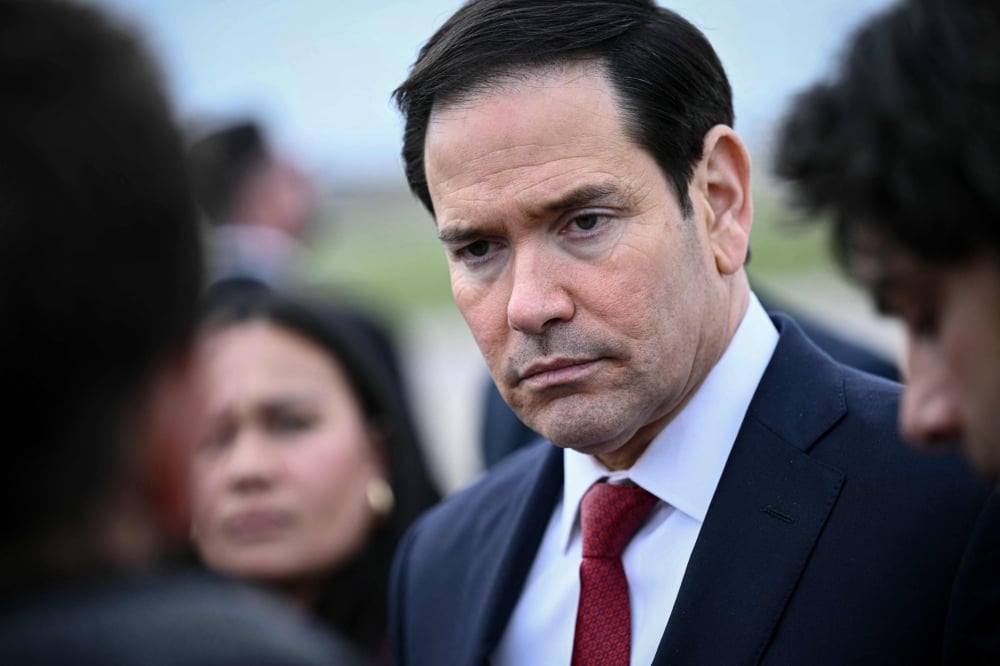
U.S. Secretary of State Marco Rubio before addressing the press following a meeting of G7 foreign ministers with partner countries, prior to his departure from Le Bourget airport, in Le Bourget, near Paris, on March 27, 2026. (Credit: Brendan Smialowski/AFP)






U.S. Secretary of State Marco Rubio said Monday, in an interview with Fox News, that Israel does not wish to "indefinitely maintain" a "buffer zone" inside Lebanon, even though Israel has established, despite the cease-fire, a "yellow line" on Lebanese territory that includes more than 60 villages in southern Lebanon.
"I don't think Israel wants to indefinitely maintain" a buffer zone inside Lebanon, Rubio said. According to him, "Israel has no long-term territorial claims in Lebanon."
He also indicated that "there is no such thing as a Lebanese-Israeli conflict. The conflict is entirely with Hezbollah. And Hezbollah is not only at war with Israel; it is at war with the Lebanese state."
Asked about the scenario in which Lebanon would join the Abraham Accords (which established diplomatic normalization between Israel and several Arab countries), he said, "We are not there yet."
The U.S. secretary of state then spoke at length about the cease-fire reached on April 16 between the Israeli state and Lebanon, after a month and a half of war with Hezbollah.
According to Rubio, "Israel has the right to defend itself against an imminent or ongoing attack from Hezbollah elements ... It is recognized in this agreement that Israel has the right to counter threats that Lebanon cannot address."
He nonetheless emphasized that "the solution on which both sides agree is a Lebanese Army capable of disarming Hezbollah."
'No territorial claims in Lebanon'
"The ideal outcome is a strong Lebanese government with a strong army, capable of dismantling Hezbollah, preventing these attacks and, ultimately, ensuring that it no longer exists as a military unit."
However, he considered that "the Lebanese armed forces, even if they may have the will, do not yet have all the capabilities at this stage to deal with all the threats posed by Hezbollah."
The American official described the cease-fire as "very particular, because Lebanon and Israel are not at war." He stressed that "Lebanese and Israelis both seek peace" and that the two peoples "have no problem with each other."
"Israel's problem is not with Lebanon, but with Hezbollah. Moreover, the Lebanese have recognized that Hezbollah is a problem for them. Not only is Israel a victim of Hezbollah, but the Lebanese are as well," the American official added.
He finally stressed that there needs to be "within the Shiite population itself a rejection of Hezbollah ... which operates inside Lebanon on behalf of the Iranian regime."
Lebanon and Israel began direct negotiations on April 14, the first since 1983, which led to a three-week extension of the cease-fire between Hezbollah and Israel, which took effect on April 17 for an initial period of ten days.
President Joseph Aoun, who was the first to request these negotiations, and the government of Nawaf Salam, which began measures in 2025 to disarm Hezbollah, have drawn the ire of the group, which refuses to hand over its arsenal while Israeli attacks continue and opposes direct negotiations with Israel.

 8 p.m. recap: Israel again threatens Beirut’s south suburbs; 2 ships hit near Hormuz; Riyadh football matches canceled