







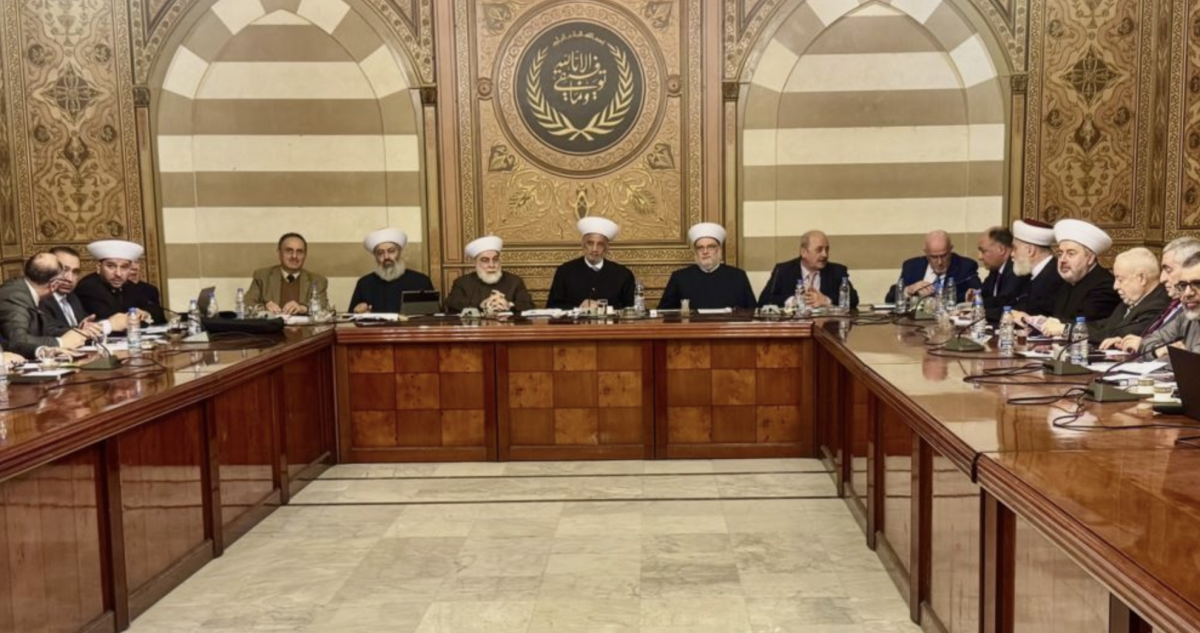
The Higher Islamic Sharia Council met at Dar el-Fatwa under the chairmanship of Mufti Abdellatif Deriane on Jan. 18, 2025. (Credit: NNA archive photo)






The Higher Islamic Sharia Council, the highest authority of the Sunni community in Lebanon, called on Saturday to "respect" the state's decision to begin direct negotiations with Israel.
Presided over by the Grand Mufti of the Republic, Abdellatif Deriane, the Council also warned against "accusations of treason," particularly against Prime Minister Nawaf Salam.
While denouncing "the scorched earth policy pursued by the Israeli occupation" in southern Lebanon, and without explicitly naming Hezbollah, the Council "reaffirmed its support for the recent decisions of the Council of Ministers."
Among these decisions are declaring the military activities of the Shiite formation "illegal" or proclaiming Beirut a "weapons-free" city.
'Diplomatic negotiations to end the war'
In its statement, the Sharia Council thus calls to "respect the constitutional right of the president of the Republic to conduct negotiations relating to the conclusion of treaties and international agreements ... as well as his choice, along with the pillars of the state, to opt for diplomatic negotiations to end the war with the Zionist entity, which waged a relentless destructive war against Lebanon, committing the most serious crimes."
This April, for the first time since 1983, Lebanon began direct meetings with Israel in Washington with the aim of carrying out negotiations between the two countries. Two meetings have taken place at the ambassadorial level in Washington, the second with the notable presence of U.S. President Donald Trump, who announced the extension of the truce in Lebanon for three weeks, until May 17.
The Higher Islamic Sharia Council also condemned the Israeli intention to establish a "buffer zone" in southern Lebanon, reaching 8 to 10 kilometers inside Lebanese territory. The text thus rejects "the scorched earth policy waged by the Israeli occupation, manifested by the total destruction and leveling of villages and neighborhoods so that no trace or sign of life remains, thereby preventing the return of the inhabitants of the South to their localities and homes, in order to establish a security belt or a buffer border zone devoid of any life."
Dar al-Fatwa also defended Salam, who has been accused by Hezbollah circles of being accommodating to Israel, even of "treason," for his declared desire to disarm the formation and to begin talks with Tel Aviv. It thus calls for "not leaving the field to hate speech, threats, intimidation and accusations of treason."
Furthermore, it calls to "refrain from any attack against the office of the prime minister or its head, as well as the other presidencies, and to avoid resorting to accusatory, escalating rhetoric that incites discord." "If these attacks continue, do we realize the magnitude of the dangers facing this country? Until when? And where are we heading?
The Council reaffirms its support for the recent decisions of the Council of Ministers, as well as their implementation and respect for their provisions," the Sunni body further writes.
Finally, Dar el-Fatwa, in line with Saudi Arabia, has reaffirmed its commitment to the Taif Agreement, which ended the Lebanese civil war (1975-1990), called for the "dissolution of all militias" and the "restoration of the state's authority" over the entire national territory.
