






France's President Emmanuel Macron (R) shakes hands with Lebanon's Prime Minister Nawaf Salam at the end of a joint press event following their meeting at the Elysee Presidential Palace in Paris on April 21, 2026. (Credit: Ludovic Marin/AFP)






French President Emmanuel Macron said Tuesday, during a press conference at the Élysée Palace alongside Lebanese Prime Minister Nawaf Salam, that Israel must “abandon its territorial ambitions” in Lebanon. He added that Hezbollah must “cease” its attacks on Israeli territory and be disarmed “by the Lebanese themselves.”
The ten-day cease-fire — the first since the start of the new war between Hezbollah and Israel on March 2 — “must be extended to allow the beginning of a genuine stabilization process,” the French president said. He called for a “political agreement between Israel and Lebanon that guarantees the security of both countries, Lebanon’s territorial integrity, and lays the groundwork for normalizing their relations.” Macron also said France was “ready to maintain its engagement on the ground” after the planned withdrawal of UNIFIL peacekeepers at the end of the year. On Saturday, a French UNIFIL soldier was killed and three others wounded in an ambush by armed elements in southern Lebanon. Macron pointed the finger at Hezbollah, which denies the accusation.
For his part, the Lebanese prime minister said Beirut is demanding the “full withdrawal” of Israeli forces from its territory, as well as the return of detainees and displaced Lebanese, as part of the direct negotiations underway with Israel. “There can be no lasting stability without a complete Israeli withdrawal from Lebanese territory, the release of detainees, and the return of displaced people to their homes and destroyed villages, which also brings back to the forefront the need to prepare an international conference for recovery and reconstruction,” he said.
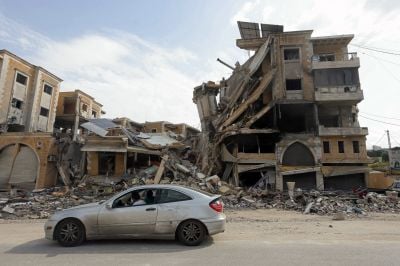
The head of government also stated that Lebanon needed “500 million Euros to cope with the humanitarian crisis over the next six months.” In Lebanon, where a fragile ten-day cease-fire came into effect last Friday, the situation remains highly unstable, with the conflict already having killed more than 2,300 people and injured thousands on the Lebanese side. New direct talks between Israeli and Lebanese diplomats are scheduled for Thursday in Washington.
'Diplomacy is not a sign of weakness'
Salam also said he fully supports these negotiations with Israel “in the name of the sovereignty of the Lebanese state in making decisions of war and peace.” He added that he is “convinced that diplomacy is not a sign of weakness, but a responsible act, so that no avenue is left unexplored in restoring my country’s sovereignty.”
On these negotiations, Macron said France would help Lebanese authorities prepare, even if Paris is not directly participating in the talks. He said it was “secondary” for France to be at the negotiating table, stressing that it is in Lebanon’s interest for all parties to contribute to supporting the process. France, which has long-standing historical ties with Lebanon, has sought to play a role in the talks but has faced reluctance from Israel and the United States.
At the start of his remarks, Salam said President Macron “has consistently shown unwavering support for the Lebanese state and its direction in all circumstances.” He also thanked him for “the military and humanitarian assistance provided to the Lebanese Army and to the Lebanese people.” In this context, he said he discussed with the French president the support conference for the Lebanese army that had been scheduled for March 4, adding that such a conference is now necessary “particularly in light of the historic decision taken by the Lebanese government, which declared Hezbollah’s armed activity illegal.”
France had said on Sunday that the prime minister’s visit would be an opportunity to reaffirm its “support” for Lebanon’s “territorial integrity” and its efforts to disarm Hezbollah in the south. However, the Élysée appeared to downplay on Tuesday the “buffer zone” established by Israel in the region. Earlier in the day, the French presidency described the Israeli-imposed buffer zone in southern Lebanon as “temporary,” without calling for its immediate dismantling, while stating that Lebanon’s “territorial integrity” must be respected “at the conclusion of negotiations” between the two countries.
