






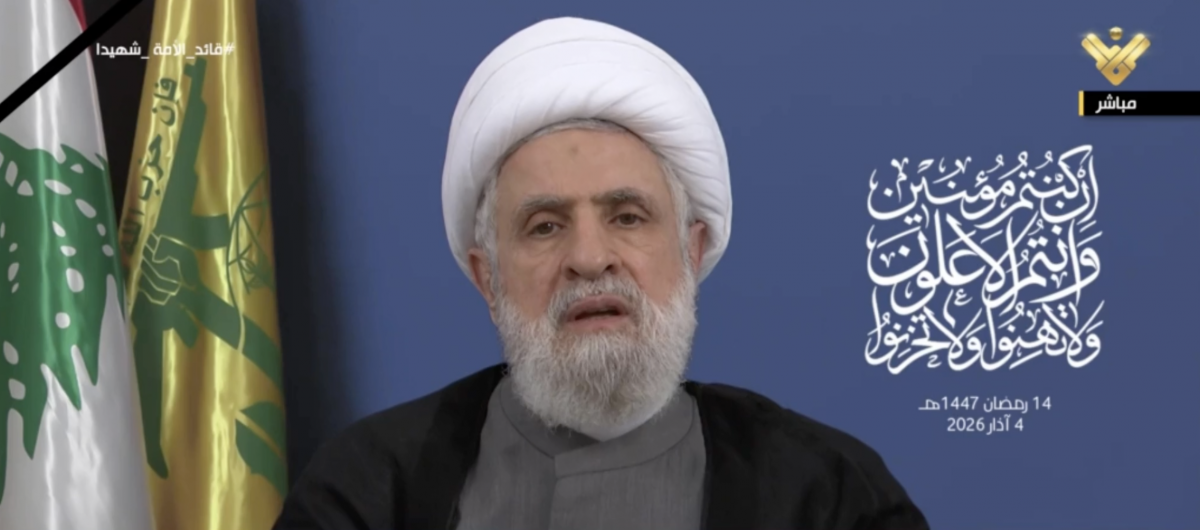
Hezbollah's Secretary-General Naim Qassem delivering a speech on March 4, 2026. (Credit: Screenshot/Al-Manar)






Hezbollah leader Naim Qassem said Saturday that the cease-fire between Lebanon and Israel, which took effect Thursday at midnight, would not have been possible "without the struggle of the resistance fighters" of his militia in southern Lebanon, while assuring that his fighters "will remain on the ground."
He also denounced the "humiliations" suffered, in his view, by Lebanon during direct negotiations with the Israeli state, which began Tuesday in Washington. Qassem also asserted that his group is open "to the fullest cooperation with the Lebanese authorities."
"The temporary cease-fire would not have been possible without the struggle of the resistance fighters on the southern fronts, a legendary fight that astonished the world, and without their unwavering resistance in the face of the Israeli-American enemy, despite the massive imbalance in military strength," declared the secretary-general of the pro-Iranian group in a speech read by an announcer on the party channel Al-Manar.
"A cease-fire means a complete cessation of all hostilities. Because we do not trust this enemy, the resistance fighters will remain on the ground, finger on the trigger, and will respond as they should to any violation. There can be no cease-fire imposed only on the resistance [Hezbollah]; it must be mutual. We will not patiently endure Israeli aggression for fifteen months while waiting for sterile diplomacy," Qassem added.
"The enemy was not able to reach the Litani River, neither during the first week as they had planned, nor during the 45 days" of the war, he said.
Despite the cease-fire taking effect two days ago, the Israeli army continued its operations in southern Lebanon Saturday, and claimed to have established a "Yellow Line" demarcation, as in the Gaza Strip.
'Shameful spectacle' in Washington
Commenting on the U.S. State Department's declaration about the Lebanon-Israel cease-fire agreement, published after it came into effect, Qassem argued that it was "practically meaningless."
"This declaration is an insult to our country and our homeland, Lebanon, this text having been dictated by the United States, which speaks in the name of the Lebanese government," he emphasized. "The declaration begins: 'The Government of Israel and the Government of Lebanon have agreed to the following statement.' But everyone knows that the Lebanese government has not met and signed any agreement regarding this declaration. Stop subjecting Lebanon to these humiliations in direct negotiations with the Israeli enemy, listening to its diktats, and watching the shameful spectacle in Washington where statements are made in the name of Lebanon," he added.
Qassem also called for the implementation of five points, namely: "the permanent cessation of aggression against all of Lebanon," whether by air, land, or sea; Israel's withdrawal from occupied territories; the release of Lebanese prisoners in Israel; the return of the inhabitants to their villages in southern Lebanon; and reconstruction with international and Arab support and under the leadership of the Lebanese authorities.
"Hezbollah is open to the fullest cooperation with the Lebanese authorities to open a new chapter based on achieving the sovereignty of our nation, Lebanon, within the framework of a national security strategy. Together, we will build our nation, Lebanon, and prevent foreign powers from imposing their will and achieving the Israeli enemy's objectives through politics," declared the pro-Iranian leader. According to him, "the Lebanese people will remain united and in solidarity with the army, the people, the resistance, and the political power that aspires to independence and the liberation of Lebanon."
Qassem also paid tribute "to Iran, its leaders, and its people, for their support and assistance." "In their official statement, [the Iranians] explicitly linked the cease-fire to that in Lebanon, then closed the Strait of Hormuz in response to the violation of the Lebanese cease-fire by the United States. This measure forced the United States to yield and Israel to cease its violations, leading to the reopening of the Strait of Hormuz," analyzed the leader, who also thanked Pakistan for its efforts to stop the fighting.