







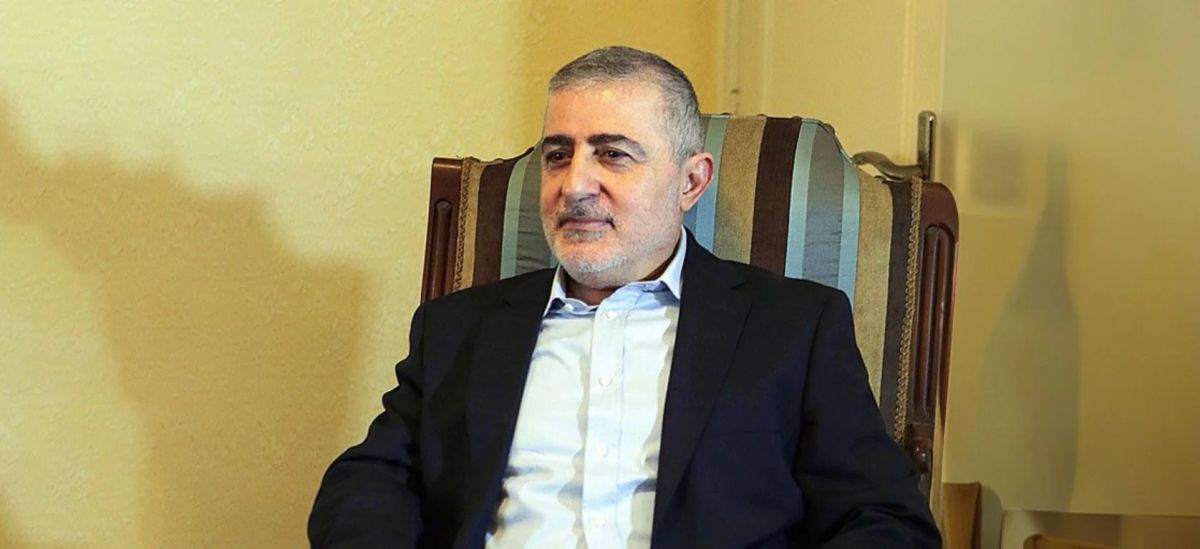
The former head of Hezbollah's coordination and liaison unit, Wafiq Safa, in Beirut in 2018. (Credit: AFP)






BEIRUT — Wafiq Safa, a high-ranking member of Hezbollah’s political council, told the Associated Press (AP) on Monday that Hezbollah will not abide by any agreements that may result from the direct Lebanese-Israeli direct talks in Washington.
For the first time since in decades, direct talks between officials from Lebanon and Israel are scheduled to take place in the U.S. on Tuesday. They will include the Israeli and Lebanese ambassadors to the United States and will be mediated by U.S. Secretary of State Marco Rubio.
“[Regarding] the outcomes of this negotiation between Lebanon and the Israeli enemy, we are not interested in or concerned with them at all,” Safa told AP. “We are not bound by what they agree to,” he added in a rare interview with international media.

Later on Monday, Hezbollah's Secretary-General Naim Qassem called Lebanese authorities to cancel planned talks with Israel, describing them as “submission and capitulation."
Safa added in the interview that Hezbollah has been informed that during the talks between Washington and Tehran in Pakistan, Iran “was able to obtain a cessation of attacks” in Beirut and its southern suburbs. These talks had failed to reach an agreement between both countries, leading the U.S. to impose a blockade on the Strait of Hormuz.
After Israel killed more than 350 hundred people in Lebanon on April 8 in an intense wave of coordinated attacks across southern Lebanon and Beirut, Israel has since not targeted the capital and its southern suburbs. Israeli media reported that U.S. put pressure on Israel to avoid striking Beirut, especially amid its negotiations with Iran. However, Deputy Prime Minister Tarek Mitri told local television channel LBCI on Tuesday that "at present, there is no firm guarantee that Beirut can be spared from Israeli bombardment."
Regarding Israel's April 8 attacks, Safa stated that none of Hezbollah's officials or cadres were killed in Beirut. He added that that Qassem’s secretary was not killed, although “maybe a relative of his was." Meanwhile, the Israeli military claimed, without evidence, that more than 250 Hezbollah members were killed in the mass strikes, including Qassem's secretary and nephew Ali Youssef Harshi.
Safa also confirmed for the first time that he was wounded during the earlier, 2024 Israel-Hezbollah war, after being targeted by two Israeli strikes in Beirut, “but God granted me survival.”
The Hezbollah senior official also said that if there is a cease-fire and a withdrawal of Israeli troops from Lebanon, Hezbollah is ready to negotiate with the Lebanese government about the fate of its weapons. “The issue of resistance weapons is a Lebanese matter that has nothing to do with Israel or the United States,” he said.
Prior to the escalation of this latest war on March 2, the Lebanese authorities announced that it had accomplished the disarmament of non-state armed actors, mainly Hezbollah, in the regions south of the Litani. However, Hezbollah's Radwan Forces are now present in the south Litani area and are engaged in ongoing battles against Israeli troops.
Talking about Hezbollah's decision to intervene in the Iran-U.S. war, Safa said that Hezbollah’s actions were preemptive because its leaders believed “Israel was preparing for a second battle with Lebanon” with the aim of destroying Hezbollah.
It was “an appropriate moment for Hezbollah ... to rebuild a new equation” and restore deterrence against Israel, he said, denying any prior deals with Tehran that Hezbollah would enter the war if Iran was attacked.
Despite the November 2024 cease-fire agreement, reached after more than 13 months of war, Israel continued to carry out daily strikes, especially on southern Lebanon, and retained its occupation of at least five positions within Lebanese territory throughout the whole entire "cease-fire" period.
In February, Hezbollah accepted the resignation of Safa from his post within the party after Hezbollah's leadership decided to remove him from his role as head of the party's Liaison and Coordination Unit, which is responsible for internal coordination, maintaining relations with political forces, and communicating with authorities and security services. He was transferred to another post within the party.
