


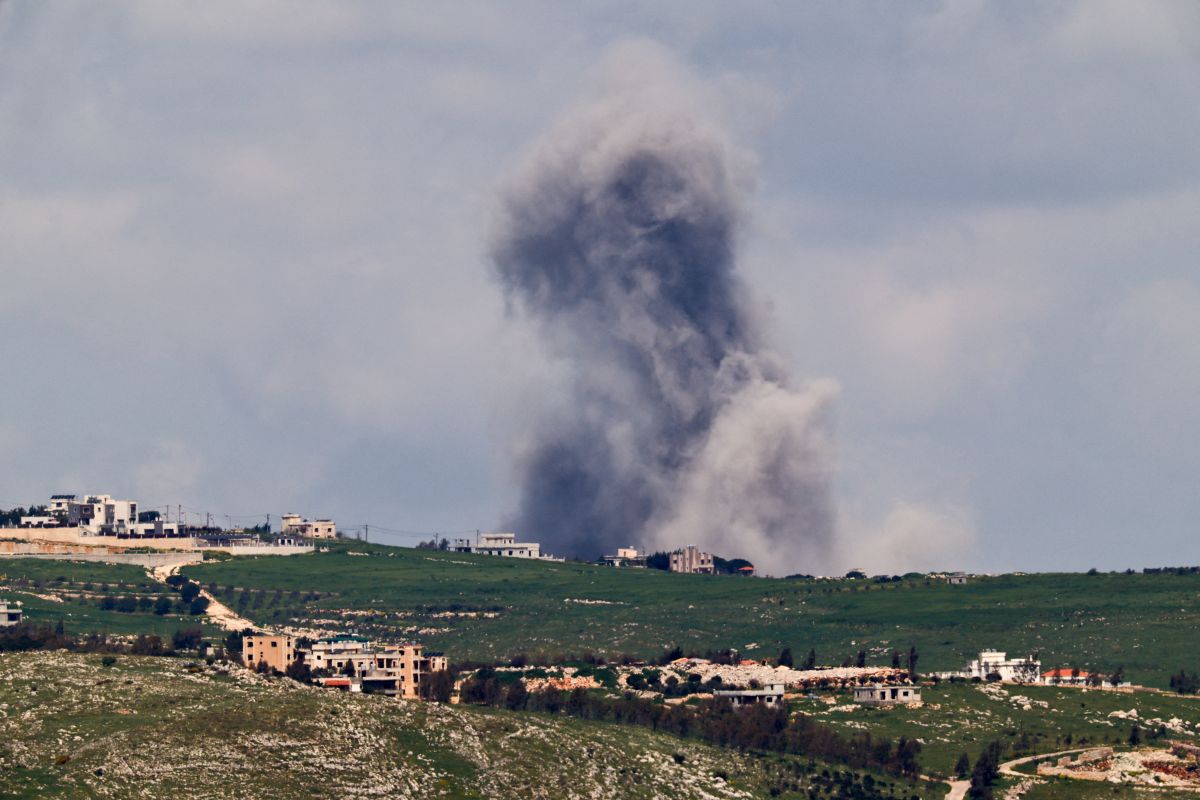
Smoke rises following an airstrike in Lebanon, seen from the Israeli side of the border, April 11, 2026. (Credit: Amir Cohen/Reuters)






The first political reactions in Lebanon came quickly after Lebanese and Israeli authorities announced that a meeting between the two countries would be held Tuesday in Washington to discuss a cease-fire declaration and the start date for bilateral negotiations under U.S. auspices.
Gebran Bassil, head of the Free Patriotic Movement (FPM) and former Hezbollah ally, expressed his "unreserved support" for the principle of negotiations with Israel in order to "end the war, restore Lebanon’s rights, and establish peace."
However, he stressed that "the process of direct negotiation is a tactical card that can be used at the right time to achieve its objectives." He added, "It should neither be wasted nor used inappropriately under Israeli aggression, not without obtaining a cease-fire, nor based on gratuitous concessions in a process of surrender and defeat," he said in a statement.
Bassil observed that negotiation is justified if it allows for the achievement of several objectives, among them "the complete cessation of Israeli maritime, land, and air aggressions; the total withdrawal of Israel from occupied Lebanese territories within internationally recognized borders, including in the context of a maritime border agreement; and the immediate return of Lebanese citizens to their localities, unconditionally."
Also among the objectives to be achieved according to the FPM head are "the deployment of the Lebanese Army throughout all Lebanese territory and borders, its proper armament within the framework of a national defense strategy, immediate implementation of the principle of monopoly of arms, and the centralization of state decision-making within its constitutional institutions."
Bassil also wants to hold Israel responsible for damages resulting from the aggression, ensure full Lebanese state sovereignty over its territory and natural resources, and finally enshrine the principle of durable, comprehensive, and just peace with Israel within the framework of the 2002 Arab Peace Initiative of Beirut.
‘The resistance will last as long as its people exist'
Hezbollah MP Hassan Fadlallah, for his part, said that "the decision to negotiate directly with the Israeli enemy is a blatant violation of the national pact, the Constitution, and Lebanese laws, and a manipulation of the country’s fate." These negotiations "exacerbate internal divisions at a time when Lebanon needs internal solidarity and unity more than ever to face Israeli aggression and preserve civil peace and coexistence among its citizens," he added.
Fadlallah also argued that "what the enemy could not get on the ground thanks to the courage of the resistance fighters, it will not get through negotiations with an authority that does not control its own decisions, that has abandoned its most basic duties, is unable to protect its people, and is not trustworthy to preserve national sovereignty." "These decisions are unconstitutional because they contradict coexistence, and are therefore doomed to fail," he insisted.
Finally, Fadlallah observed that Lebanese authorities should have taken advantage of the favorable international opportunity — thanks to Iran’s firm stance — to halt the aggression against Lebanon before the start of negotiations in Islamabad, but failed to do so. "Our people will remain committed to the resistance to defend their land, existence, and legitimate rights, as well as their national partnership," he concluded, stressing that "the resistance will last as long as its people exist."

 7 p.m. recap: Netanyahu seeks mastermind behind Flydubai incident; Washington sanctions 2 French nationals; Ben Gvir's 'I want to kill you' threat