







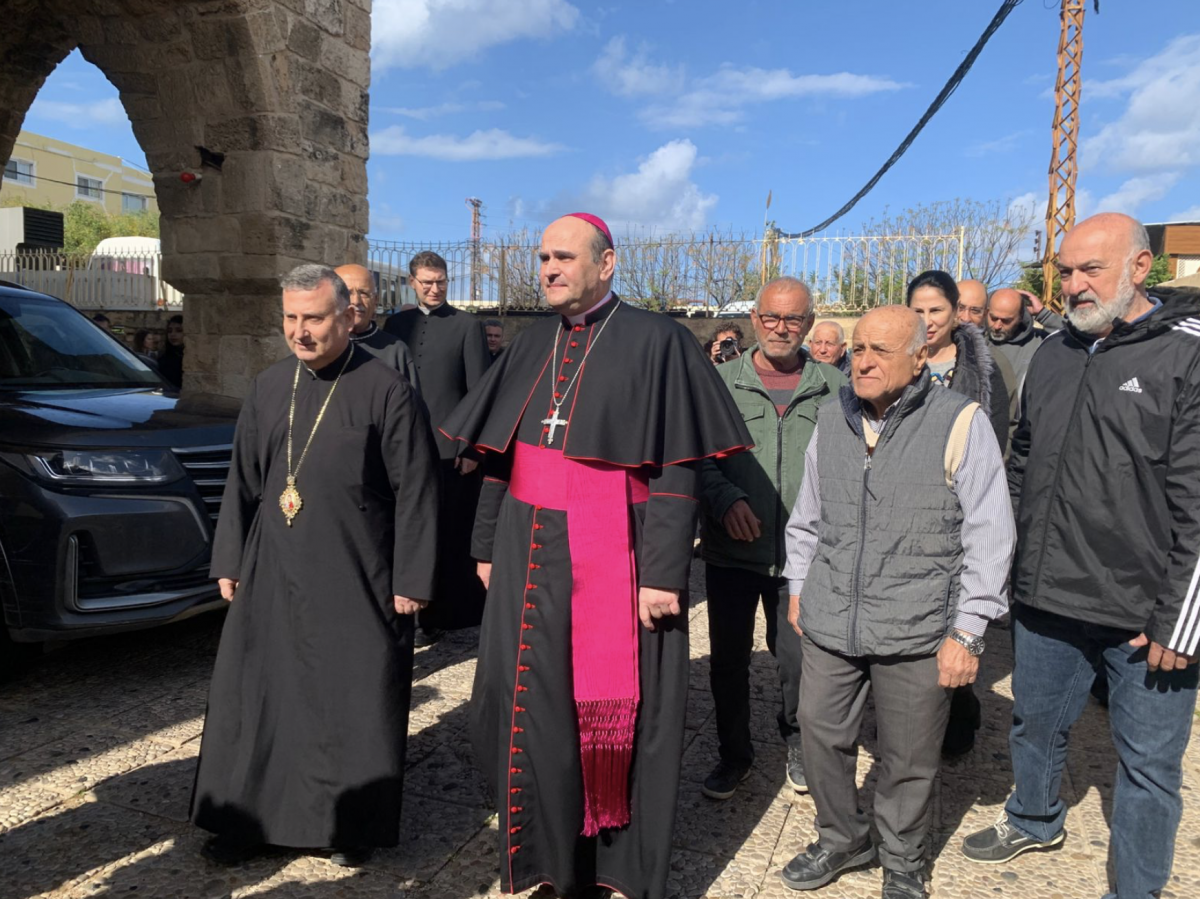
The Apostolic Nuncio, Monsignor Paolo Borgia, during a distribution of aid in Tyre, South Lebanon, on March 30, 2023. Photo Stéphanie Khouri/L'Orient-Le Jour






The Maronite Church patriarchate in Lebanon expressed its “deepest disappointment” Sunday following the cancellation of a Vatican-led humanitarian convoy to the Christian village of Dibil (Bint Jbeil), citing a “violation of international humanitarian law.”
The convoy, planned several days in advance and scheduled for this Easter Sunday, was canceled Saturday night for “security reasons,” as the Israeli army continues its invasion of southern Lebanon and orders residents within a 40-kilometer radius to leave their homes.
The convoy “was to deliver more than 40 tons of medicine and essential goods to residents of this region who are cut off from the rest of the country, deprived of resources, and threatened with disappearing due to ongoing fighting and repeated evacuation orders from the Israeli army,” the statement emphasized.
The Catholic organizations L’Œuvre d’Orient and Caritas-Lebanon “recall that the cancellation of a humanitarian convoy, even for security reasons, constitutes a violation of international humanitarian law, especially when the convoy aims to help vulnerable civilian populations trapped in their villages,” the statement said.
“It is also an affront to the residents remaining in southern Lebanon, who are unarmed and caught in the crossfire of a war between Hezbollah and Israel, which puts their existence at risk and threatens them with forced displacement every day,” the Maronite patriarchate's statement decried.
“Finally, it sends a painful message to the Christians of southern Lebanon, who find themselves prevented from celebrating Easter with a delegation under Vatican auspices,” the statement added.
“From Bkerké, Caritas-Lebanon and L’Œuvre d’Orient reaffirm their commitment and admiration for the courage and peacemaking witness demonstrated by those who remain in southern Lebanon,” the statement concluded.
For his part, Father Nagib Amil, pastor of the Rmeish parish (Bint Jbeil), told MTV that “the roads around Rmeish are completely cut off, and we cannot transport medical cases to hospitals.”
“We are anxious about our fate, and the food aid we have will only last for two months,” he warned. He noted that there is currently no passable route between Rmeish and Dibil, and that “the nearest hospital is in Saida, 70 km away.”
Sixteen villages in the southern Lebanon border zone, where Israel seeks to establish a buffer zone, remain inhabited to this day, including Dibil and Rmeish. Spread out between the districts of Bint Jbeil in the central sector of the border strip, and Marjayoun and Hasbaya in the east, these villages, ranging from small towns with hundreds of residents, like Rmeish, to tiny hamlets home to just a few families, are isolated from the rest of Lebanon.
Six humanitarian convoys attempting to reach them have been organized since the war began in early March, which has already resulted in more than 1,461 dead and 4,430 wounded, according to a Sunday update from Health Ministry.
