


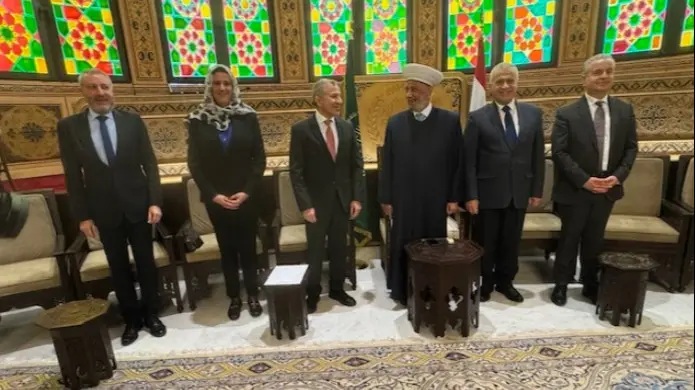
FPM leader Gebran Bassil and party's delegation meet with Lebanon's Grand Mufti Abdellatif Derian in Dar al-Fatwa on March 31, 2026. (Credit: NNA)






Free Patriotic Movement (FPM) leader Gebran Bassil presented on Tuesday his "proposal to protect Lebanon through dialogue" to the country's Grand Mufti Abdellatif Derian, Druze Sheikh Akl Sami Abi al-Mona, and the vice president of the Higher Shiite Islamic Council Ali al-Khatib.
Israel's war with Hezbollah escalated on March 2 following the U.S.-Israeli attack on Iran. Since then, Israel has killed at least 1,268 people in Lebanon and forced over one million residents, mostly from the South, into displacement.
Since Hezbollah launched rockets toward Israel in support of Iran, and its military and security activities were declared “illegal” by the government on March 2, divisions on the local scene have reached their peak, not only between political parties but also on social networks and in the media.
Politically, tensions are palpable, with divisive issues such as the disarmament of Hezbollah and the expulsion of the Iranian ambassador dominating the government's agenda.
After meeting President Joseph Aoun on Thursday, Bassil announced that he had presented him with “a proposal to protect Lebanon through dialogue among the Lebanese, and not confrontation.”
The FPM leader, along with some of the party's MPs, visited on Tuesday Derian in Dar al-Fatwa, Sheikh Abi al-Mona at the Druze Community House in Verdun, and al-Khatib in the council's headquarters in Hazmieh, according to the state-run National News Agency (NNA). Bassil said he received support from all of these religious leaders regarding his initiative.
"This phase requires great awareness; today is not a time for political bidding or electoral competition, but rather a time for wisdom and vigilance to safeguard the country," Bassil said from Dar al-Fatwa.
Furthermore, he said that the FPM will continue this tour with these "comprehensive ideas and speak with all religious and political parties and syndicates, hoping to translate it into joint Lebanese action, through unified efforts to preserve and protect Lebanon."
At the Druze Community House in Verdun, Basil said: “Our mission today is to stop the war and prevent internal fighting, chaos, strife, self-security, violence, and ideas that undermine the unity and existence of Lebanon.”
For his part, Mona stressed “the need for serious efforts to be integrated among religious, political, and national authorities to overcome the difficult phase the country is going through, and to prioritize a moderate, unifying voice over voices that may lead to divisions among the people of the same nation."
Finally, during Bassil's last stop at the Shiite Council's headquarters, al-Khatib welcomed the delegation “to his home,” saying: “I agree with most of the points you presented. The important thing is to avoid internal strife. At that point, each of us may have a viewpoint, and we can sit and discuss it calmly to reach solutions. If intentions are sincere, the state will assume responsibility in a way that ensures no one feels compelled to protect themselves.”
"You, along with many sincere people in this country, are working toward that, and as a Free Patriotic Movement, you have played a positive role in this regard. Your movement today comes within this framework, so may God bless your efforts," al-Khatib told Bassil.
Meanwhile, the latter said: “In the wars of 2006 and 2024, we saw how displaced people returned directly to their homes. Today, Israel’s plan is for permanent displacement to fragment Lebanon and create a new demographic reality. Our response must be greater solidarity among ourselves and stronger attachment to our land."
Bassil's initiative revolves around three main ideas. The first is an internal code of conduct based on the rejection of violence and media and political incitement. The second is based on the collective rejection by the Lebanese of any internal discord, Israeli occupation, and any foreign interference in Lebanese affairs. Finally, the third proposes a solution based on the exclusivity of arms in the hands of the Lebanese Army and state, as well as complete Israeli withdrawal from Lebanese territory.

 7 p.m. recap: Netanyahu seeks mastermind behind Flydubai incident; Washington sanctions 2 French nationals; Ben Gvir's 'I want to kill you' threat