


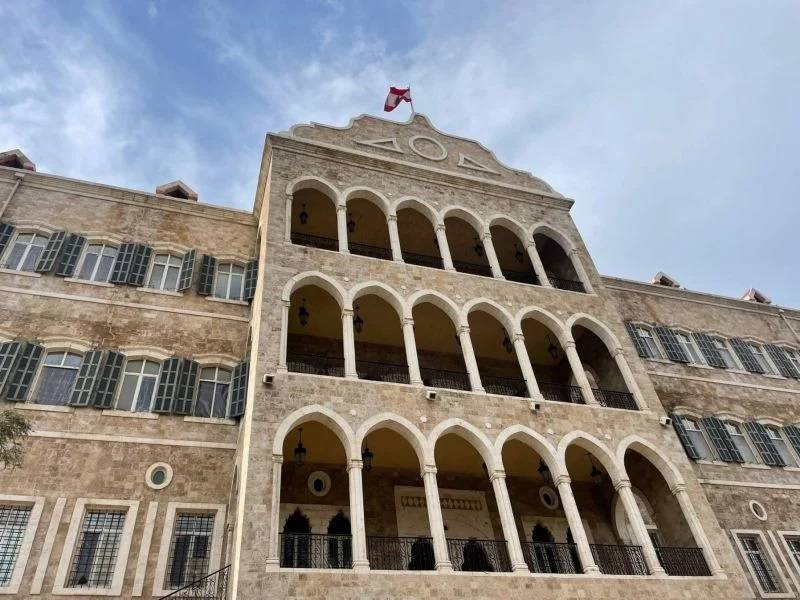
The Grand Serail in Beirut, Feb. 13, 2024. (Credit: Philippe Hage Boutros / L'Orient-Le Jour)






BEIRUT — Cabinet met Thursday afternoon at the Grand Serail in the absence of ministers from Amal and Hezbollah (Yassine Jaber, Rakan Nasreddine, Tamara Elzein, and Mohammad Haidar.)
The session was expected to address the expulsion of Iran’s ambassador to Lebanon, Mohammad Reza Shibani, but the topic was ultimately not discussed due to the absence of the Shiite duo. Fadi Makki, a fifth Shiite minister not affiliated with Amal or Hezbollah, did attend the meeting.
This dynamic reflected the determination of President Joseph Aoun and Prime Minister Nawaf Salam not to reverse the decision of the Foreign Ministry, despite dissatisfaction among Hezbollah and Amal circles.
“The agenda for this session focused solely on the issue of displaced persons, the consequences of displacement, Israeli attacks, and their effects across housing, relief, social, economic, financial, and naturally military aspects,” said Information Minister Paul Morcos after the meeting.
Before the session, a Foreign Ministry source told L’Orient-Le Jour that Minister Joe Rajji had no intention of reversing the ambassador’s accreditation withdrawal. “There is no middle ground for now. If there were, the Shiite ministers would have announced their participation,” the source said. A source close to the Grand Serail agreed, while also ruling out the collapse of the cabinet. A figure close to Ain al-Tineh confirmed that Parliament Speaker Nabih Berri had not requested the president to reverse the decision and opposed any scenario that could topple the government.
Fadi Makki explained that despite disagreeing with the ultimatum to the Iranian ambassador, he participated as a “national necessity” to ensure proper functioning of public affairs and respond to escalating challenges.
He emphasized that in light of Lebanon’s existential crisis, “state presence must be reinforced, and national responsibility prioritized over all other considerations.” Makki called on the Cabinet to focus on displaced persons, strengthen internal dialogue, intensify diplomatic efforts to end the war, and counter Israeli territorial expansion. His decision was later criticized by residents of his hometown Hboush in southern Lebanon.
Cabinet decisions
After the meeting, the government decided to immediately refer the matter to the U.N. Security Council regarding Israeli actions that “threaten Lebanon’s sovereignty,” said Morcos. This came as Israel announced plans to intensify its military campaign against Hezbollah. The decision cited “the bombing of most bridges over the Litani River,” the “massive forced displacement of residents,” and “the advance of Israeli troops on Lebanese territory, accompanied by destruction that threatens Lebanon’s sovereignty and territorial integrity.”
“We consider these acts, under any label, whether security belts or buffer zones, extremely serious and a threat to Lebanon’s sovereignty, territorial integrity, and citizens’ rights, and totally contrary to international and humanitarian law as well as the U.N. Charter,” said Prime Minister Nawaf Salam. He added that the Foreign Minister and Lebanese abroad would file a complaint with the U.N. Security Council, and he would contact the U.N. Secretary-General directly.
Solidarity with Kuwait and regional security
Salam also expressed solidarity with Kuwait following reports of a foiled terrorist plot there. Kuwaiti authorities said a 20-member network, including Kuwaiti, Iranian, and Lebanese nationals linked to Hezbollah, had planned assassinations and recruitment for such operations. Salam stated: “What harms Kuwait harms Lebanon.
The Lebanese community in Kuwait largely respects the law and contributes to economic life, creating a strong bridge between our countries.”
He condemned Iranian attacks on Gulf countries, noting that since the conflict began, 83 percent of missile or drone strikes targeted these nations, as well as Jordan, Turkey, and Azerbaijan, while only 17 percent targeted Israel. “Lebanon cannot remain silent while our Arab brothers face daily attacks,” he said.
Domestically, Salam emphasized that displaced Lebanese are among the victims of this imposed war and announced “new measures to strengthen security in the capital,” including increased patrols by the army and security forces.

 1 p.m. recap: Salam in Nabatieh; up to 10,000 more US troops heading to Middle East