







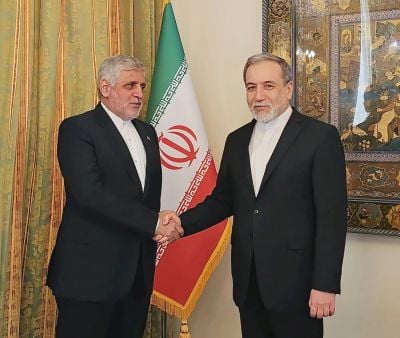
The Iranian ambassador to Lebanon, Mohammad Reza Shibani (left), shakes hands with Iranian Foreign Minister Abbas Araghchi, Wednesday, Feb. 25, 2026. (Photo published on the X account of the Iranian embassy in Beirut/@IranEmbassyLB)






A sit-in will be held Thursday at 4 p.m. in front of the Iranian embassy in Bir Hassan, in the southern suburb of Beirut, which has been under Israeli fire since the start of the war, to "protest" and "condemn" the expulsion of the Iranian ambassador to Lebanon, according to information from our correspondent in southern Lebanon.
On Tuesday, the Lebanese Ministry of Foreign Affairs summoned Iran’s chargé d’affaires, Toufic Samadi Khoshkhou, to Beirut to inform him that Lebanon had withdrawn the accreditation of Iranian ambassador Mohammad Reza Shibani. Declared persona non grata, the diplomat must leave Lebanese territory no later than Sunday, March 29, 2026.
This decision was made as the Lebanese state seeks to distance itself as much as possible from Iran and its Revolutionary Guards, in order to get out of the war waging between Iran and the United States and Israel. It comes a day after an Israeli strike on Hazmieh, a suburb of Beirut, targeting a member “of the Quds Force” of the Iranian Revolutionary Guards, its elite unit.

The sit-in carries the title: “The ambassador of the Islamic Republic of Iran is in his home, in his country, among his people, and in the hearts of those who love him.” It is being organized “to denounce policies supporting U.S.-Zionist aggression against Lebanon and the region, and to reaffirm the place of the Islamic Republic of Iran in the hearts of patriots.” This demonstration will bring together a group presenting itself as a coalition “of national political parties and figures,” forming a political alliance “including figures and factions of the resistance.”
Hezbollah sharply criticized the Lebanese state’s decision, and called on President Joseph Aoun and Prime Minister Nawaf Salam to reverse it. In a statement, the Hezbollah “strongly condemned and categorically rejected” the official Lebanese decision, calling it “devoid of any legal basis.” “This hasty and reprehensible measure serves neither the higher interests of Lebanon, nor its sovereignty, nor its national unity. On the contrary, it constitutes a reversal of these principles, a manifest submission to external pressures and diktats, as well as a blatant infringement on the prerogatives of the president,” the statement added.

For its part, the Amal movement, Hezbollah’s ally, also on Wednesday called on the state to reverse its decision to “prevent the country from plunging into a political and national crisis.”
In a statement, Lebanese diplomacy clarified that this decision concerned the ambassador himself, and did not constitute a break in diplomatic relations. The credentials of Mohammad Reza Shibani had already been accepted, after the diplomat’s arrival in Beirut on Feb. 26, two days before the start of the war launched by the United States and Israel against Iran.
However, he had not yet set an appointment with Foreign Minister Joe Rajji. Shibani had already served as Iranian ambassador to Lebanon from 2005 to 2009, and then as ambassador to Syria from 2011 to 2016.

 8 p.m. recap: Israel again threatens Beirut’s south suburbs; 2 ships hit near Hormuz; Riyadh football matches canceled