






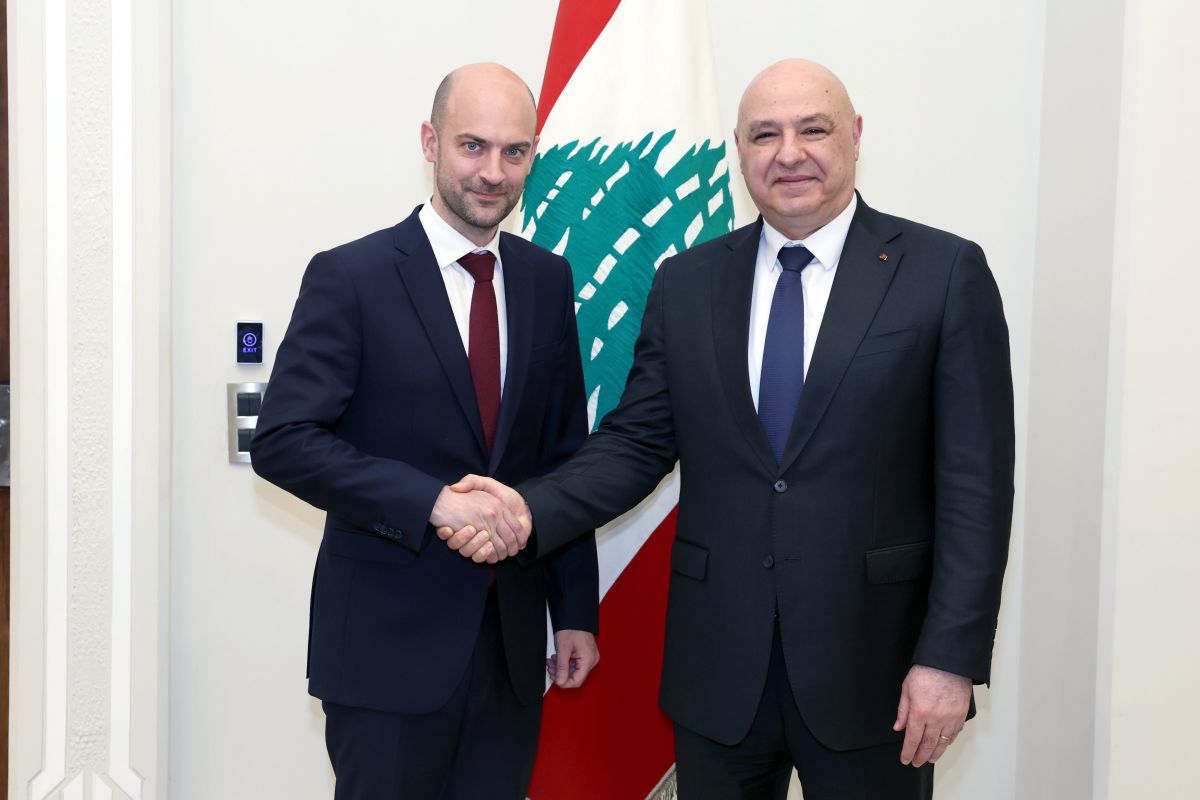
French Minister for Europe and Foreign Affairs Jean-Noël Barrot received by President Joseph Aoun on March 19, 2026. (Credit: X/@lbpresidency)






French Foreign Minister Jean-Noel Barrot was in Lebanon on Thursday, as the Israeli army continues its military operations against Hezbollah. He visited the presidential palace in Baabda, where he met with President Joseph Aoun.
“The negotiation initiative [with Israel] remains in place, but the military escalation is preventing its launch,” Aoun told Barrot. The Lebanese presidency reported that Barrot “expressed France’s readiness to work to end the military escalation, building on the ‘courageous’ negotiation initiative announced by President Aoun.”
Ten days earlier, Aoun had accused Hezbollah of trying to provoke Lebanon’s “collapse” on behalf of Iran and called for “direct” negotiations with Israel to end the war. French President Emmanuel Macron has been in near-daily contact with Aoun.
Last Saturday, he called on Israel to engage in “direct talks” with the Lebanese government and “all components” of Lebanon. Macron said he was ready to “facilitate” these discussions by “hosting them in Paris” to prevent Lebanon from “falling into chaos.”
President Aoun also reaffirmed to Barrot “the need for a cease-fire and the implementation of the necessary guarantees for its success by the concerned parties,” emphasizing that hostilities must stop to create conditions for negotiation, according to the NNA.
He also noted that “the government continues to implement decisions related to the monopoly on arms, even if the military escalation prevents full execution of the plan set by the army.”
According to reports, Barrot has been in contact with U.S. counterpart Marco Rubio and with Ron Dermer, the Israeli official responsible for negotiations with Lebanon. Both expressed willingness to discuss the Lebanese issue but are seeking more concrete measures at a time when Israel is reluctant to agree to a cease-fire. France continues to pursue efforts to reduce tensions.
Barrot then traveled to Ain al-Tineh, where he met with Parliament Speaker Nabih Berri. Berry thanked “France and its president for their initiatives and efforts to end the aggression against Lebanon and for supporting its sovereignty and unity across its territory.”
“Implementing the 2024 agreement, mediated by the U.S. and France, and Israel’s commitment to respect it will end the aggression and allow displaced persons to return. The essential point is to activate the ‘Mechanism’ as the framework for monitoring, enforcement, and negotiation set out in this agreement,” he stressed, the NNA reported.
Barrot also met with Prime Minister Nawaf Salam and the Maronite Patriarch Bechara al-Rai in Bkirki.
In his meeting with Salam, the French minister reaffirmed “France’s support for Lebanon during this period.” He also emphasized that “France is working with all parties to halt the escalation” and “supports the decisions of the Lebanese government.”
The French Ministry of Foreign Affairs had said in a statement that Barrot’s visit “demonstrates France’s support and solidarity with the Lebanese people, drawn into a war they did not choose. The minister will consult the country’s main authorities on the situation in Lebanon and ways to de-escalate, building on discussions with the president of the Republic.”
A week after delivering nearly 60 tons of humanitarian aid to displaced populations, Barrot announced a new aid package “to support the Lebanese people,” the statement said.
On Thursday evening, Barrot posted photos on X of his visit with displaced persons. “In Beirut, alongside displaced people being assisted by the Red Jackets of the Order of Malta. In solidarity with the Lebanese people, drawn into a war they did not choose, we are doubling our humanitarian aid to Lebanon, raising it to €17 million,” he said.
Barrot is scheduled to travel to Israel on Friday, his first visit to the country since November 2024, and especially since France recognized a Palestinian state in September 2025 — a move that angered the Israeli government.
The minister will meet with Israeli authorities to discuss security, humanitarian concerns, and prospects for de-escalation, continuing the diplomatic efforts led by President Emmanuel Macron, the French Foreign Ministry said.
Hezbollah drew Lebanon into the Middle East war on March 2 by firing missiles at Israel to avenge the death of Iran’s Supreme Leader, Ali Khamenei, who was killed on the first day of the Israeli-American offensive against Iran.
Israel has since carried out massive bombings across large parts of Lebanon, including the capital Beirut, and ground incursions in the south with troops and armored vehicles.
Israeli strikes have killed more than a thousand people, according to authorities, and displaced over a million, more than a sixth of the country’s population.
