






Passenger planes parked on the tarmac at Dubai International Airport in the United Arab Emirates on March 11, 2026. (Credit: AFP)






About two weeks after the U.S.-Israeli war in Iran began, countries across the Middle East and the Gulf are still restricting their airspace and limiting flights by national carriers, despite some gradual easing.
More than 40,000 flights have been canceled out of about 72,000 scheduled since the start of the war on Feb. 28, according to data published this week by Cirium, an aviation data analytics firm.
L'Orient-Le Jour reviewed the latest measures taken by countries across the region, based on information from news agencies, the flight-tracking website Flightradar24 and industry sources.

Lebanon
Lebanese airspace and its airport remain open, even after an Israeli escalation reignited in the country on March 2.
Only Middle East Airlines is operating flights, serving a limited number of destinations — mostly in the Gulf — often with longer routes that may change depending on security conditions and access to air corridors.
Syria
Damascus International Airport has been closed since late February. Syrian authorities recently reopened an air corridor from Aleppo for special flights, mainly operated by the private carrier Cham Wings Airlines and open to foreign airlines. Romanian carrier Dan Air said it plans to schedule flights.
Iran
Airspace and airports across Iran remain fully closed until March 15, with a few exceptions granted on a case-by-case basis.
Bahrain and Kuwait
Both countries have kept their airspace closed. Kuwaiti authorities reported damage Thursday following a drone strike on the capital’s airport. Travelers wishing to leave Kuwait can cross into Saudi Arabia by road with a 72-hour transit visa.
Bahrain has relocated passenger and cargo aircraft to less exposed locations and announced that visa holders will not face fines for overstaying for one month after the airspace reopens.
Iraq
Airspace and airports remain completely closed until March 13.
Qatar
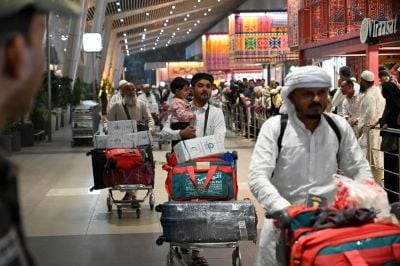
The Qatar Civil Aviation Authority partially reopened the country’s airspace last Saturday after a week of full closure. Since then, Qatar Airways has operated several repatriation flights and scheduled 119 flights between March 13 and 17.
The government has also extended visas for stranded travelers by one month free of charge and is covering hotel and meal costs. Flights to Lebanon are being decided on a day-to-day basis.
United Arab Emirates
The UAE kept air corridors open through Emergency Security Control of Air Traffic zones, where flights operate under enhanced security measures.
Etihad Airways, Emirates, Air Arabia and Flydubai are operating some repatriation and limited commercial flights.
Emirates suspended flights to Lebanon until March 14, while Etihad does not plan to resume flights to Beirut before March 22.
Saudi Arabia
Airspace remains partially closed near the borders with Iraq and the Persian Gulf, but flights continue through other corridors. Saudi airlines have canceled flights to Lebanon for now, although the kingdom’s main airports remain open.
Oman
Airspace remains open, but Oman Air suspended flights to nine Middle Eastern destinations because of the volatile security situation.
SalamAir has suspended flights to Beirut until March 28.
Jordan
After an initial partial closure, Jordanian airspace has largely reopened. Aircraft are advised to carry extra fuel in case of delays, according to Flightradar24.
Traffic at Queen Alia International Airport remains stable, with between 110 and 130 flights per day, said Daifallah al-Farajat, head of the country’s Civil Aviation Regulatory Commission.
Royal Jordanian continues to operate some flights to Lebanon, though cancellations occur depending on developments.
Cyprus, Egypt and Turkey
Airspace remains open, but airlines have reduced or suspended some routes to the Middle East and Gulf due to the conflict. Turkish Airlines does not expect to resume flights to Lebanon before March 19.


 7 p.m. recap: Iran warns Egypt, Israeli soldiers vote in south Lebanon, Haret Hreik responds to Kataeb