







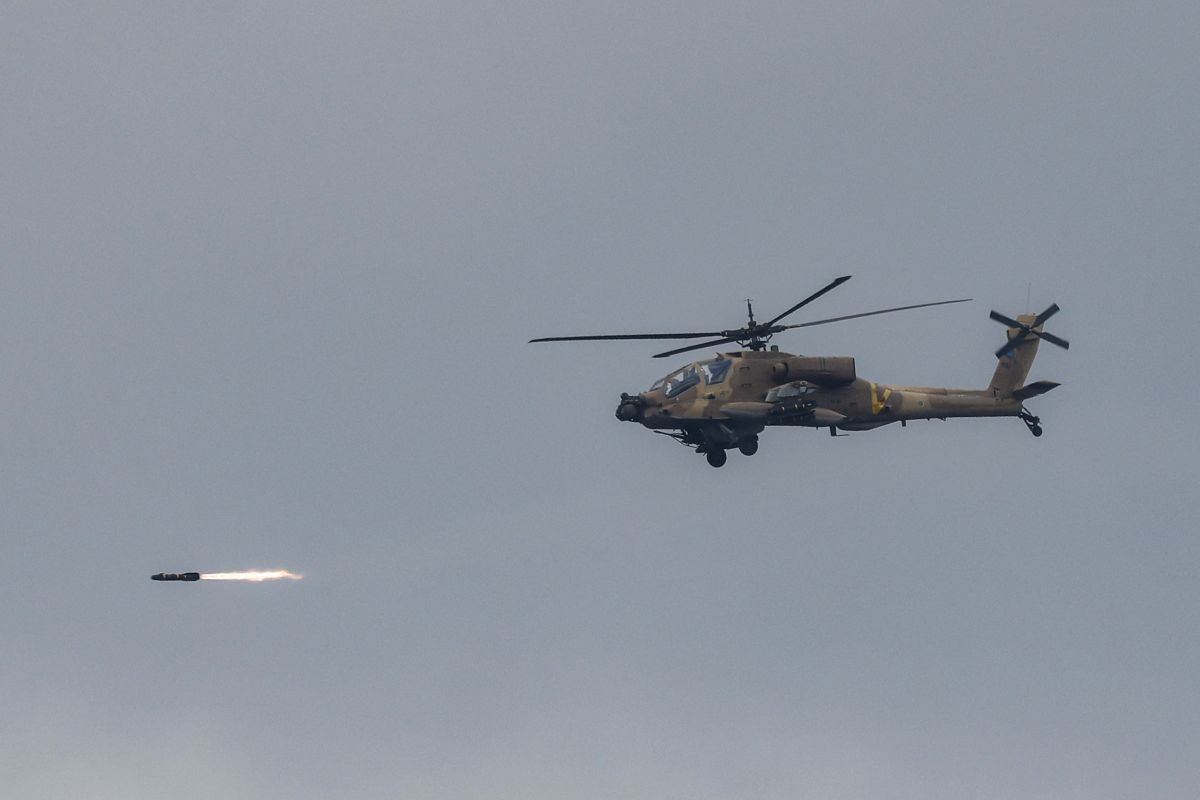
An Israeli "AH-64 Apache" attack helicopter firing rockets toward southern Lebanon, above the Blue Line, on March 4, 2026. Photo Jalaa Marey/AFP An Israeli Air Force AH-64 Apache attack helicopter fires rockets while flying at a position along the border between northern Israel and southern Lebanon on March 4, 2026. Israel's military said on March 4 that it had begun striking southern Lebanon after issuing a call to evacuate all areas south of the country's Litani river. (Photo by Jalaa MAREY / AFP)






BEIRUT — Israeli ground troops pushed deeper into southern Lebanon on Wednesday, raising fears of a broader invasion and possible renewed, deeper occupation, as Israel openly signaled its intention to establish a "buffer zone" north of the border.
As of Wednesday, the precise scope of the operation — whether a limited infiltration, a larger incursion or the start of a full-scale invasion — remained unclear.
At noon, the Israeli army’s Arabic spokesperson, Avichay Adraee, issued an evacuation order to residents of southern Lebanon: "You must evacuate your homes without delay and immediately move to the north of the Litani River." The message targeted tens of thousands of civilians living around the border area.
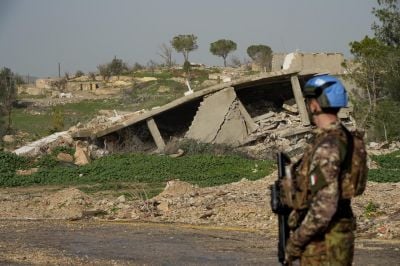
The announcement was accompanied by a map shaded in red, outlining roughly 832 square kilometers stretching from Hourah in the east to Qasmieh in the west, where the Litani River flows into the Mediterranean. After ordering residents of more than 100 villages to leave over the previous two days, the Israeli army expanded its threats to include the coastal city of Sour, home to nearly 40,000 people.
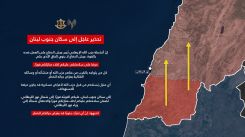
According to the latest information, Israeli troops invading Lebanese territory established a position Wednesday afternoon in front of Khiam’s municipal building in the Marjayoun district, after heavy machine-gun fire and artillery shelling targeted the village. Israeli troops advanced from the fortified Hammames hill, one of six positions Israel has occupied in southern Lebanon since the Nov. 27, 2024, cease-fire that ended the previous round of open warfare between Israel and Hezbollah.
An Israeli battalion also entered Mais al-Jabal Government Hospital (Marjayoun) in the morning and took up positions there, while embankments were erected in the Azraiel neighborhood, south of Kfar Shuba in the Hasbaya district, our regional correspondent reported.
Lebanese Army arrests 27 for 'illegal possession of weapons and ammunition'
The Lebanese Army said late Wednesday it was "repositioning some posts at the border," citing "limited resources" and the need to implement "exceptional measures to maintain security and prevent any armed demonstrations in various regions."
A day earlier, it had evacuated several observation posts along the border, due to the military imbalance between the two forces.
In its statement, the army condemned "ongoing Israeli attacks on various regions" and "the advance of Israeli forces inside Lebanese territory, in blatant violation of international resolutions and Lebanese sovereignty." It also reported missile and drone launches from Lebanese territory without naming Hezbollah.
The army added that it had reinforced its presence along the eastern border in coordination with Syrian authorities, whose forces deployed along the border with Lebanon and Iraq on Tuesday.
The United Nations Interim Force in Lebanon (UNIFIL) said it observed Israeli troops entering Lebanese territory near Markaba, Odaisseh and Kfar Kila (all in the Marjayoun district), as well as Ramieh (Bint Jbeil), before withdrawing south of the Blue Line.
Mounting death toll
At least one young man was killed in Khiam, according to our correspondent, though the total number of casualties from the day’s strikes in southern Lebanon remained unclear.
The Health Ministry said Israeli attacks between dawn Monday, March 2, and Wednesday evening, March 4, had killed at least 72 people and wounded 437. A day earlier, the official toll stood at 40 dead and 246 injured.
In Tall al-Nahas, near Khiam in the Marjayoun district, a woman was trapped for several hours inside her home after it was hit by gunfire from nearby Israeli positions. Following calls for help from her family, the Lebanese Army and the Red Cross evacuated her.
Two Israeli soldiers wounded and two tanks hit in Lebanese territory
This small village was also the scene of another major incident in the day's clashes. Among the 12 operations claimed on Wednesday, Hezbollah announced that it had targeted an Israeli Merkava tank with an anti-tank missile. It also released video footage documenting the attack.
Reuters also reported that two Israeli soldiers were wounded. Hezbollah also said it targeted another "enemy tank" in Houla, in the Marjayoun district.
The group further claimed nine missile or drone attacks against sites inside Israel, including Metula, Safed, Haifa, Ramat David and Tel Aviv. Israeli media did not report confirmed impacts.
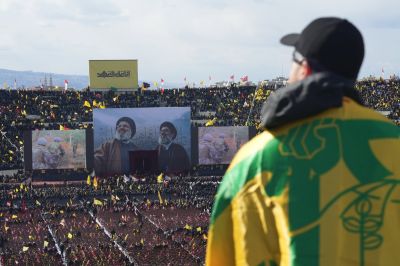
Seven children killed in the past 24 hours
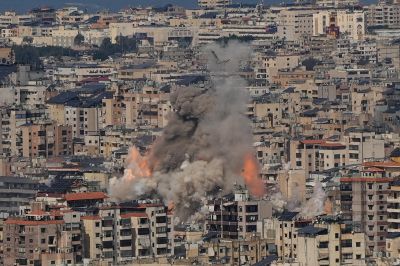
In addition to southern Lebanon, Israeli airstrikes also hit Beirut’s southern suburbs and the Bekaa Valley. The deadliest attack over the past 24 hours occurred in Baalbeck, where at least eight people were killed and 14 wounded when a four-story residential building was bombed by Israel.
Among the victims were two young girls, Miral and Maram Abdel Sater, and their older brother, Rabih, our regional correspondent reported. Maryam Raad, a professor at the Lebanese University, was also identified among those killed.
Seven children were killed and 38 wounded across Lebanon over the past 24 hours, the Health Ministry said, figures cited in a report by the United Nations Children’s Fund (UNICEF).
Nearly 60,000 people — including 18,000 children — were displaced during the same period, adding to tens of thousands already uprooted. More than 12,000 families have sought shelter in over 300 reception centers for internally displaced people, many of which have reached full capacity.
