






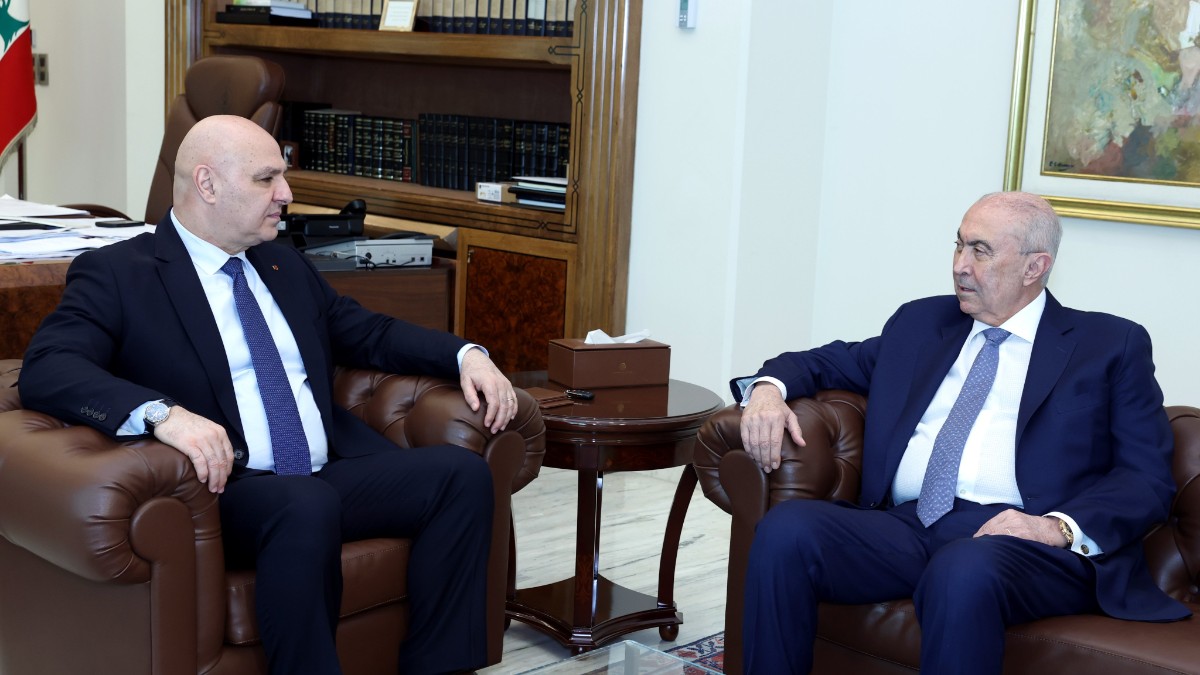
President Joseph Aoun (left) receiving MP Fouad Makhzoumi at the Baabda Presidential Palace, on Feb. 23, 2026. (Credit: National News Agency)






The parliamentary elections, theoretically scheduled for next May, featured prominently on Monday during President Joseph Aoun’s meetings with several MPs at the Baabda Presidential Palace.
These discussions are taking place while, according to our information, negotiations are underway to formalize a postponement of the election, which is proving controversial, particularly regarding voting arrangements for expatriates.
The aim is to allow the next elections to bring about an upheaval in the current political balance in Parliament, resolve the issue of arms monopoly and fully implement the Taif Agreement.
“I have called for adherence to constitutional deadlines to avoid any vacancy, and for that, I request that the parliamentary elections be properly organized on time,” said Makhzoumi from the palace.
However, he specified that the vote “should guarantee the right of Lebanese expatriates to vote for all 128 seats in Parliament.”
He also advocated for “the adoption of megacenters, which would allow greater participation and enhance transparency.”
The expatriate vote has been a controversial issue in Lebanon for several months and could be used as a pretext for a possible postponement of the elections.
The current law provides for the creation of six specific seats for expatriates, while a majority of MPs in Parliament have expressed support for an amendment to this article that would allow emigrants to vote for one of the 128 parliamentary seats based on their region of origin in Lebanon.
Yet Parliament Speaker Nabih Berri still refuses to discuss this option in the chamber, even though the article on the six diaspora seats lacks an implementation mechanism and is therefore unenforceable.
Facing these challenges, and although the Interior Ministry has already initiated the electoral process, the government has sent Parliament a draft law to temporarily freeze the article on the 16th constituency, thereby allowing expatriates to vote for all seats, as was the case in the 2018 and 2022 elections.
This proposal has also been ignored by Berri, whose critics suspect him of fearing the expatriate vote, even as the Amal-Hezbollah alliance tries to maintain absolute control over Shiite representation.
As for the megacenters mentioned by Makhzoumi, they would have allowed voters to cast their ballots outside their home localities.
'Illegitimate and undemocratic'
MP Firas Hamdan (Opposition-affiliated) was also received on Monday at the Baabda Presidential Palace.
After his meeting with Aoun, Hamdan said he "had conveyed to him his concern about holding the elections with expatriate voting for the 128 seats and with megacenters, otherwise the elections would be illegitimate and undemocratic."
He added, "The president, in turn, stressed the need to hold the elections on time."

 8 p.m. recap: Israel again threatens Beirut’s south suburbs; 2 ships hit near Hormuz; Riyadh football matches canceled