


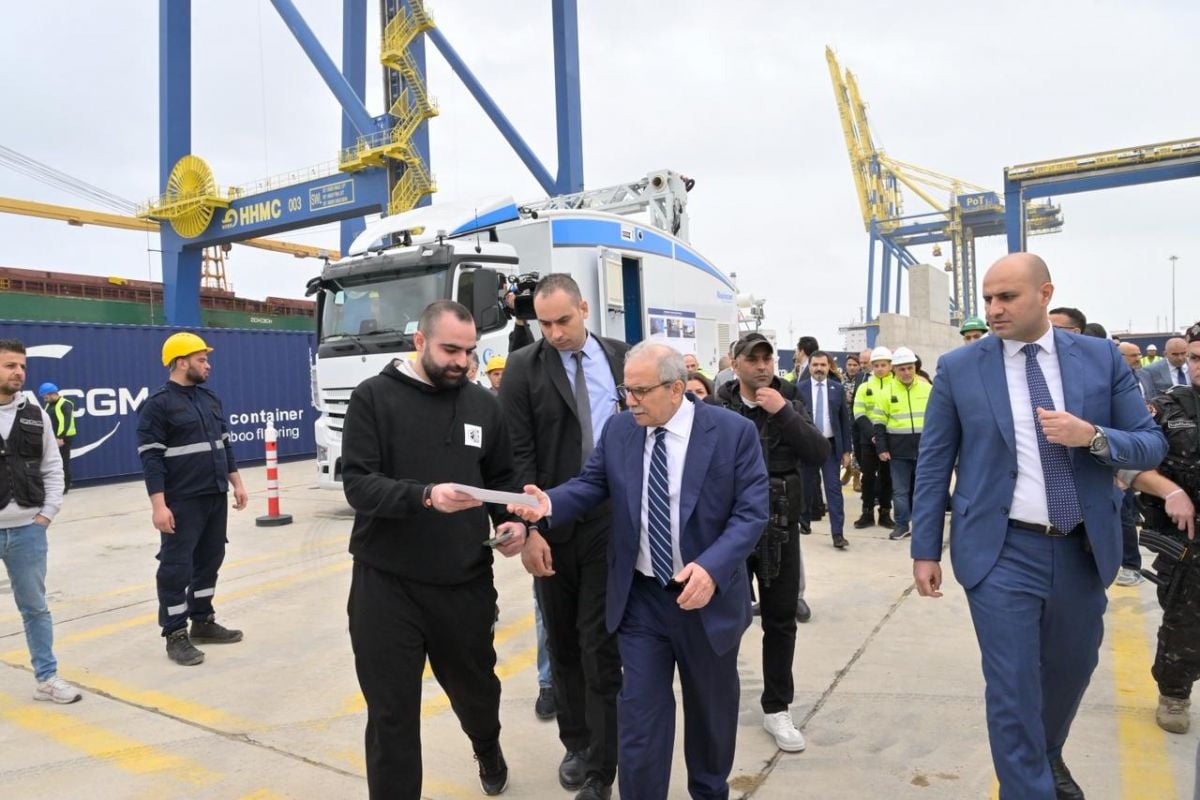
Prime Minister Nawaf Salam during a visit to Tripoli, Feb. 17, 2026. (Credit: @GrandSerail/X)






Prime Minister Nawaf Salam traveled to Tripoli Tuesday morning to oversee the implementation of the emergency plan for buildings at risk of collapse, a week after the collapse of a building in Bab al-Tabbaneh that left 13 dead.
The prime minister's visit coincided with a meeting of local officials from Lebanon’s second-largest city, who are dedicated to supporting displaced residents.
Accompanied by Social Development Minister Haneen Sayed, the prime minister first went to the city’s hotel institute, where some of the 229 families evacuated from the 21 cracked buildings since Feb. 9 have been temporarily housed, according to the latest report from Monday's Cabinet meeting at the Baabda Presidential Palace.
The report noted that temporary shelter has been provided to 64 of these families so far, with efforts ongoing. In total, about 114 buildings at immediate risk of collapse are slated for evacuation.
Salam later chaired a meeting attended by Tripoli municipal council president Abdel Hamid Karimeh, who reconsidered his decision to resign over repeated collapses in the city.
Karimeh also took part in this morning’s wider meeting, chaired by the acting governor of northern Lebanon, Iman al-Rafei, which gathered many local officials from Tripoli’s federation of municipalities.
Discussions mainly focused on supporting residents evacuated from cracked or threatened buildings, the need to provide housing solutions, and coordinating efforts across the urban area, according to the state-run National News Agency (NNA).
It was also decided to continue "inspections of the buildings and evacuations in coordination with the relevant agencies," while facilitating "support for affected families, including access to temporary accommodation and reasonable rents, and preventing any exploitation."
The assembly also called for strengthening the role of moukhtars in this regard.
The Bab al-Tabbaneh tragedy, which killed 13, including a three-year-old child, and injured eight, had been preceded by another fatal collapse in the Qobbeh neighborhood at the end of January.
On Sunday, the Tripoli municipality carried out its first demolition in this underprivileged part of the city.
Alongside the visit, a demonstration was organized starting at 11 a.m. at the entrance to the city’s port by several Tripoli unions, including civil servants and road transport workers.
The aim was to send a "clear message" to the government to protest its decision to raise VAT and gasoline taxes to fund an increase in the salary index for civil servants and the military pension fund.
Meanwhile, the Minister of Education and Higher Education, Rima Karameh, extended the suspension of classes at the al-Haddadine Girls’ High School in Tripoli until Wednesday, “to allow maintenance teams to install temporary toilets, which will be used until repairs are completed in the designated areas.”
She said that after that date, “the school will resume its activities and welcome students as usual, noting that repair work on the building will begin as soon as possible and will be carried out in a way that does not disrupt the school’s operations.”
The minister added that she was “closely following the file of renovation and maintenance of Tripoli’s schools, and coordinating with the municipality to ensure that any dilapidated buildings at risk of collapse pose no danger to nearby school buildings.”

 7 p.m. recap: Netanyahu seeks mastermind behind Flydubai incident; Washington sanctions 2 French nationals; Ben Gvir's 'I want to kill you' threat