


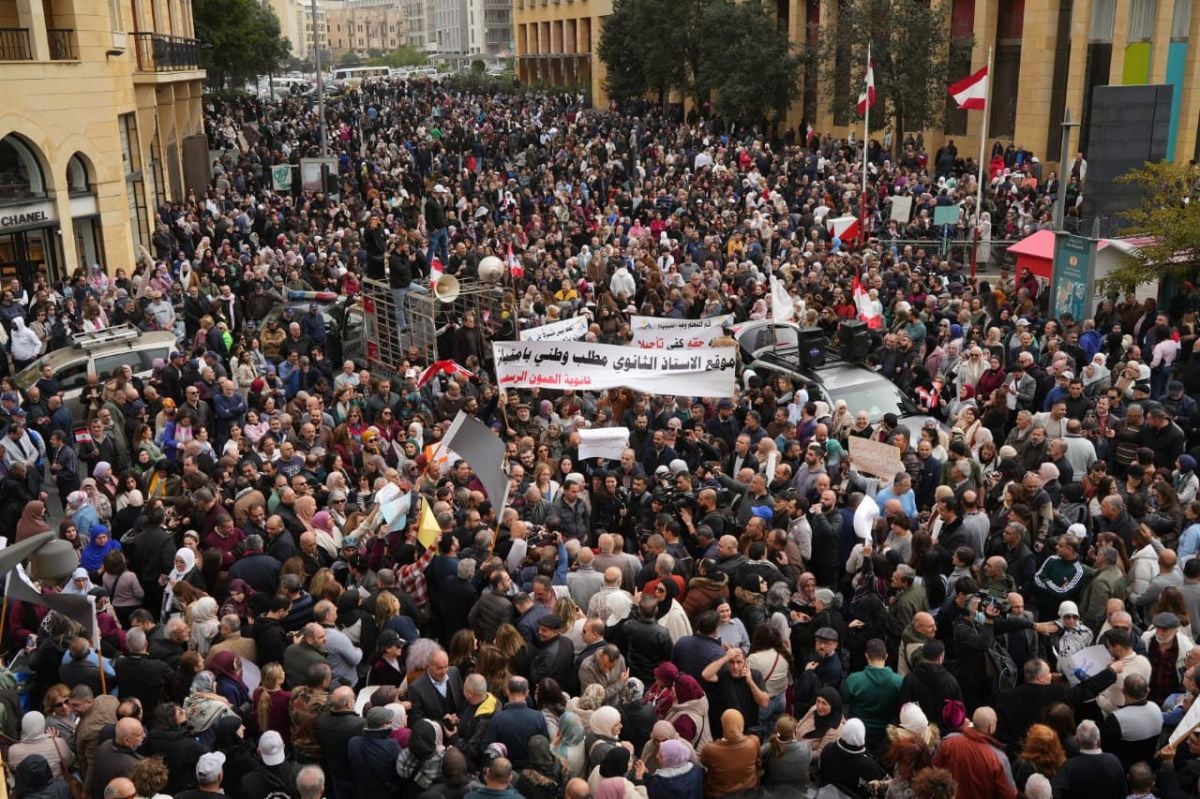
Demonstration in front of the Parliament in Beirut against the 2026 budget draft examined by MPs, on Jan. 27, 2026. (Credit: Mohammad Yassine/L'Orient-Le Jour)






BEIRUT — Several public sector teachers’ unions representing primary, intermediate, secondary and technical education warned Sunday that they would not accept any “partial solution or symbolic increase” to their salaries ahead of Monday's Cabinet session on a potential wage adjustment.
“We are awaiting this crucial session to draw the necessary conclusions and are keeping our meetings open, in coordination with the public sector leagues, so that we may adopt the appropriate position,” the unions said in a statement.
“The government faces a final test. Either it takes courageous decisions to save public education, or it bears sole responsibility for the consequences of any escalation,” they added.
Referring to the mid-February deadline granted to the government to approve a long-awaited salary increase, the unions reiterated their core demands. They called for gradually restoring teachers’ purchasing power and offsetting the impact of inflation by raising the salary multiplier to 37 times, increasing the hourly wage for contract teachers by the same amount, immediately incorporating all allowances into the base salary and establishing a clear mechanism with precise figures.
The deadline was set by the Cabinet at the end of January, when active and retired civil servants, including teachers and military personnel, staged protests outside Parliament during the budget vote.
The unions are also pressing for the swift adoption of a new salary scale that would adjust wages across the public sector.
Public sector wages have been severely eroded by the collapse of the Lebanese lira since the financial crisis erupted in 2019. The exchange rate, stabilized over the past two years, now stands at roughly 60 times the former official peg. Salaries, however, have not been raised sufficiently to compensate for the loss in purchasing power.
The government, which is seeking to demonstrate its reform credentials to the International Monetary Fund, remains reluctant to implement sweeping pay increases before overhauling a public sector widely viewed as overstaffed relative to the country’s size.
 7 p.m. recap: Flames, smoke reported near Aramco site near Riyadh; Houthis accuse Saudi Arabia of 56 strikes on Sanaa