





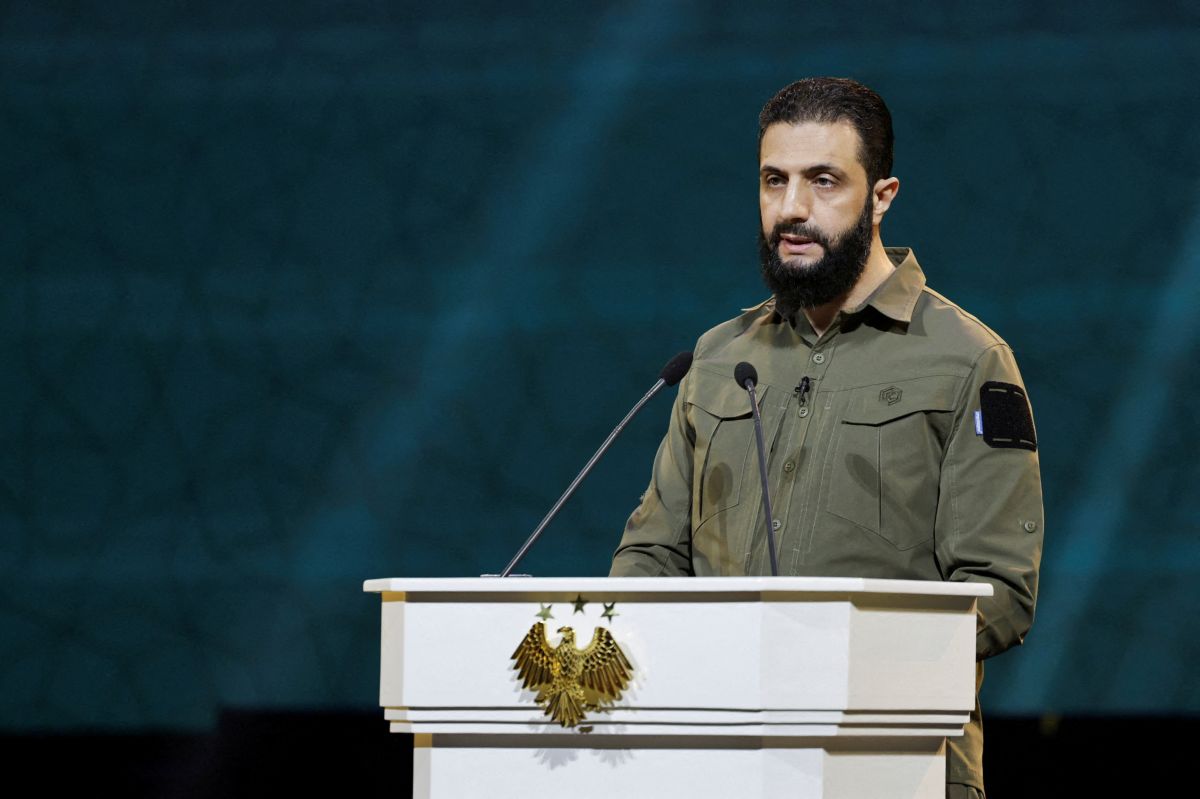
Syrian President Ahmad al-Sharaa delivering a speech on the first anniversary of the fall of the Assad regime, Dec. 8, 2025, in Damascus. (Credit: Khalil Ashawi/Reuters)






Syrian President Ahmad al-Sharaa, his foreign minister, Assaad al-Shaibani, and interior minister, Anas Khattab, were targeted in five foiled assassination attempts in 2025, orchestrated by a jihadist group considered close to the Islamic State (IS) organization, according to a U.N. report.
The report specifies that Sharaa was particularly targeted during trips to the Aleppo province in northern Syria, as well as Daraa in the south, by a jihadist group called “Saraya Ansar al-Sunna,” considered a new offshoot of IS.
The report, submitted Wednesday to the United Nations Security Council by Secretary-General António Guterres and prepared by the U.N. Office of Counter-Terrorism, does not provide dates or details about the attempts targeting Sharaa, Shaibani and Khattab, and adds that the current Syrian president remains “a priority target” for IS.
The report states that these assassination attempts are further evidence that remnants of jihadist groups still present in Syria remain determined to “undermine the efforts of the new government” and “actively exploit security vacuums and uncertainty” in the country.
This front group would have allowed IS to benefit from a “credible ability to deny any involvement” in these attempted attacks and to “improve its operational capabilities.”
Last November, the Syrian government joined the international coalition fighting IS, which controlled large swaths of Syrian territory during the civil war (2011-2024).
Former chief of the Syrian branch of al-Qaeda, the al-Nusra Front, later renamed Hay’at Tahrir al-Sham (HTS), Sharaa, known by his fighter name Abu Mohammad al-Jolani, eventually broke with al-Qaeda.
During this period, HTS simultaneously waged war against IS, which led to the assassination of several of Sharaa's lieutenants, particularly in the Idlib region.
'Ongoing threat'
U.N. counterterrorism experts estimate that the jihadist group “Saraya Ansar al-Sunna” continues to operate throughout Syrian territory, mainly targeting security forces, especially in the north and northeast of the country.
During an ambush on Dec. 13 against American and Syrian forces near Palmyra, two U.S. soldiers and their Syrian translator were killed, while three other Americans and three members of the Syrian security forces were wounded.
U.S. President Donald Trump then decided to launch military operations aimed at eliminating IS fighters.
According to U.N. experts, IS still has about 3,000 fighters split between Iraq and Syria, the majority of whom are based in Syria.
At the end of January, the U.S. military began transferring detainees accused of being IS members, imprisoned in northeastern Syria, to Iraq to ensure they remain in secure facilities.
Baghdad subsequently indicated that these detainees would be prosecuted there.
A total of 4,583 of them have already arrived in Iraq out of a target of 7,000, Saad Maan, head of the Iraqi government security information cell, told AFP on Tuesday.
This transfer was carried out in parallel with the Syrian army’s takeover of prisons and camps housing thousands of IS-linked detainees, which had previously been managed by Kurdish forces, as part of a cease-fire agreement between the Kurdish-led Syrian Democratic Forces (SDF) and the Sharaa government.
The report also specifies that in December, before Damascus took control of northeastern Syria, more than 25,740 people remained in the al-Hol and Roj camps, more than 60 percent of whom were children, along with thousands of others in various detention centers scattered across the northeast of the country.

 7 p.m. recap: Iran warns Egypt, Israeli soldiers vote in south Lebanon, Haret Hreik responds to Kataeb