


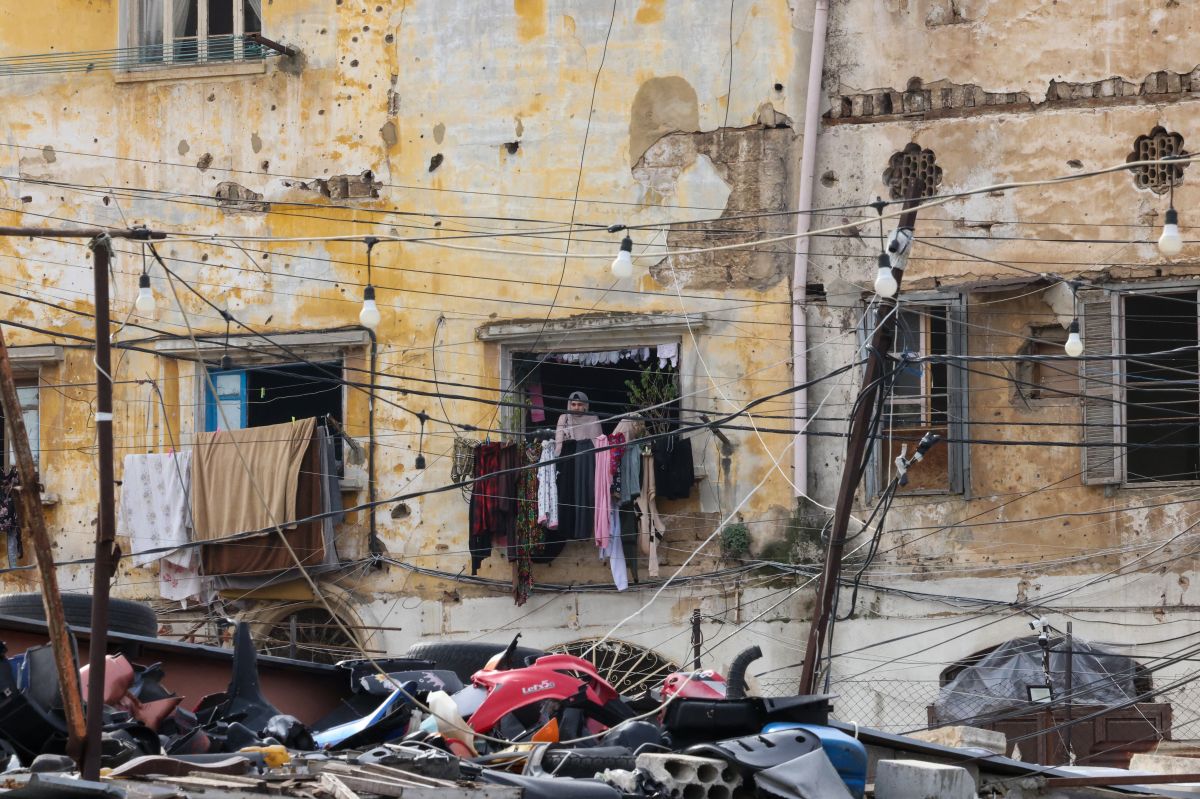
A woman leaning on the window of a dilapidated building in the Bab al-Tabbaneh neighborhood of Tripoli, in northern Lebanon, on Feb. 9, 2026. (Credit: Anwar Amro/AFP)






The issue of buildings at risk of collapse continues to stir concern in Lebanon. While building collapses and evacuation calls have increased recently in Tripoli, in northern Lebanon, calls have also been made to address this issue in other major cities in the country, such as Beirut and Saida, where at-risk buildings have also been identified.
Beirut MP Fouad Makhzoumi on Thursday called for the city to address its aging buildings. "After the Tripoli tragedy, we can no longer wait ... A 2019 study found 187 old and dilapidated buildings in Beirut that pose a danger to public safety," the lawmaker wrote on the X platform.
"The president of the Beirut municipality had already started working on this issue and coordinating with the city governor. During our conversation today, he confirmed to me that procedures have been accelerated," Makhzoumi said.
He also called for the numbers on dilapidated buildings in the capital to be updated, expressing his readiness to contribute to any "preventive action for the safety of Beirut residents."
When contacted, neither Beirut Municipality President Ibrahim Zeidan nor Makhzoumi was available for further details.
Meanwhile, a source close to the Makhzoumi Foundation, which works on humanitarian projects, said the foundation had raised $100,000 in aid for victims in Tripoli.
100s of buildings at risk of collapse
Questioned by L'Orient-Le Jour about the situation of aging buildings in the capital, Indira al-Zouhairi, president of the National Real Estate Commission, believes the numbers are now “much higher” than those cited by Makhzoumi, which date back to 2019.
“The areas most at risk in the capital are the neighborhoods of Khandaq al-Ghamiq, Bashoura and Basta. But buildings in the suburbs are also in danger, like those in Burj Hammoud. Not to mention the case of Beirut’s southern suburbs, which were heavily bombarded for months in 2024,” she said.
“The problem is that there is no official count on this topic. Hundreds of buildings are at risk, including traditional ones. Several factors are at play, namely negligence and lack of maintenance, made worse by the economic crisis,” she explained.
Additionally, she noted that the stability of some buildings was affected by the port explosion in 2020, the earthquake that struck the region in February 2023, as well as the Israeli bombings in 2024.
She also recalled that a 2017 study counted 10,000 threatened buildings in the capital.
A study carried out by the Lebanese Army just after the Beirut Port explosion, covering a part of the capital, reported 85,744 at-risk housing units, she added.
An emergency plan in Saida
In the city of Saida, in southern Lebanon, where many aging housing units have been identified, the municipality on Thursday launched a 60-day emergency plan to rehabilitate these buildings in collaboration with regional engineers, our correspondent reported.
This intensive 60-day action plan aims to build a comprehensive scientific database of at-risk buildings, particularly in the old city and densely populated areas.
The plan’s ultimate goal is to protect threatened buildings and present a financing proposal ready for submission to donors.
Participants also established an emergency protocol to handle sudden collapses, providing legal protection for the municipality and ensuring prompt intervention for affected individuals.
Since the start of winter, several evacuations and collapses have occurred in Tripoli, the capital of northern Lebanon, mainly due to negligence and a lack of building maintenance.
In January, a father and his daughter died in a building collapse that made headlines in Lebanon.
Authorities have repeatedly warned about the growing risk of collapses in the city, the country’s most impoverished, where infrastructure is deteriorating amid chronic funding shortages.
On Tuesday, the municipality proceeded with the immediate evacuation of the Kabbara building in the Qobbeh district.
New evacuation calls were issued Thursday, particularly in the Bab al-Tabbaneh and Qobbeh neighborhoods, according to our correspondent in northern Lebanon.
On-site monitoring is handled by a team of municipal engineers and by the Internal Security Forces (ISF). The director general of Civil Defense has also put a team of rescuers on standby in the city.
Faced with this situation, Prime Minister Nawaf Salam’s government decided Monday, following an emergency meeting, to order the evacuation of 114 at-risk buildings in Tripoli within one month and to cover the housing costs of the affected residents.

 7 p.m. recap: Netanyahu seeks mastermind behind Flydubai incident; Washington sanctions 2 French nationals; Ben Gvir's 'I want to kill you' threat